
Most teams chase the wrong rivals. Your real threat isn’t the brand down the street—it’s the site that outranks you for your customers’ searches.
This guide shows how to identify true online competitors, not just business rivals, using a repeatable workflow. You’ll learn how to find SEO competitors, tier them by threat, uncover gaps, and use automation to turn insight into rankings.
What “true online competitors” really means (and why it matters)
True online competitors are the sites that consistently win visibility for the search intents you must own—regardless of their business model. They may be comparison blogs, marketplaces, media sites, tools, directories, or niche communities.
That’s different from business rivals (companies that sell what you sell). Search competitors might not offer your product at all, yet still siphon your traffic and buyers by capturing top results and SERP features.
Why it matters: Mapping search competitors reveals where attention flows, clarifies intent gaps, and focuses your content on winnable opportunities.
Outcome: A prioritized roadmap that aligns topics and formats with what the SERP actually rewards.
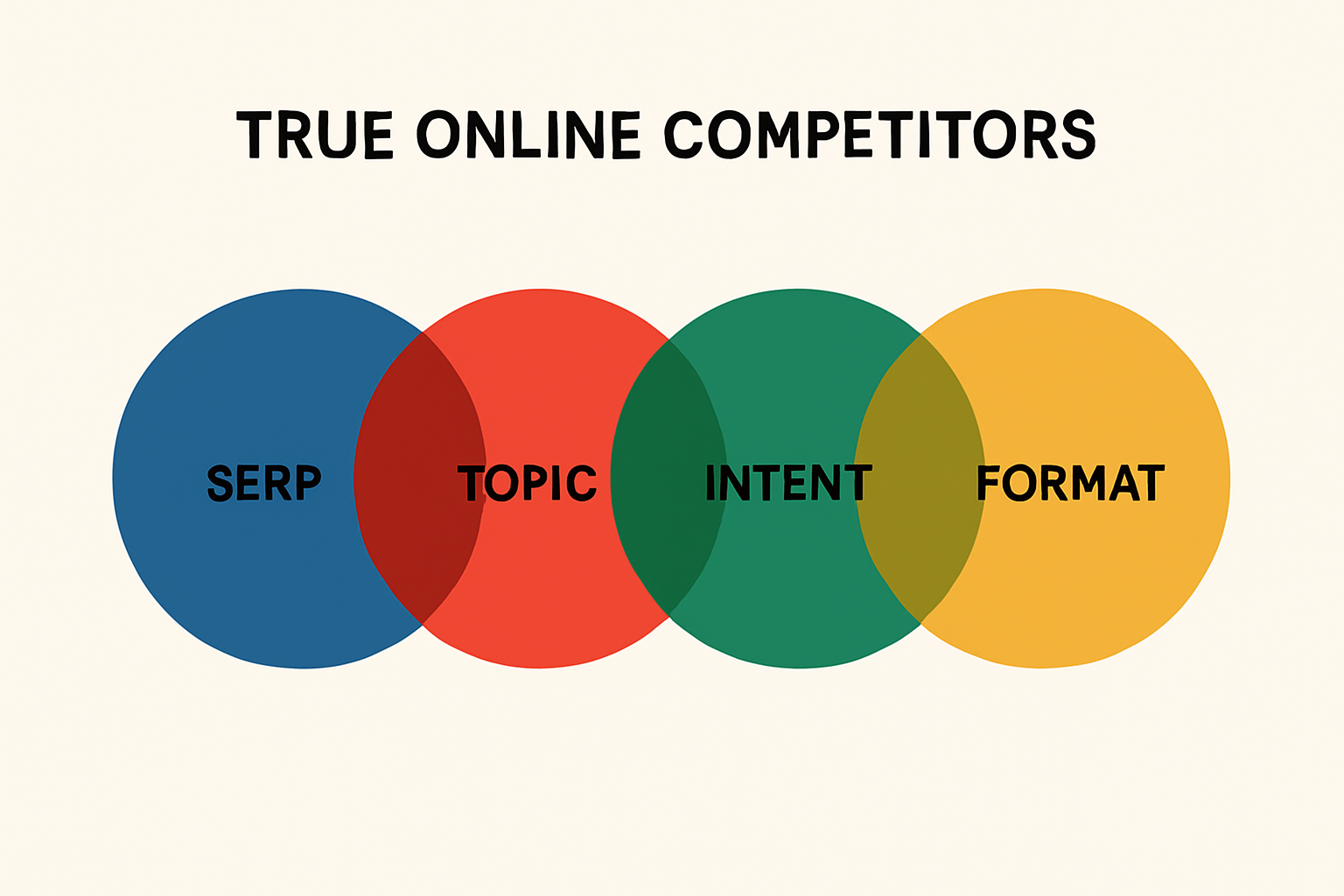
Define your competitor types before you search
Before you try to find SEO competitors, define who you’re looking for. Categorize rivals so you can evaluate the right players per intent.
SERP competitors: Domains that rank alongside you for target keywords in the US SERPs.
Topic competitors: Sites deeply covering your core themes (glossaries, hubs, academies).
Intent competitors: Pages that win for specific intents (best, vs, near me, how to).
Format competitors: Owners of featured snippets, People Also Ask, videos, local packs, or tools.
Step-by-step: How to find SEO competitors from scratch
Use this practical workflow to reliably find competitor websites and prioritize them.
Start with seed keywords mapped to search intent
List your products/services and the problems they solve.
Group keywords by informational (learn), commercial (compare), and transactional (buy) intents.
Expand with modifiers: how to, best, vs, top, near me, template, example, pricing.
Map to themes so you can later cluster gaps and share of voice by topic.
Tip: Keep 10–20 seed terms per intent to start. This enables manageable sampling without skewing to a single keyword.
Analyze SERPs across modifiers, locations, and devices
Sample US SERPs on mobile and desktop—competitor sets often differ.
Record top 10 results and SERP features (snippet, PAA, video, local pack).
Note recurring domains across intents and modifiers (e.g., best, vs).
Flag non-commercial sites (publishers, aggregators) that dominate visibility.
Use Semrush competitors and overlap reports the smart way
Semrush’s competitor tools can show domains with high keyword overlap and traffic potential. Start with:
Organic Research → Competitors: Find domains sharing top overlapping keywords and estimate traffic share.
Keyword Gap: Compare your domain vs. 3–5 rivals to see missing and weak positions.
Position Tracking: Monitor a curated competitor set for rank and SERP features by device and location.
Semrush’s advantage is depth of data and breadth of coverage; industry sources highlight its extensive keyword and backlink databases and dedicated competitor analysis features across 25B+ keywords and vast domain profiles, making it a staple for competitive research.
Cross-verify with manual checks and branded queries
Run branded + non-branded queries (e.g., your brand + alternatives) to catch comparison pages shaping demand.
Open top results and scan internal linking; hubs often reveal additional rivals.
Use People Also Search For and PAA to uncover adjacent topics and sites.
Spot-check on mobile incognito and different regions to reduce personalization bias.
Related reading: See our guide on competitor keyword research tactics and our keyword gap analysis playbook.
Build your competitor universe and tier it by threat level
Combine tool data and manual checks into one master list. Then tier rivals by how much they limit your growth.
Calculate a simple keyword overlap and visibility score
Use this quick scoring model to prioritize:
Overlap score (0–5): Count shared keywords in top 20 vs. your seeds. Normalize across intent.
Visibility score (0–5): Weight average rank (top-3 = 5, 4–10 = 3, 11–20 = 1) and traffic share.
Authority modifier (–1 to +1): Adjust for domain strength and topical relevance.
Priority = Overlap + Visibility + Authority. Tier 1 should be your highest total scores and most active rivals in your core intents.
Account for SERP features and content formats
Add +1 if a rival owns the featured snippet for a core keyword.
Add +1 if they control multiple PAA positions or video thumbnails.
Add +1 for strong local pack presence if you’re location-dependent.
Subtract –1 if their wins are in formats you can easily surpass (e.g., thin listicles).
Spot hidden competitors by intent and content type
Some of your biggest search threats aren’t product competitors. They’re content and format specialists that dominate intent-specific SERPs.
Informational rivals: guides, glossaries, and tools
Content hubs with evergreen guides and glossaries funnel top-of-funnel traffic.
Interactive tools (checkers, graders) generate links and repeat visits.
Media and community sites can outrank brands with strong topical authority.
Commercial rivals: comparisons, alternatives, and “best” lists
Third-party “best” lists and alternatives pages shape purchase decisions.
Publisher reviews and affiliate sites often capture intent-rich clicks.
Comparison tables (X vs. Y) frequently win featured snippets.
Transactional rivals: templates, calculators, and pricing pages
Templates and calculators capture bottom-funnel intent without selling anything.
Pricing pages for adjacent products can intercept solution-aware searchers.
Quick-win gap analysis to outmaneuver competitors
Turn your mapping into action with a focused 30–60 day plan.
Cluster gaps: topics they own that you can win
Group keywords by topic and intent. Filter for KD you can realistically win.
Prioritize clusters where your authority is close to parity and SERPs reward your format strengths.
Plan internal links from existing related pages to accelerate rankings.
Serp feature gaps: snippets, PAA, and video thumbnails
Rewrite intros to answer the query in 40–60 words for snippet capture.
Add concise Q&A sections to target People Also Ask.
Publish short how-to videos and embed them to win thumbnails.
Deep dive next: AI competitor analysis in 7 steps.
How to use SEOsolved to automate competitor discovery
If your team struggles to find competitor websites, analyze gaps, and produce content fast, SEOsolved removes the heavy lifting. It’s an AI-powered platform that:
Analyzes competitors across intents and surfaces hundreds of ranking keywords automatically.
Builds a tailored content roadmap with prioritized topics and formats.
Generates high-quality, optimized articles with credible sources in minutes.
Tracks outcomes so you can iterate by cluster and intent.
Instantly analyze competitors and surface ranking keywords
Paste a few seed URLs or domains and let SEOsolved crawl, cluster, and score overlap. You’ll see which rivals truly matter and which keywords move the needle—without spending days in spreadsheets.
Build a tailored content roadmap in minutes
SEOsolved prioritizes topics by intent, difficulty, and potential impact, then maps internal links and SERP feature targets. You get a clear, week-by-week plan.
Generate high-quality, SEO-optimized articles fast
Fill the gaps with credible, optimized articles aligned to user intent. Editing controls keep brand voice tight while you scale.
Stat Ranking Today with automated competitor analysis and content creation.
Metrics to track: Prove you found the right competitors
Use these KPIs to validate your mapping and measure progress by cluster and intent.
Share of voice by cluster and intent
Track visibility for each topic cluster and intent (informational, commercial, transactional).
Monitor gains where rivals previously dominated. Rising SOV confirms correct prioritization.
Keyword coverage and ranking improvements
Measure net-new keywords and top-10 growth vs. your competitor set.
Watch volatility; stabilize ranks before expanding into harder clusters.
Content velocity vs. your competitor set
Benchmark your publishing cadence and quality against Tier 1 rivals.
Match or exceed their pace with higher-quality, intent-aligned content.
Common mistakes to avoid when finding competitors
Wrong competitor focus: Looking only at business rivals, not search competitors.
Single-keyword bias: Overweighting one term instead of sampling across modifiers.
Vanity metrics: Prioritizing DA/DR without intent and overlap context.
Ignoring SERP features: Missing rivals who win via snippet, PAA, or video.
No tiering: Treating all domains equally instead of scoring threat level.
Mini case study: From messy list to precise rival map
A B2B SaaS team started with 97 “competitors” from internal opinions and old pitch decks. After running the workflow:
Seeded 45 queries across three intents.
Sampled US SERPs on mobile and desktop with modifiers (best, vs, how to).
Used Semrush competitor and gap reports to cluster overlap.
Manually verified top results and PAA/feature owners.
Result: 14 true online competitors. Tier 1 had 5 domains owning snippets and PAA in core commercial queries. The team filled three content gaps (two comparison pages, one template tool) and gained 22 top-10 rankings in 60 days.
Templates and worksheets to speed execution
Use this lightweight spreadsheet layout to score rivals quickly:
Columns: Domain, Intent Mix, Overlap Count, Avg Rank, Traffic Share, SERP Features Owned, Authority, Priority Score, Notes.
Formula: Priority = Overlap (0–5) + Visibility (0–5) + Authority (–1 to +1) + Feature Bonus.
Maintain separate tabs per intent for clarity.
Want examples? Explore our comparisons, including Surfer SEO alternatives and SpyFu alternatives.
Next steps
You now have a reliable way to find Semrush competitors, map true online rivals, and turn gaps into rankings.
Define competitor types and sample SERPs by intent and device.
Use overlap scoring and SERP feature weighting to tier threats.
Convert insights into a 30–60 day gap plan and measure SOV by cluster.
Prefer to automate the research and content production? Stat Ranking Today with SEOsolved—get a tailored content roadmap and publish optimized articles in minutes.
Semrush competitors and alternatives at a glance
Here’s a quick, high-level snapshot of popular platforms often considered when researching competitors and content gaps:
Tool | Notable Strength For Competitive Research | Useful When You Need… |
|---|---|---|
Semrush | Broad competitor suite, keyword and domain overlap, gap and rank tracking | A single workspace for overlap, gaps, and multi-intent tracking |
Ahrefs | Backlink research depth and robust keyword database | Deep link profiling and content gap comparisons |
Moz Pro | Authority metrics (DA/PA) to benchmark site strength | Fast, simple authority comparisons across domains |
Mangools | Clean UI with accessible pricing | Simplified keyword and SERP checks for smaller teams |
Note: Combine tool insights with manual verification and intent mapping for the most accurate competitor universe.
FAQ
What is the fastest way to find SEO competitors?
Sample US SERPs for 10–20 seed keywords per intent, then use Semrush’s competitor and gap reports to cluster overlap. Verify manually, then tier by threat.
How are search competitors different from business competitors?
Search competitors are the sites winning your target intents in SERPs. They may not sell what you sell but still capture your audience’s attention.
How do I prioritize competitors?
Score overlap, visibility, authority, and SERP features. Focus on Tier 1 domains with high overlap and feature ownership across commercial intents.
Which SERP features should I target first?
Featured snippets, People Also Ask, and video thumbnails give fast visibility gains when you align format and concise answers to intent.
Can I automate competitor discovery and content production?
Yes. SEOsolved analyzes competitors, builds a prioritized roadmap, and generates optimized articles to fill gaps quickly.