In 2026, briefs won’t just guide writers—they’ll steer AI agents that research, plan, and publish. Nail your AI content brief now to rank faster, spend less, and outpace competitors.
This guide shows what an AI content brief is, how to build one that aligns with search intent and business goals, the tooling landscape, prompting patterns, and where SEOsolved automates strategy-to-article in minutes.
What Is an AI Content Brief? Why It Matters in 2026
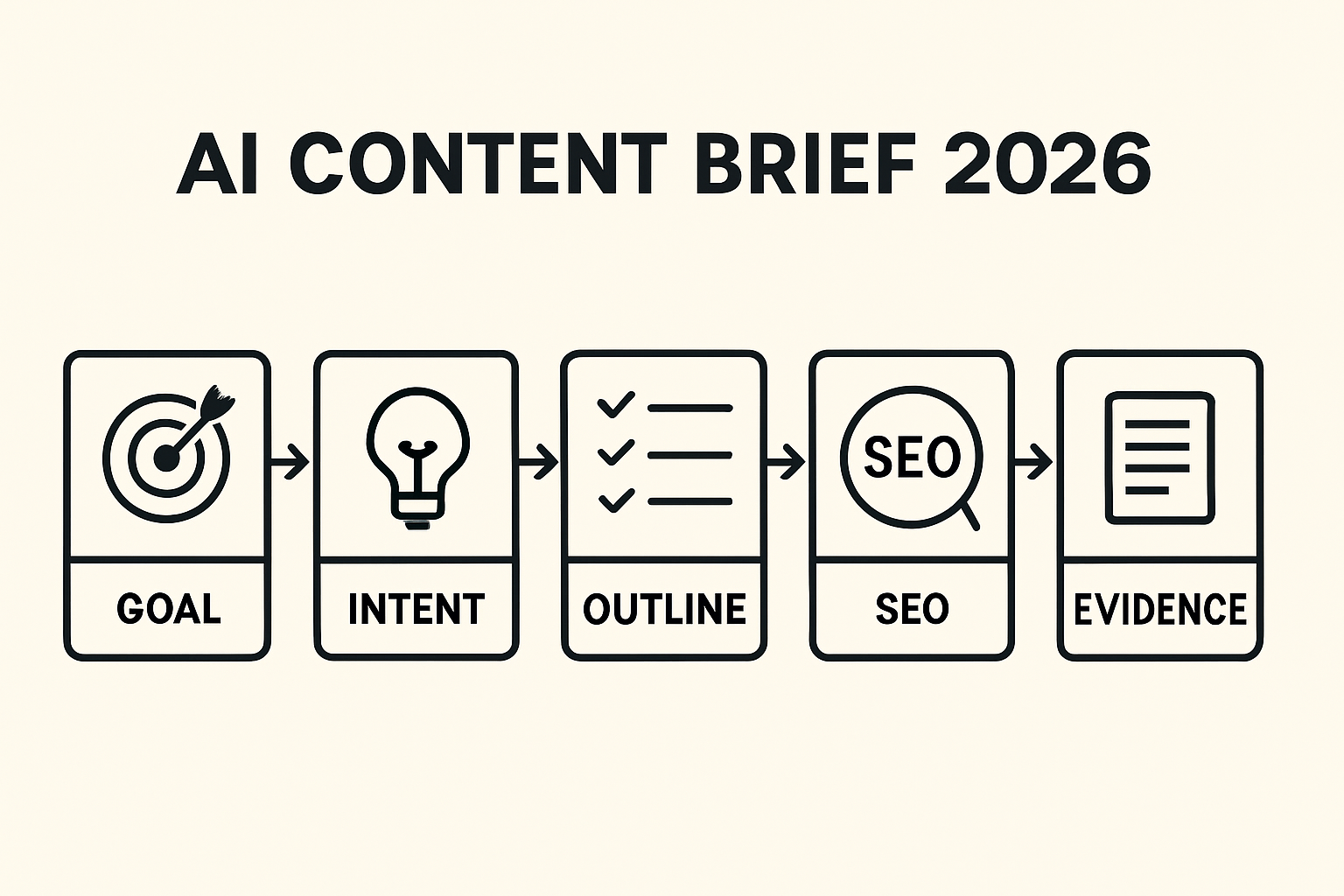
Definition: An AI content brief is a structured plan that gives humans and AI agents the context, goals, keywords, outline, sources, and on-page rules needed to produce a piece that ranks and converts.
Unlike traditional briefs, the 2026 version anticipates autonomous, agentic workflows—AIs that think, plan, remember, and act through a full content lifecycle. As industry observers note, 2026 is shaping up to be the year of agentic AI, where you hand an objective to the system and expect reasoning and alternatives in return (video overview).
Why it matters now:
- Ranking edge: AI search reads and repackages content. Clear hierarchy, short paragraphs, and structured data improve discoverability and citations (Storyblok).
- Speed-to-publish: Briefs that embed search intent and on-page rules cut drafts and revisions.
- E-E-A-T by design: Requiring sources, SMEs, and claims up-front boosts trust signals.
Search Intent to Brief: Aligning Business Goals and SERP
Every brief should start with who it’s for and what the business needs to achieve. Map buyer pains to search intent and to a measurable outcome (e.g., demo requests, free trials, email signups).
- Audience pain: “We can’t publish consistently,” “We don’t know which topics will rank.”
- Search intent: Informational vs. transactional vs. navigational—validated with SERP features, competing formats, and People Also Ask.
- Business outcome: Qualify readers with checklists, CTAs, and case-like proof to move them to the next step.
Tip: Group pages into topic clusters to build depth and internal linking. See how to scale clusters in weeks in our guide on Automated Internal Linking.
The Anatomy of a High-Performing AI Content Brief
Modern briefs combine strategy, SEO, and credibility. Here’s what to include so writers—and AI agents—can execute with clarity.
Core Elements: Goal, Audience, Angle, and Promise
- Goal: The business metric (e.g., MQLs, free trials), the ranking target, and the conversion micro-step.
- Audience: Persona, ICP tiering, and stage in the buyer journey.
- Angle/POV: What’s contrarian, proprietary, or more useful than the SERP status quo.
- Promise: The concrete value a reader will walk away with (checklists, templates, decisions made).
Keyword and SERP Foundation
- Primary/secondary keywords: Include difficulty, volume, and topical fit.
- Competitors and content gaps: Identify missed subtopics, outdated data, or weak E-E-A-T on page one. For methods, see Competitor Keyword Research.
- SERP features: PAA, featured snippets, videos, and FAQs to target with structure and schema.
Outline, Questions, and Subtopics
Translate your research into a crisp content outline. Include:
- H2/H3s that match intent and search behavior.
- Must-cover entities (brands, concepts, tools) for semantic breadth. Learn more in Semantic SEO.
- FAQs and definitions for snippet capture and AI citations.
On-Page SEO Requirements
- Title tag and meta description: Length, hook, and primary keyword placement.
- Headings: Short, descriptive, aligned to questions.
- Internal links: Map to cluster pages and buying paths.
- Schema: Article + FAQPage + BreadcrumbList; consider HowTo or Product where relevant.
- Media notes: Compressed images, descriptive alt text, and accessibility cues.
Evidence, Sources, and E-E-A-T
- Credible sources: Cite industry data and standards. AI search favors readable, well-cited pages (Yext).
- SMEs: Pull quotes or reviews from subject-matter experts; add bylines and bios.
- Proprietary data: Summaries or anonymized benchmarks that others can’t replicate.
Delivery, Timeline, and Acceptance Criteria
- Timeline: Draft due date, review windows, publishing slot.
- Deliverables: Word count range, file format, and assets (tables, charts).
- Definition of done: On-page checklist cleared, links added, schema validated, QA signed off.
How to Create a Content Brief Step-by-Step (Manual vs AI)
Build briefs manually for depth—or accelerate with AI to scale production. Here’s a process you can adopt today.
1) Define Outcome, Audience, and POV
- Clarify the business metric (e.g., demo requests).
- Document ICP and buyer stage.
- Choose a differentiating angle (data-backed, contrarian, solution-first).
Use fast audience research techniques and past content performance to choose a POV. If you’re automating, instruct the AI to propose 3 angles and justify each against SERP intent.
2) Mine SERPs and Competitors for Gaps
- Scan top 10 results and PAA to list must-cover questions.
- Compare outlines and spot thin coverage or outdated stats.
- Note backlink patterns and content formats that win.
For a deeper dive into tooling and tactics, read Competitor Keyword Research: Tools, Tactics, Results.
3) Build the Outline, Questions, and Entities
- Create H2/H3s that mirror how readers search.
- Add entities (brands, standards, concepts) to broaden topical coverage.
- Insert 4–6 FAQs for snippet capture.
4) Specify On-Page SEO and Linking
- Draft title and meta with keyword and hook.
- List internal links to cluster content and conversion pages.
- Recommend schema: Article + FAQPage; validate before publish.
5) Evidence, Sources, and Review Loop
- List citations you’ll use and any SME to interview.
- Insert claims review and fact-check in the editorial workflow.
- Preserve brand voice with examples and banned phrases.
6) Timelines, Deliverables, and Handoff
- Set due dates and reviewers.
- Define word-count band and required assets.
- QA, optimize, publish, and monitor KPIs.
Featured snippet tip: Keep steps succinct and action-oriented; pair with an FAQ block and HowTo/FAQ schema at publish.
Tooling Landscape: Brief Creator, Generator, and Software
Not all tools are equal. Here’s how to differentiate a quick brief generator, a hands-on brief creator, and end-to-end content brief software.
| Tool Type | Best For | Strengths | Limitations |
|---|---|---|---|
| Brief Generator | Rapid first pass; small teams | Speed, baseline outline, basic keywords | Surface-level research; needs human edits |
| Brief Creator | Strategists building custom POVs | Deeper control, evidence-first planning | Time-intensive per brief |
| Content Brief Software | Scaling multi-page content programs | Research, collaboration, versioning, exports | Can be siloed from publishing workflows |
When to Use a Brief Generator
- Validating a new topic fast.
- Producing a draft outline to align stakeholders.
- Kickstarting content in low-risk categories.
Evaluating Content Brief Software Features
- Keyword inputs and SERP analysis depth.
- Collaboration, comments, and version control.
- Export formats (Google Docs, Markdown, CMS blocks).
- Internal link suggestions and schema hints.
Cost and ROI Considerations
- Total cost of ownership: Licenses + onboarding + workflow integration.
- Time saved: Research, planning, and editing hours reclaimed.
- Publishing cadence: Weekly vs. daily output changes ROI dramatically.
From Brief to Published: Workflow and Handoffs
Standardize the path from strategy to live page to cut delays and maintain quality.
Writer Handoff Checklist
- Goal, audience, POV, and promise stated up front.
- Outline with H2/H3s, entities, and FAQs.
- Keyword list with search intent and competing angles.
- On-page requirements: title/meta, internal links, schema.
- Evidence pack: sources, quotes, proprietary data.
Editor QA and Optimization Pass
- Accuracy and completeness vs. search intent.
- Clarity: short sentences, one idea per line, snackable definitions (Yext guidance).
- On-page optimization and internal links to pillar/cluster pages.
- Accessibility and performance checks.
CMS Formatting, Internal Links, and Schema
- Use structured fields (schema, tags, modular blocks) so AI models recognize topics and relationships (Storyblok).
- Map internal links to clusters and conversion paths.
- Validate Article, FAQPage, and BreadcrumbList schema.
Want to move from manual to automated execution? See Automated Content Creation and AI Writing Tools That Rank.
AI Prompting Patterns for Better Briefs
Well-structured prompts reduce rewrites and improve on-brand accuracy.
Prompt Frames for Intent, Outline, and FAQs
Copy, adapt, and reuse:
- Intent probe: “List the dominant user intents behind [keyword]. For each, give top subtopics, content type, and SERP features to target.”
- Outline builder: “Draft an outline for [keyword] aimed at [persona] at [stage]. Include H2/H3s, entities, and 5 FAQs. Keep paragraphs short.”
- Gap finder: “Compare the top 5 ranking articles for [keyword]. Identify missing subtopics, stale stats, and weak E-E-A-T.”
- On-page pack: “Propose 3 title tags (60 chars) and 3 meta descriptions (150 chars) with primary keyword and a hook.”
Guardrails: Brand Voice, Claims, and Citations
- Provide a style card (tone, banned phrases, reading level).
- Require citations for any stats; flag claims for review.
- Instruct AI to avoid overclaims and include SME quotes when available.
Where SEOsolved Fits: Strategy-to-Article Automation
SEOsolved automates the entire journey—strategy, briefs, and articles—so teams spend less time planning and more time publishing.
- Competitor analysis at scale: The platform analyzes SERPs and competitors to surface hundreds of ranking keywords and gaps.
- Content roadmap: It builds a prioritized plan of what to publish next, so you never start from scratch.
- Brief automation: Auto-generates titles, outlines, and on-page guidance aligned to intent and E-E-A-T.
- Article generation: Produces SEO-optimized drafts with credible sources—often in as little as 30 minutes.
- Multi-surface visibility: Optimizes for Google, ChatGPT, and other AI-driven search surfaces.
Result: Fewer meetings, fewer rewrites, and a predictable path from keyword to published article.
Competitor Analysis and Keyword Discovery at Scale
Instead of hand-building lists, SEOsolved inspects competitor pages and backlinks, then suggests clusters where you can win faster. This aligns with the shift from generic to targeted AI solutions that perform in complex, real-world workflows (JD Supra analysis).
Tailored Content Roadmap Accelerates Brief Creation
Roadmaps connect your goals to prioritized topics and internal links. SEOsolved’s roadmap means every brief inherits strategy—no blank pages, no random acts of content.
SEO-Optimized Articles with Credible Sources in Minutes
Because AI search “reads” text and prefers citable sections, SEOsolved structures content with short paragraphs, FAQs, and citations (see The Tilt and Yext). That’s how articles claim snippets and earn AI citations.
Rank on Google, ChatGPT, and Other Search Engines
Text remains the connective tissue that models index and cite. While AI-driven discovery is growing, traditional search still dominates most discovery time (eMarketer/Comscore). SEOsolved helps you win across both worlds with semantic breadth and clean structure.
Build vs Buy: Standalone Brief Generator vs Unified Platform
Use this decision lens to pick the right path for your team and cadence.
Decision Matrix by Team Size and Publishing Cadence
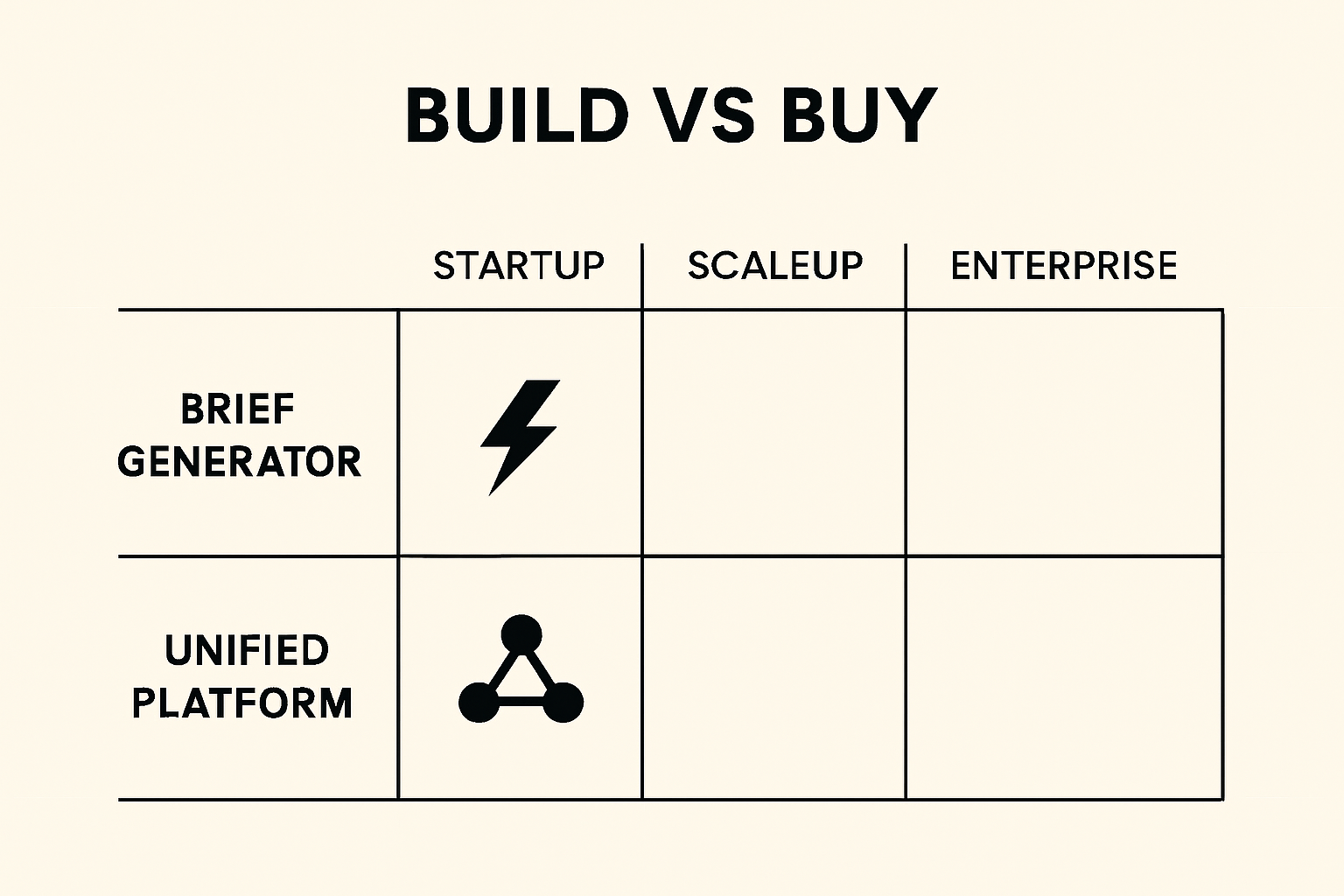
- Startup (1–3 creators): A brief generator may suffice for 2–4 posts/month—until you need a roadmap and consistent E-E-A-T.
- Scaleup (3–8 creators): Unified platform recommended. You’ll need shared roadmaps, internal linking, and QA.
- Enterprise (pods): Unified platform + governance and version control to manage multi-market consistency.
Migration Path to SEOsolved Without Disruption
- Start parallel: Use SEOsolved for one cluster while legacy tools run as usual.
- Migrate templates: Import titles, outlines, and on-page rules into your workflow.
- Phase out tools: Replace piecemeal research and generators with the unified pipeline.
Templates and Checklists You Can Use Today
Steal these structures to accelerate consistent brief creation.
SEO Blog Post Brief Checklist
- Goal, audience, POV, promise
- Primary + secondary keywords and intent
- Outline with entities and FAQs
- On-page SEO: title/meta, internal links, schema
- Evidence: sources, SME, proprietary data
- Timeline, deliverables, acceptance criteria
Landing Page Brief Template
- Audience/job-to-be-done and key objections
- Message hierarchy: headline, proof, CTA
- Feature-to-benefit mapping and social proof
- Schema: Product + FAQ + Breadcrumb
- A/B test ideas and analytics events
Thought Leadership Brief Outline
- Thesis and counterpoint
- Evidence and expert quotes
- Implications and actions
- FAQs and definitions
- Author bio and credentials
Measure What Matters: KPIs for Brief Effectiveness
Prove your briefs improve speed, quality, and outcomes.
Time-to-First-Draft and Revision Rates
- TTFD: From assignment to first draft submission.
- Revision rounds: Brief clarity correlates with fewer rewrites.
- Throughput: Pieces published per creator per month.
Rankings, Traffic, and Conversion Impact
- Featured snippets and PAA placement.
- Non-brand organic clicks and time on page.
- Micro and macro conversions tied to each page.
Pitfalls to Avoid With AI Content Briefs
Common mistakes that cost rankings—and how to avoid them.
Overfitting to Keywords vs. Matching Intent
Quick rule: Write to satisfy the task behind the query, not to repeat the string. Evidence, clarity, and structure beat keyword stuffing.
Thin Sources and Missing E-E-A-T Signals
Demand citations, expert input, and fresh updates. AI search won’t cite what it can’t read or trust. Keep content chunked, citable, and well-structured (Yext checklist).
FAQs on AI Content Briefs and Software
What is an AI content brief?
A structured plan with goals, audience, keywords, outline, sources, and on-page rules that guides both human writers and AI agents to produce content that ranks and converts.
How do I create a content brief quickly?
Use a brief generator for a first pass, then refine with SERP gaps, entities, and citations. Platforms like SEOsolved automate titles, outlines, and article drafts.
What features matter in content brief software?
Keyword inputs, SERP analysis, collaboration, versioning, export options, internal linking, and schema guidance.
How does E-E-A-T fit into briefs?
Require credible sources, SME input, clear bylines, and proprietary data. Add FAQs and definitions for citable sections.
Will AI replace manual briefs?
AI accelerates research and drafting, but strategy and brand voice still need human oversight—especially in regulated or complex markets.
Get Started: Create AI Content Briefs Faster
Whether you’re publishing weekly or daily, the fastest wins come from aligning strategy, structure, and speed. That’s what SEOsolved automates—end to end.
Next Steps Checklist
- Select one topic cluster to pilot.
- Draft a brief with goals, intent, outline, and sources.
- Add on-page rules, schema, and internal links.
- Ship a first draft within 48 hours; review with the checklist.
- Scale with a unified platform for roadmaps and auto-generated articles.
CTA: Stat Ranking Today (https://www.seosolved.com/)
Ready to automate strategy and article creation? Stat Ranking Today with SEOsolved and turn ideas into ranked pages—fast.
Related reads: Semantic SEO • Automated Content Creation
Why the 2026 Shift Raises the Stakes
By 2026, AI systems will manage full workflows—research to publishing—across text, video, and visuals, enabling faster, more personalized programs (Smartli). As these agents proliferate, content that’s structured, citable, and current will win visibility.
And as analysts note, capital will flow to durable, high-value AI businesses that withstand legal and market scrutiny—not generic platforms (JD Supra). Your content ops must reflect the same rigor.
Finally, remember that while AI assistants are rising, most online discovery time still comes through traditional search today (eMarketer/Comscore). The winners optimize for both worlds—now.