
Stop starting from scratch. In 2025, AI content repurposing lets you turn one great piece into dozens of high-performing assets—fast—so you can 5x reach without 5x budget.
In this guide, you’ll get a plain-English definition, ROI math, a 7-step workflow, source-to-format playbooks, prompt libraries, a vetted tools stack, and a 14-day sprint plan—plus how SEOsolved automates the engine end-to-end.
What Is AI Content Repurposing in 2025?
Definition: AI content repurposing is the process of transforming one source (e.g., a pillar blog, webinar, or podcast) into multiple channel-ready formats—social posts, short videos, threads, carousels, emails—using AI to maintain intent, structure, and accuracy at scale.
It’s not copy–paste. It’s content atomization with guardrails: aligning each derivative to a specific platform, length, and call-to-action, while preserving the original insight. The payoff is multi-channel visibility and compounding SEO lift as you own more SERP surfaces and social feeds.
60–80% time saved vs. net-new creation every time you publish across channels (source).
Systematic repurposing can boost content reach by ~300% by meeting people in their preferred formats (source).
Improved SEO is a core advantage as AI helps tailor, structure, and scale assets faster (Netguru).
Tactic #1: Atomize every pillar into a platform-native set (LinkedIn carousel, X thread, Shorts/Reel, newsletter, FAQ, and 2–3 internal-link support posts) to multiply distribution touchpoints.
The Business Case: ROI of Repurposing vs Net-New Creation
Repurposing compounds returns from each cornerstone asset. Beyond time savings, you gain more entry points to your funnel and faster SEO feedback loops.
Teams save 60–80% production time (source); some AI platforms report up to 70% time reduction in copy creation (Persado data).
Repurposed cornerstones can generate ~300% more engagement than single-format outputs (source).
Brands executing repurposing see higher engagement; one report notes 2x engagement vs only net-new programs (source).
Best-in-class content marketing returns average $5.20 per dollar, with leaders up to $13 (source).
Approach | Time per Campaign | Formats Shipped | Expected Reach |
|---|---|---|---|
Net-New Only | 100% | 1–2 | Baseline |
Repurpose-First (AI) | 20–40% | 8–15 | 2–5x |
Tactic #2: Shift to a 70/30 repurpose-first mix: 70% derivatives from pillars, 30% net-new for fresh angles.
Related reading: see how automated content creation accelerates a whole SEO program.
The 7-Step AI Content Repurposing Workflow
Step 1: Select a High-Intent Pillar and Audience Persona
Choose a topic with search intent, pipeline potential, and clear revenue alignment. Validate keyword difficulty and demand, and define a primary persona and job-to-be-done.
Use a pillar-first structure to keep angles tight and derivatives relevant. For templates, grab our pillar page framework.
Tactic #3: Prioritize “money pages” (problem, solution, comparison) over generic thought leadership to ensure derivatives convert.
Step 2: Extract Core Angles, Questions, and Quotes
Mine the source for sub-themes, FAQs, quotable lines, and stats. Create a snippet bank with 10–20 pull-quotes, 5 FAQs, 3 story examples, and 3 data points for fast reuse.
Tip: Many marketers struggle to ideate and keep content engaging (16–17% cite these as challenges) (source). A structured extraction step fixes that.
Step 3: Map Formats to Channels and Buyer Journey
Assign each angle to top/mid/bottom-funnel and match to format: carousels for awareness, threads for education, short video for demand capture, and case snippets for conversion.
Tactic #4: Build a 1:Many mapping grid: each pillar yields 1 newsletter, 1 carousel, 1 thread, 1 long video, 2–3 Shorts/Reels, 3 social posts, 1 FAQ, and 2 support articles.
Step 4: Lock Style Guide, Voice, and Compliance Rules
Standardize tone, claims thresholds, prohibited phrasing, disclaimers, and link/UTM policy. In 2025, 71% of people want disclosure when AI is used—add a short note where appropriate (source).
Step 5: Generate Derivative Assets with Guardrails
Use templates that constrain length, structure, and CTAs. Have AI create drafts, not finals—then layer human editorial judgment for nuance and brand safety.
Algorithms can identify the best segments and tailor per platform, boosting consistency and quality (Kaltura).
AI complements creativity by handling repetitive work so your team focuses on strategy and innovation (source).
Tactic #5: Use “guardrail prompts” with explicit inputs: angle, audience, platform, word count, CTA, and links.
Step 6: Human Edit, Fact-Check, and Add E-E-A-T
Review for accuracy, add citations, and include expert bylines. Maintain a source log with URLs for every stat. Add media like charts and product screenshots.
Step 7: Publish, Distribute, and Iterate from Analytics
Ship consistently. Set a re-share cadence and test hooks, thumbnails, and CTAs. Track rankings, CTR, watch time, saves, and assisted conversions; optimize the next wave from learnings.
Tactic #6: Run a 3x-cadence plan for each derivative: publish, re-share with a new hook 7–10 days later, and bundle into a monthly roundup.
Case-in-point: Buffer expanded reach by ~400% after systematizing repurposing (source). Even Netflix leans on AI to assemble highlight reels and trailers tailored to audience preferences (source).
Source-to-Format Playbooks
How to Repurpose Blog Content for Social Media (Templates and Examples)
Turn one blog into a week of posts. Keep structure tight and platform-native.
LinkedIn carousel (8–10 slides): Slide 1 hook, 5–7 insights, 1 stat, 1 case, final CTA. Use our Social Media Post Generator AI for draft copy blocks.
X thread (7–12 posts): Hook, 3 takeaways, 2 examples, 1 stat, 1 CTA. Add 1 internal link.
Instagram caption: 120–180 words + 3–5 hashtags + save/share CTA.
Facebook post: 80–120 words + link preview + question to spark comments.
Copy-and-use prompt:
"Repurpose this blog for [PLATFORM]. Audience: [ICP]. Goal: [AWARENESS/MQL]. Structure: [OUTLINE]. Length: [WORDS]. Voice: [BRAND VOICE]. Include: [STAT], [QUOTE], CTA to [OFFER]. Link: [URL with UTM]."
Tactic #7: Use platform-native formats (carousels and threads) to maximize reach and saves on LinkedIn and X.
Blog to Video: YouTube, Shorts, and Reels
YouTube (6–8 minutes): Script with problem–solution, 3 key points, and a “what to do next” segment. Add keywords to title, description, and chapters. See our Video SEO 2025 playbook.
Shorts/Reels (30–60 seconds): One insight per clip. Hook in 2 seconds, one proof point, one CTA. Batch 3–5 clips per blog.
Captions: 2–3 hashtags + UTM link in pinned comment or bio.
Podcast to Blog and Newsletter
Transcribe the episode. Segment into 3 themes with quotes.
SEO blog: Turn the strongest theme into a 1,500–2,000 word post with FAQs and schema.
Newsletter: A 3-section digest: main idea, quick wins, and “one ask.”
Webinar or Slide Deck to Blog Cluster and Lead Magnet
Pillar: Summarize the webinar’s core thesis.
Support posts: 3–5 deep-dives covering subtopics.
Lead magnet: A 1–2 page checklist PDF with the best steps.
Prompt Library for Reliable, On-Brand Outputs
Carousel and Thread Generator (LinkedIn and X)
"Create a [8-10 SLIDE LINKEDIN CAROUSEL] from this source. Audience: [ICP]. Hook: [BENEFIT-LED]. Slides: 1 HOOK, 5-7 INSIGHTS, 1 STAT, 1 CASE, 1 CTA. Tone: [VOICE]. Add 1 internal link to [TOPIC]."
"Turn this into a [7-12 TWEET THREAD]. Lead with a contrarian hook, then 3 tips, 2 examples, 1 stat, and a CTA. Add relevant hashtags and a short UTM link."
60-Second Video Script and Hook Variations
"Write a 60s video script. Hook: 5 options. Body: 120-180 words, 1 proof point, 1 action step. CTA: [OFFER]. Caption: platform-specific with 2 hashtags."
Newsletter Condenser: From Pillar to 3-Section Email
"Condense this pillar into a 3-section email: WHY IT MATTERS, WHAT TO DO, ONE ASK. Subject: 3 options. Preview text: 45-60 chars. Insert 2 UTM-tagged links."
Design Brief Prompts for Canva or Figma
"Design a 1080x1080 LinkedIn carousel. Style: clean, brand colors. Provide copy blocks for each slide, headline hierarchy, and notes for imagery."
Content Repurposing Tools Stack
Strategy and Pillar Creation: SEOsolved
SEOsolved handles the heavy lifting: connect your site and it analyzes competitors, surfaces 500+ ranking keywords, builds a content roadmap, and auto-generates 30–60 high-quality, sourced blogs per month—the perfect repurposing fuel. That’s ~80+ hours reclaimed monthly with about 10 minutes of your time per week.
Explore our buyer’s guide to AI writing tools that rank in 2025.
Design and Scheduling: Canva, Buffer, Hootsuite
Canva for on-brand visuals; Buffer/Hootsuite for multi-platform scheduling. Efficiency gains stack when you pre-approve templates and content calendars.
Automation and Collaboration: Notion, Zapier, Make
Use Notion for briefs and approvals; Zapier/Make to push drafts to your CMS, design queue, and schedulers. AI agents commonly yield 25–47% productivity lift by automating repetitive tasks (source).
Using SEOsolved to Scale Repurposing End-to-End
1) Connect Your Site and Generate a 6-Month Roadmap
Input your domain. SEOsolved scans competitors, identifies 500+ keywords, and prioritizes topics by impact and effort.
2) Approve Briefs, Tone, and Sources
Lock headings, target intents, brand voice, and required citations so derivatives inherit the right structure and E-E-A-T.
3) Auto-Generate Pillar Blogs and Support Articles
Produce 30–60 long-form, SEO-optimized articles each month—well-structured, deeply sourced, and ready to atomize.
4) Export Repurpose-Ready Snippets and Angles
Pull summaries, quotes, FAQs, hooks, and stat callouts directly for social, video, and email. This is where how to repurpose blog content for social media gets fast.
5) Automate Publishing to Channels
Push posts to CMS and schedulers with UTMs and consistent CTAs via Zapier/Make. Maintain canonical links and internal links automatically.
6) Track Rankings, Leads, and Repurpose Multiplier
Monitor target keyword rankings, form fills, and derivative output per pillar to improve throughput. Many programs see 25–40% organic traffic lift when repurposing is executed consistently (source).
Stat Ranking Today — connect your site and ship your first pillar this week.
Quality, Attribution, and E-E-A-T Safeguards
Fact-Check and Source Integrity
Validate every stat and claim. Keep a source log (title, URL, date).
Use recent, credible references; avoid dead links and unverified numbers.
Author Bylines, Citations, and Internal Linking
Assign expert bylines and bios with relevant credentials.
Link to cornerstone pieces and related guides to build topical authority.
Example: connect this playbook with automated content creation and video SEO.
On-Brand Voice and Accessibility
Maintain tone consistency and readability targets (e.g., grade 8–10).
Add alt text, captions, and contrast-aware visuals. Ensure link contrast and keyboard navigation support.
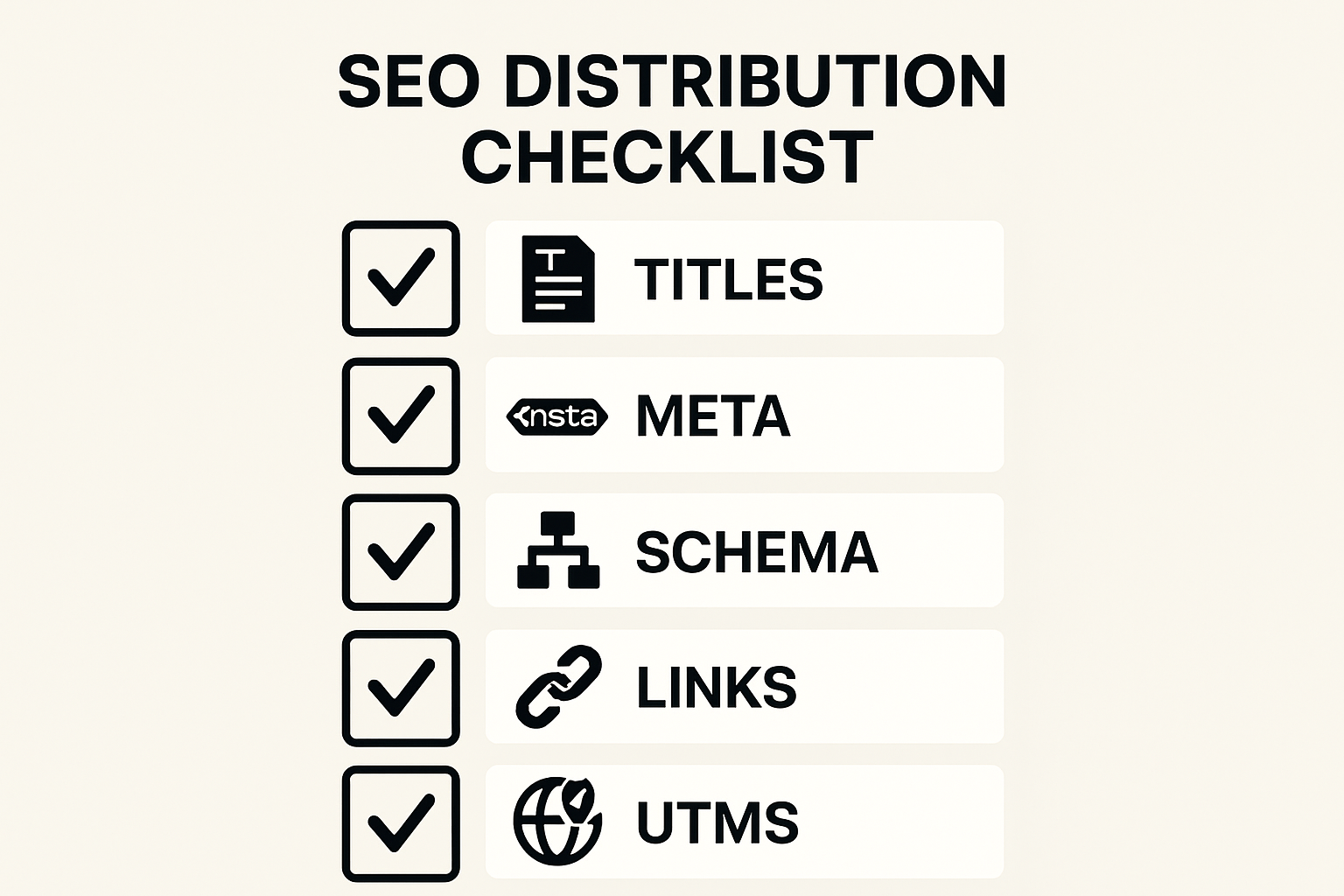
SEO and Distribution Checklist
On-Page Essentials for Repurposed Posts
Unique title and meta with primary intent-aligned keyword.
H1/H2 structure, scannable bullets, and internal links to pillars/supports.
Compressed images, descriptive alt text, and clear CTAs.
Schema, Video SEO, and Rich Snippets
Article schema for blogs; VideoObject for YouTube/Shorts embeds; HowTo/FAQ where relevant.
Chapters, captions, and keyworded descriptions on video for richer surfaces.
Internal Links, Canonicals, and Content Pruning
Use canonical tags to avoid duplicate content and keyword cannibalization.
Prune thin or overlapping posts; consolidate into stronger assets.
Tactic #8: Add schema and UTMs to every derivative to improve discoverability and attribution clarity.
Metrics That Matter and a Simple Dashboard
Repurpose Multiplier and Output per Pillar
Track how many quality derivatives you ship per source. Aim for 8–15 per pillar, including social, video, and email assets.
Tactic #9: Set a minimum acceptable multiplier (e.g., 10 derivatives per pillar) and hold teams to it.
Traffic, Rankings, and Assisted Conversions
Monitor keyword rankings, organic sessions, and assisted conversions from repurposed assets with UTM layers and model-based attribution.
Engagement by Format and Channel
Compare watch time, CTR, saves, shares, and comments to double down on winning formats. Personalized content can drive much higher engagement (202% lift study).
Time Saved and Cost per Asset
Quantify operational efficiency vs. manual production. Expect significant time savings by quickly identifying content to repurpose (source).
Common Pitfalls and How to Fix Them
Over-Automation Without Editorial Judgment
Keep a human in the loop for nuance and brand safety. Add an editor checkpoint to every derivative.
Duplicate Content and Keyword Cannibalization
Target unique sub-intents and use canonical tags. Interlink support posts to the pillar to prevent overlap.
Off-Brand Tone and Inconsistent Style
Enforce a written style guide, voice presets, and compliance rules baked into prompts.
Low-Utility Formats That Do Not Match Intent
Choose formats by audience and funnel stage. If the topic needs demonstration, use short video over long text.
Forgetting Distribution and Refresh Cadence
Schedule re-shares, update stats quarterly, and run seasonal refreshes to maintain accuracy and ranking strength.
14-Day Sprint Plan to Launch Your Repurposing Engine
Days 1–2: Audit, Goals, and Channel Priorities
Inventory existing content; tag by performance, topic, and intent.
Set KPIs: repurpose multiplier, rankings, organic traffic, MQLs.
Pick 2 primary channels (e.g., LinkedIn + YouTube) and 1 backup.
Days 3–6: Generate Pillars with SEOsolved
Connect your site, approve briefs and voice, and generate 3–5 pillar blogs.
Extract snippet banks: quotes, stats, FAQs, hooks, CTAs.
Days 7–11: Create and QA Derivatives
Produce carousels, threads, Shorts/Reels, and a newsletter issue per pillar.
Run editorial QA: fact-check, E-E-A-T, compliance, and accessibility.
Days 12–14: Publish, Schedule, and Measure
Publish to CMS and schedule social with UTMs and consistent CTAs.
Set dashboards to track rankings, engagement, and assisted conversions.
Next Steps: Launch with SEOsolved
If you’ve built a product but struggle to get found, let SEOsolved create your SEO pillars and fuel your repurposing engine. Connect your domain, approve briefs, and start shipping high-intent content weekly with minimal effort.
Stat Ranking Today and compound results from your next pillar.
FAQs
What is AI content repurposing?
It’s using AI to transform one source asset into multiple channel-ready formats (social, video, email) while preserving intent and accuracy.
How fast can I see results?
Many teams see reach and engagement lift in 2–6 weeks, with organic traffic and rankings improving over 1–3 months.
Will repurposing hurt SEO with duplicate content?
No—differentiate angles, use canonical tags, and interlink to avoid cannibalization. Tailor each piece to a unique intent.
Which formats deliver the best ROI?
Short video, LinkedIn carousels, and X threads often perform well. Test by audience and funnel stage to confirm winners.
Do I need to disclose AI use?
Yes, consider a brief note. 71% of people prefer AI use to be disclosed in 2025 surveys.