Blue links are giving way to AI-generated answers. If you want your brand cited inside ChatGPT, Gemini, Perplexity, or Grok results in 2026, you need a new playbook.
This guide explains AI search engine optimization through GEO—Generate/Generative Engine Optimization—and gives you a 90‑day plan, platform tactics, and a blueprint to get cited, not sidelined.
Read This First: What is AI Search Engine Optimization (GEO)?
Definition: GEO (Generate/Generative Engine Optimization) is the practice of structuring content and site signals so AI answer engines can retrieve, understand, and cite your brand inside generated responses—not just rank your pages in classic SERPs.
You’ll see both phrasings—“Generate Engine Optimization” and “Generative Engine Optimization.” The academic origin of GEO dates to late 2023 work by Princeton-affiliated researchers, which formalized tactics to influence how generative systems select and summarize sources (source).
In short: traditional SEO aims for clicks from rankings; GEO aims for inclusion and attribution in AI answers.
Why GEO matters now: from blue links to generated answers
Users increasingly ask AI to summarize, compare, and decide. ChatGPT usage reportedly reached 800M weekly active users in Oct 2025, doubling from February, while enterprise AI adoption climbed rapidly (data). Previsible’s 2025 AI Traffic Report saw AI-referred sessions jump 527% in five months (report summary).
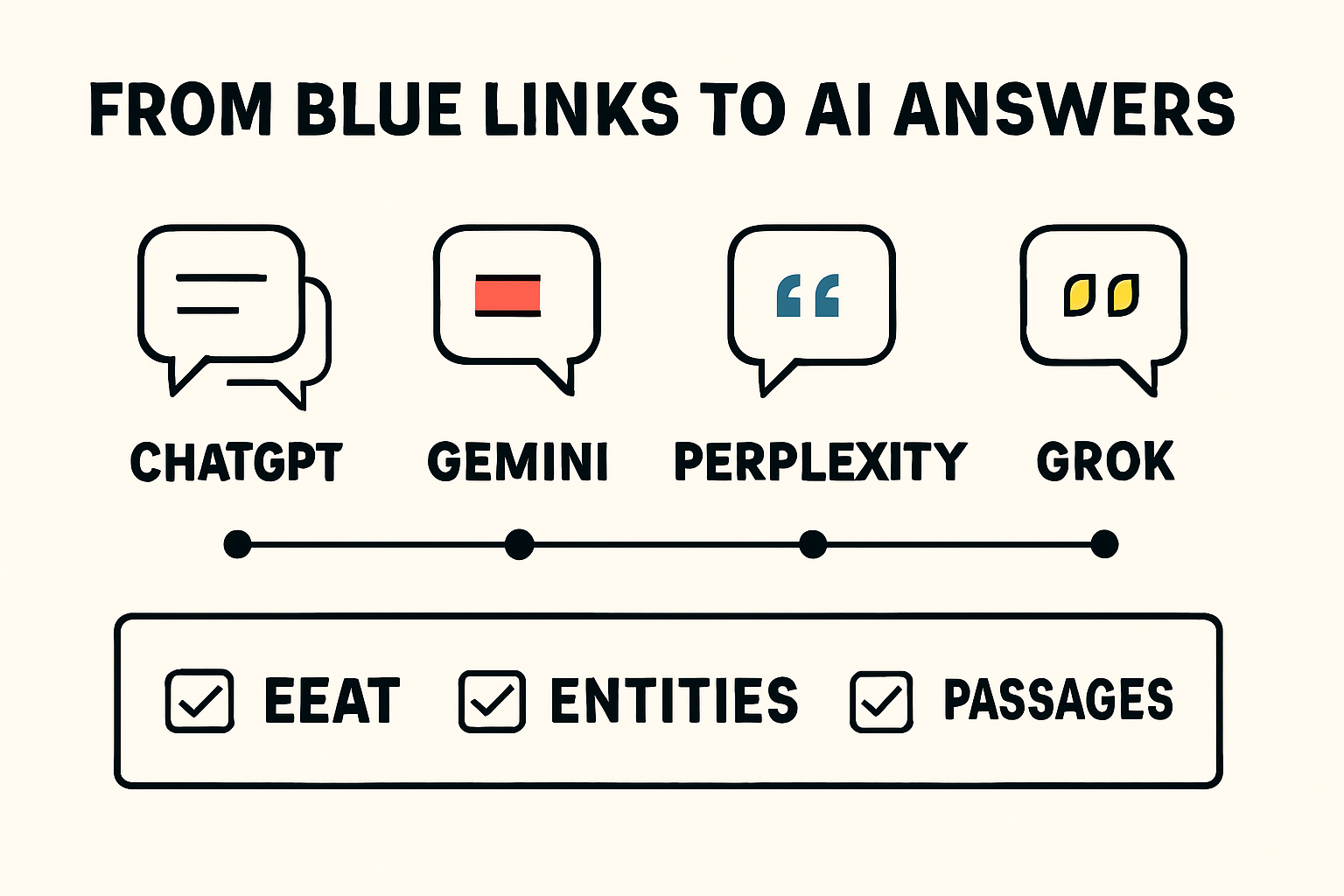
As answer engines (ChatGPT, Gemini, Perplexity, Grok) synthesize results, they increasingly surface passages and cite sources directly in the response—meaning your content must be retrieval-friendly, factually precise, and easy to quote.
GEO vs. SEO: overlap and crucial differences
SEO still matters. But GEO changes the objective: optimize so passages are lifted, summarized, and cited. Research indicates AI search favors passage-level understanding over page-level ranking, and topic coverage over exact-match keywords (analysis).
| Dimension | Traditional SEO | GEO (AI Search Optimization) |
|---|---|---|
| Primary Goal | Rank pages to earn clicks | Be cited and summarized in AI answers |
| Optimization Unit | Page & site | Passage, entity, source |
| Signals Emphasized | Backlinks, keywords, UX | EEAT, clarity, coverage, citations, schema |
| Content Structure | Hubs, thorough guides | Answer-first sections, Q&A, TL;DRs |
| Measurement | Rankings, organic sessions | Mentions, citations, AI referrals, assisted conversions |
How AI Search Engines Work (LLMs, Retrieval, and Sources)
AI search engines blend retrieval with large language models (LLMs). The system fetches relevant passages, then the model synthesizes a coherent answer, often with citations. Think of it as “find, filter, and explain.”
Retrieval and synthesis: where your content fits
Retrieval systems evaluate term and topic relevance, authority, freshness, and structure, then return candidate passages, not just pages. The LLM composes a response, frequently attaching sources. Well-structured, credible paragraphs—clear definitions, steps, and stats—are the content most likely to be lifted and cited (overview).
Entities and knowledge graphs: the backbone of GEO
Entities (people, organizations, products, places, topics) anchor understanding. Align your pages with recognized entities and clarify relationships so AI can place you in the correct context. Building entity-centric clusters is foundational to GEO; it’s also core Semantic SEO. For a deeper dive, see our guide on Semantic SEO and authority.
Signals AI systems prefer: clarity, credibility, and coverage
- EEAT (Expertise, Experience, Authoritativeness, Trustworthiness): clear bylines, bios, and first-party evidence signal reliability (insights).
- Passage-level clarity: self-contained paragraphs that answer a query succinctly (research summary).
- Topical coverage: entity-rich clusters outperform keyword-first pages; query clusters matter (guide).
Ranking Signals for AI Answers: How to Rank in AI Search Results
To increase your odds of being cited in AI answers, optimize for source trust, entity coverage, structure, and originality.
Source-level trust and EEAT for generative engines
- Author transparency: add expert bios, credentials, LinkedIn links, and role-based emails.
- Brand reputation: showcase press mentions, case studies, and review signals.
- First‑party evidence: publish screenshots, data tables, and methodology notes.
- Editorial governance: add bylines, last‑updated dates, and correction policies.
Entity coverage, topical authority, and internal linking
Cover the entities your audience cares about across subtopics and intents, then bind pages with descriptive internal links. Clusters help AI understand your authority footprint. Automate the process with systems that map entities and create links at scale—see Automated Internal Linking.
Schema and structured data that clarify meaning
- Organization & Person: define your brand and authorship.
- Article: headline, author, datePublished, dateModified.
- FAQPage & HowTo: question/answer blocks and step lists AI can lift.
- Product & Review (if relevant): features, offers, ratings.
- BreadcrumbList: clarify site hierarchy.
Answer-first formatting AI can lift and cite
Design each section to be quotable. Use this repeatable pattern:
- Lead with the answer in 1–2 sentences.
- Follow with a numbered list of steps or bullets.
- Add a stat or definition with a source.
- Close with a short example or edge case.
For hands-on formatting examples, see our 2025 AI content playbook.
Original data, sources, and outbound citations
AI engines reward pages that contribute net-new insight and cite trustworthy references. Publish primary research, user studies, benchmarks, or anonymized aggregates. Link out to credible sources to boost your citability and trust signals (overview).
Pro move: Package your proprietary data into short, labeled charts and 2–3 sentence abstracts—ideal for passage lifting.
Ready to operationalize GEO? If you need a faster path from research to publish, Start Ranking Today with SEOsolved. It analyzes competitors, maps entities, and generates answer-first drafts with sources—often in under 30 minutes.
GEO Content Blueprint: Create Pages AI Wants to Quote
Build clusters that mirror how answer engines process topics—by intent, entity, and passage.
Topic clusters mapped to entities and intents
- Map entities: product, problems, adjacent solutions, stakeholders.
- Group intents: define, compare, price, implement, troubleshoot.
- Create clusters: pillar + 6–12 supporting pieces answering each intent.
- Link meaningfully: descriptive anchors, not generic “learn more.”
Automate discovery with competitive intelligence—our AI Competitor Analysis framework shows how to extract topics in minutes.
Q&A sections, TL;DRs, and FAQ blocks
Insert a TL;DR answer box at the top and end major sections with 3–5 FAQs. These blocks are highly quotable and align with FAQPage schema.
Evidence-rich content: stats, definitions, and examples
Mix precise definitions, short examples, and sourced stats. GEO emphasizes factual content AI can extract and attribute (primer).
Media that matters: diagrams, images, and code excerpts
- Diagrams: explain workflows or data flow (RAG, pipelines).
- Images: use descriptive filenames and alt text.
- Code samples: for technical audiences, keep snippets short and labeled.
Updating cadence: freshness without churn
Update quarterly for fast-moving topics; biannually for stable guides. Log changes with dateModified. Encourage recrawl via sitemaps and internal links, not superficial rewording.
Technical GEO: Make Your Site Easy for AI Retrieval
Technical foundations ensure your content is discoverable, parsable, and chunked into logical passages.
Clean HTML, clear headings, and logical chunking
- Semantic HTML: use article, section, h2/h3, lists, and tables.
- Concise sections: 120–200 word paragraphs with scannable subheads.
- Consistent patterns: definition → steps → example → citation.
Sitemaps, robots directives, and canonical hygiene
- Maintain XML sitemaps for all major sections and media.
- Avoid duplicate confusion with rel=canonical and content deduplication.
- Use robots.txt and meta robots to restrict thin or staging content.
Essential schema for GEO: Organization, Person, FAQ, HowTo
Prioritize Organization, Person, Article, FAQPage, and HowTo schema to clarify authorship, purpose, and structure. These types map neatly to answer-first modules.
Performance and accessibility signals
- Optimize Core Web Vitals; compress images and defer non-critical JS.
- Ensure mobile-friendly layouts and high-contrast color choices.
- Always add descriptive alt text and ARIA labels where appropriate.
GEO for Major AI Search Engines (ChatGPT, Gemini, Perplexity, Grok)
Each platform differs in presentation, but all reward clarity, authority, and structured answers.
ChatGPT with browsing: clarity, sources, and concise summaries
- Lead with a 2–3 sentence summary and a numbered list.
- Place your strongest stat or definition near the top with a citation.
- Use clean headings and short paragraphs for passage extraction.
Google AI experiences: entities, schema, and expertise signals
- Align to entities and add Organization/Person schema for EEAT context.
- Cover query clusters and related entities; link within the cluster.
- Keep dates current; show update notes and reviewer bylines (GEO overview).
Perplexity: direct answers and attributed citations
- Put TL;DRs and concise bullets near the top of the page.
- Favor short, labeled passages with clear nouns and verbs.
- Link to authoritative external sources to strengthen perceived reliability.
Grok and social-driven discovery
- Publish timely takes with data; recency and authority matter.
- Summarize threads and link back to durable resources on your site.
- Use clear titles and named entities to reinforce context.
Measurement: Track AI Search Visibility and Impact
GEO performance is measured by visibility in AI answers, referrals from AI engines, and downstream outcomes.
Manual checks with reproducible prompts
- Define 10–20 core prompts per cluster (who/what/how/compare).
- Test weekly at fixed times; log sources cited and positions.
- Rotate phrasing to simulate query expansion (synonyms/entities).
Programmatic monitoring basics
- Track brand mentions, citations, and referral parameters.
- Set up alerting for new citations on key pages.
- Benchmark share of citation vs. competitors per topic.
Outcome metrics: assisted conversions and branded demand
- Attribute assisted conversions from AI-referred sessions.
- Monitor branded search growth by market/segment.
- Estimate revenue impact using linear or time-decay models.
90-Day GEO Action Plan for Problem-Aware Teams
Execute in three focused sprints. Keep deliverables small, repeatable, and citation-ready.
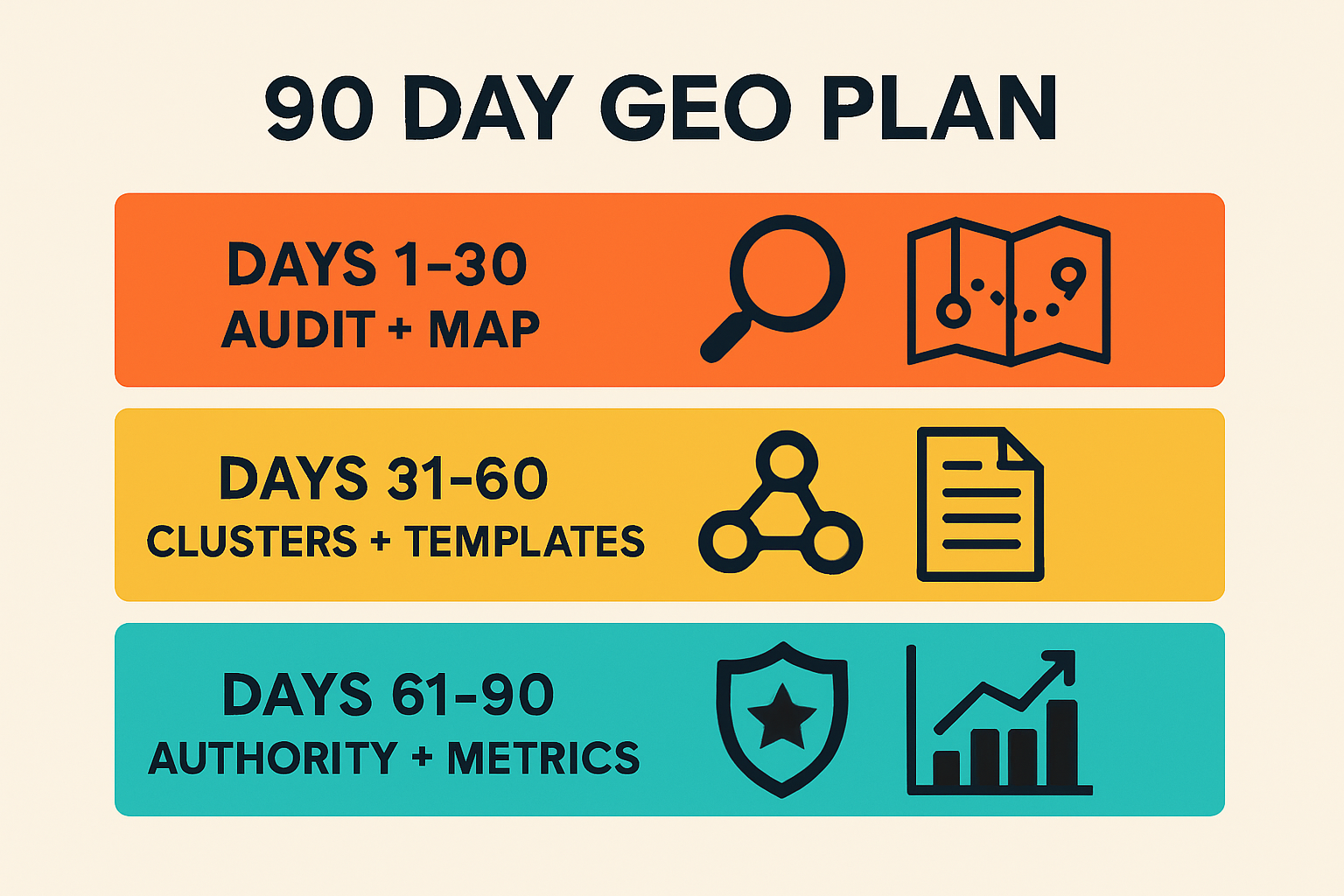
Days 1–30: Audit, entity map, and quick wins
- Audit content & tech: headings, schema, internal links, CWV.
- Build an entity map: products, problems, audiences, adjacent topics.
- Draft 3 answer-first templates: TL;DR + steps + example + cite.
- Fix high-ROI pages: add bios, dates, FAQ blocks, and sources.
Days 31–60: Cluster buildout and GEO page templates
- Launch 1–2 priority clusters with 6–10 posts each.
- Add FAQPage/HowTo schema to each new article.
- Standardize TL;DR and Q&A components across templates.
- Automate internal linking within the cluster.
Days 61–90: Authority, measurement, and iteration
- Publish 1–2 primary research posts with downloadable charts.
- Begin weekly citation sampling for core prompts.
- Iterate titles, summaries, and examples based on what’s cited.
- Strengthen bios, About page, and trust badges sitewide.
Using SEOsolved to Accelerate GEO Execution
AI is already automating core SEO work—44.1% of tasks—with 75.4% of pros saying they can scale better using AI (study summary). SEOsolved turns that efficiency into a GEO advantage.
Analyze competitors and uncover ranking keywords in minutes
SEOsolved rapidly analyzes competitors and uncovers hundreds of ranking keywords. Use those insights to assemble entity-aligned clusters that match how AI expands queries into related variations (query clusters insight).
Build a tailored content roadmap for GEO priorities
Turn findings into a roadmap mapped to entities, intents, and topic clusters, prioritizing pages with high citability. See how we structure this in our guide to AI content optimization.
Generate high-quality, SEO-optimized articles with sources
SEOsolved produces answer-first drafts with TL;DRs, steps, and citations you can publish fast—backed by credible sources and schema-ready layouts. For scaling editorial without sacrificing quality, also see Automated Content Creation.
From strategy to publish in as little as 30 minutes
Teams use SEOsolved to go from competitor scan → entity map → draft → publish in under 30 minutes, speeding GEO execution and expanding surface area for citations.
Enable ranking across Google, ChatGPT, and other engines
SEOsolved is built to help you rank across Google and appear in AI answers from ChatGPT, Gemini, Perplexity, and Grok—so you win both classic SERPs and answer engines.
Common Pitfalls and Ethical Considerations in GEO
Optimize for users first. AI search engines detect low-value, derivative content and weak claims.
Avoid spammy prompts and low-value automation
- Don’t mass-produce thin content. AI systems prioritize genuine expertise (insight).
- Favor quality over volume—3 or 4 excellent pieces beat 30 generic ones.
- Always include verifiable sources and clear definitions.
Maintain transparency: authorship, updates, and corrections
- Add bylines, role-specific author pages, and reviewer notes.
- Show last-updated dates and change logs.
- Publish a corrections policy and respond quickly to issues.
FAQs About AI Search Optimization (GEO)
What is SEO for AI called?
It’s called GEO—Generate/Generative Engine Optimization. GEO optimizes content and site signals so AI systems can retrieve, summarize, and cite your brand inside their generated answers.
How do I rank in AI search results?
Build entity-rich clusters, add EEAT signals, structure answer-first sections, use schema (FAQ/HowTo), publish original data, cite sources, and monitor mentions/citations—then iterate titles and summaries based on what gets cited.
Which AI search engine should I prioritize?
Start with your audience’s channel. Generally: optimize for shared GEO fundamentals—entities, EEAT, TL;DRs, schema—then tailor for ChatGPT browsing, Google AI experiences, Perplexity’s concise citations, and Grok’s recency.
Is GEO replacing traditional SEO?
No. GEO complements SEO. You still need crawlability and rankings, but GEO ensures your passages are included and attributed in AI answers—even when no click occurs.
What content formats are most quotable?
Short definitions, numbered steps, comparison tables, and data-backed bullets near the top of the page—each 80–150 words with a clear takeaway and a source.
Conclusion: Your Next Steps to Win GEO in 2026
Move fast: adopt GEO, measure, and iterate
Answer engines are the new front page. Ship answer-first content, strengthen EEAT, instrument measurement, and iterate toward what gets cited. GEO is how you stay visible as AI compresses the click-path.
Start ranking today with SEOsolved
Accelerate research, planning, and content creation with SEOsolved—your shortcut to GEO-ready clusters and publishable drafts in minutes. Start Ranking Today.