If organic growth feels slow and costly, you’re not alone. In 2026, the right AI SEO platform can compress months of research and production into days—without sacrificing quality.
This buyer’s guide explains how AI-first platforms differ from traditional SEO software, how to map features to business goals, what to test in demos and pilots, and how to calculate ROI. We’ll also show how SEOsolved drives speed-to-value with competitor analysis, content roadmapping, and high-quality draft generation—fast.
The AI SEO Platform Landscape in 2026
AI SEO platform describes an integrated system that uses artificial intelligence for SEO strategy, research, and content execution. Unlike legacy “point tools,” these platforms unify competitor analysis, topic discovery, clustering, and generation—accelerating end-to-end search engine optimization.
Why it matters in 2026: Google’s evolving AI experiences and assistant-style answers are changing how visibility is won. Brands must optimize for classic rankings and “Search Everywhere” surfaces powered by search engine optimization AI—from Google AI Overviews to chat assistants.
Definitions and Core Capabilities
AI-based SEO platforms combine data ingestion, modeling, and content workflows to automate high-impact tasks at scale. Typical capabilities include:
Strategy automation: Turn competitor signals and SERP patterns into prioritized content roadmaps (pillar, cluster, and FAQ coverage).
Keyword discovery and clustering: AI groups queries by intent and difficulty, highlighting gaps your rivals miss.
Content generation and optimization: Create briefs and drafts aligned to entities and on-page structure via AI powered SEO software.
On-page semantic coverage: NLP suggests related entities and FAQs so you cover topics holistically, not just repeat a term. See how NLP helps semantic depth in Clickrank’s guide on AI in SEO.
Predictive and competitive analysis: Machine learning can forecast intent shifts and analyze rival strategies at scale.
AI vs. Traditional SEO Software
Classic engine optimization software surfaces data; AI-first platforms decide and draft. The difference shows up in speed, scale, and outcomes:
Traditional SEO Software | AI-First SEO Platform |
|---|---|
Manual research, spreadsheets, siloed tools | Automated insights into a unified content roadmap |
Keyword lists without clustered intent | AI clustering by topic, funnel stage, and difficulty |
Guidelines for writers | Briefs + first drafts aligned to entities and sources |
Slow to pivot on SERP changes | Adaptive, predictive adjustments based on live data |
Where AI Shines—and Its Practical Limits
Strengths:
Pattern detection across massive SERP datasets for smarter topic selection.
Drafting briefs and articles fast—ideal for consistent publishing cadence.
Entity coverage and semantic completeness powered by artificial intelligence SEO analyzers.
Limits:
Needs editorial oversight to ensure accuracy, compliance, and brand voice.
Requires transparent sourcing to support E-E-A-T and reduce risk of factual drift.
Governance matters: avoid thin or duplicate content, even if the tool makes it easy.
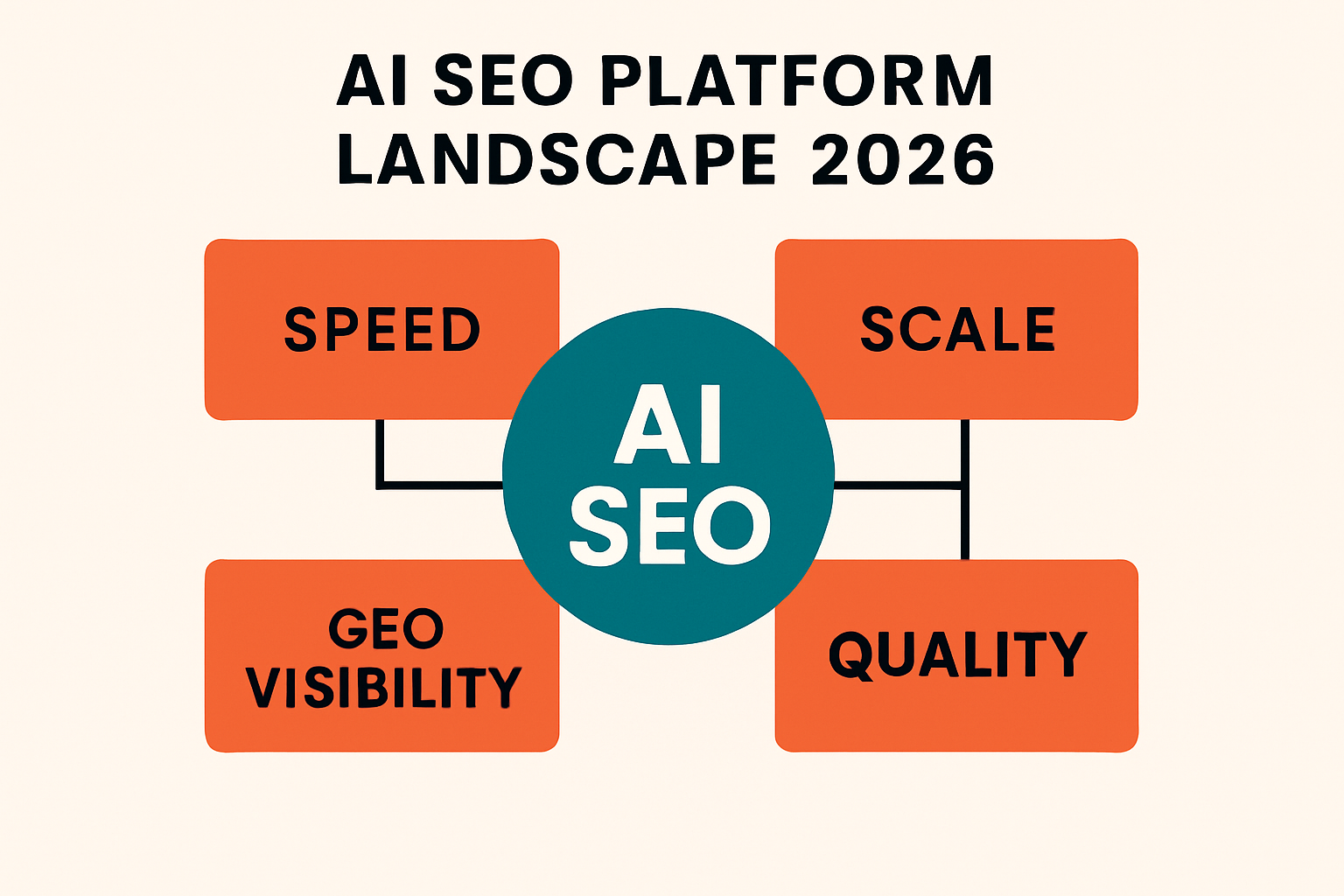
AI experiences also impact clicks: research notes Google’s AI features may reduce traffic by answering inside the interface and limiting visible sources. That’s why optimizing for presence inside AI results is now a must-have, not a nice-to-have.
Map Your Goals to the Right Capabilities
Buy the platform that fits your outcomes—not the longest features page. Align these goals with capabilities in seo optimization AI platforms.
New Sites and Startups: Ship Content Fast
Early-stage teams need topical authority quickly. Look for an AI content marketing tool that can:
Turn a few competitor URLs into a first 90-day content plan.
Generate outlines and drafts for consistent weekly publishing.
Suggest related entities and FAQs for full-topic coverage.
Offer a free AI content generator tier or trial to validate fit.
Deep dive next: AI writing tools that rank.
Growing Brands: Scale With Quality Controls
As volume increases, guardrails matter. Prioritize AI SEO software that supports:
Custom style guides and brand voice presets.
Source controls and citation insertion for E-E-A-T.
Topic clustering to avoid cannibalization.
Multi-step approvals to keep accuracy and consistency high.
Related reading: Automated content creation to scale SEO.
Agencies and Teams: Templates, Governance, and Speed
Agencies need reuse and repeatability. Favor platforms with:
Reusable templates for briefs, outlines, and internal linking.
Roles, permissions, and audit logs—your lightweight seo agent governance layer.
Bulk operations and batch drafting to serve multiple clients.
Integrations with CMS and analytics—reduce handoffs; avoid brittle addon SEO scripts.
Mid-article CTA: Want strategy plus drafts in minutes, not weeks? Stat Ranking Today.
Selection Criteria That Actually Predict Success
Great buyers prioritize outcomes like ranking velocity and content quality. Use these criteria to separate hype from impact.
Strategy Automation and Content Roadmapping
Does it convert competitor data into a prioritized content plan automatically?
Can it reflect intent, difficulty, and business fit—not just search volume?
Does it update the roadmap when SERP dynamics change?
Keyword Discovery and Competitor Intelligence
Depth of keyword discovery and clustering—does it reveal gaps rivals ignore?
Competitive gap analysis by topic and funnel stage.
Integration with an AI-based SEO tools stack for monitoring.
Next, learn a proven process: AI competitor analysis in 7 steps.
Content Generation Quality, Sources, and Speed
Are drafts coherent, on-brand, and backed by credible sources?
Does the platform manage entity coverage and internal links?
What is the typical time-to-first-draft for a 2,000-word article?
Workflow Fit, Roles, and Governance
Role-based access, approvals, and review queues.
Versioning and change tracking to maintain editorial trust.
API or CMS connectors to reduce manual steps—avoid brittle auto SEO software hacks.
Budgeting: Free vs Paid AI SEO Tools
Free tiers are useful for validation, but teams usually move to paid tiers to scale quality and governance. Here’s how to think about ROI.
What You Get With Free Tools
Limited credits and features; enough to test keyword discovery and drafting.
Often strong for ideation; weaker for governance and integrations.
Pair a free AI content generator with Search Console for quick wins.
Signs You’re Ready to Upgrade
Publishing more than 4–6 posts per month.
Need brand voice controls, source management, and approvals.
Want faster velocity from research to publish using AI powered SEO software.
Pricing Models and Total Cost of Ownership
Expect subscription tiers by seats and usage. Budget guidance in 2026 suggests small businesses often spend $100–$300/month for a practical stack, while larger teams invest substantially more as they scale. Agency retainers frequently exceed platform costs, so software ROI stacks quickly if it saves dozens of hours monthly.
Shortlisting and Running a Fair Evaluation
Use an objective process and let data—not demos—decide.
Capability Matrix: Content, Technical, Links
Score vendors across core pillars. Weight “Content Strategy & Generation” highest if you’re pursuing editorial growth:
Content strategy and generation: Roadmapping, clustering, drafts, entity coverage, internal linking.
Technical SEO: Issue detection, structured data support, performance suggestions.
Link intelligence: Competitor backlink gaps and outreach guidance.
For a broader tools view, see: SEO tools in 2025: Outsmart rivals.
Demo and POC Checklist
Use this 10-point checklist during demos to stay objective:
Load 3 competitor URLs; ask the platform to build a content roadmap.
Request keyword clustering with intent tags and difficulty.
Generate one long-form brief and a first draft with cited sources.
Verify entity coverage and on-page structure recommendations.
Check brand voice controls and reading-level options.
Inspect fact-check tools or built-in AI SEO analyzer features.
Confirm CMS export, analytics, and governance (roles/approvals).
Measure time-to-first-draft and editing steps to publish.
Ask how the roadmap adapts to SERP changes week-to-week.
Evaluate reporting for rankings, AI visibility, and conversions.
14-Day Pilot Plan and Success Criteria
Run this timeboxed pilot to validate lift and throughput:
Days 1–2: Input competitors, products, ICP, and target geos.
Days 3–4: Approve the content roadmap (10–20 prioritized topics).
Days 5–10: Generate drafts, edit for voice, verify sources, publish 6–10 posts.
Days 11–14: Monitor rankings, impressions, AI visibility mentions, and CTR.
Success criteria to track: time-to-first-draft, editorial hours saved, entity coverage scores, early impression growth, and top-20 keyword counts.
Implementation: Integrate AI Into Your Workflow
Make AI an extension of your editorial ops, from inputs to publish.
Prep: Brand Inputs, Competitors, and Guidelines
Brand assets: messaging pillars, tone-of-voice, compliance notes.
Competitive set: 3–5 direct competitors and 3 SERP leaders.
Audience and ICP: jobs-to-be-done, pain points, buying triggers.
SEO governance: internal linking rules, target SERP features, schema plan.
Content Ops: Briefs to Publish
Generate briefs with target entities, headers, and internal link suggestions.
Create drafts; editors verify facts, voice, and compliance.
Optimize on-page: titles, metas, schema, images, and internal links.
Publish and track in analytics; update content after 30–45 days based on data.
Quality: Fact-Checking, Sources, E-E-A-T
Require inline citations to authoritative sources.
Use an AI SEO analyzer to validate entity coverage and structure.
Have subject-matter experts review high-stakes pages.
Keep a changelog for major updates to cornerstone content.
Measure ROI: From Rankings to Revenue
In 2026, measure both traditional rankings and AI answer visibility. Optimize for Google and for AI-driven assistants simultaneously.
KPIs Across Google and AI Assistants
AI visibility: Frequency of appearing in AI results and Overviews.
Engagement quality: Time on page, scroll depth, repeat visits.
Conversions: Leads, trials, or revenue attributed to organic and AI surfaces.
Content Velocity vs. Quality Economics
Balance “publish more” with “publish better.” Track editing hours saved and quality signals (backlinks, shares, expert mentions). Use best AI content generators to accelerate production, then invest those saved hours into expert review and link acquisition.
Forecasting Traffic and Payback
Build a simple model: prioritized topics → monthly search demand → target CTR → conversion rate → revenue. Then overlay expected lift from improved entity coverage and internal linking. Revisit quarterly as intent and SERPs shift.
Compliance, Risk, and Best Practices
Stay within platform policies and search guidelines while scaling output with AI.
Avoid Thin Content and Shortcuts
Do not mass-publish unedited AI drafts; enforce editorial review.
De-duplicate and consolidate overlapping pages to avoid cannibalization.
Use AI SEO tools for semantic depth, not for keyword stuffing or doorway pages.
Data, Privacy, and Model Safety
Protect confidential data; clarify what the platform logs, stores, or trains on.
Use redaction for sensitive inputs; restrict access by role.
Maintain a source-of-truth for claims and ensure citations are verifiable.
Staying Within Google Guidelines
Focus on helpful, expert content; avoid manipulative link schemes.
Use structured data to clarify meaning and boost rich results eligibility.
Optimize for AI Overviews by covering entities thoroughly and citing credible sources.
Product Spotlight: SEOsolved for Speed-to-Value
SEOsolved is an AI-powered SEO platform designed to turn your competitor landscape into a prioritized content roadmap and high-quality drafts—fast. It’s built for teams who want results across Google, ChatGPT, and other AI-driven engines.
What SEOsolved Automates
Competitor analysis: Identify content gaps and ranking opportunities from rival sites.
Keyword discovery: Uncover hundreds of relevant terms, clustered by topic and intent.
Tailored content roadmap: Prioritize high-intent topics with clear publishing order.
Draft generation with sources: Produce SEO-optimized articles that cite credible references for trust and editability.
Why It Fits Product-Aware Buyers
If you need to execute quickly, SEOsolved compresses the cycle from research to draft to publish-ready. That means faster ranking potential on Google, stronger presence in AI answers, and less manual effort maintaining your content engine.
30-Minute Workflow to First Drafts
Paste 3–5 competitor URLs and your niche details.
Approve the AI-generated, prioritized content roadmap.
Generate long-form drafts with citations and internal link suggestions.
Lightly edit for brand voice, then publish and monitor.
Ready to see it? Stat Ranking Today.
30-Minute Quickstart with SEOsolved
Follow these steps to realize value fast—ideal for a first POC.
Step 1: Input Competitors and Niche
Provide competitor domains, your product categories, ICP, and regions. The platform analyzes SERPs, clustering opportunities and surfacing high-impact topics using its AI SEO analyzer-style intelligence.
Step 2: Generate a Tailored Content Roadmap
Review an AI-prioritized plan organized by intent, difficulty, and business value. Approve 10–20 topics for the first sprint.
Step 3: Create SEO-Optimized Articles with Sources
Generate long-form drafts with entities, headings, and citations. Editors tune voice, add internal links, and prep for publish. This is where best AI for SEO writing pays dividends.
Step 4: Publish, Monitor, and Iterate
Ship content weekly, monitor impressions, AI visibility, and conversions. Update the roadmap monthly based on results.
Decision Checklist and Next Steps
Move from research to action with this short checklist and plan.
Your AI SEO Platform Checklist
Roadmapping from competitor data (automated)
Keyword clustering with intent and difficulty
Draft generation with credible sources
Brand voice controls and governance
Structured data and entity coverage guidance
CMS/analytics integrations and reporting
AI visibility and conversion tracking
Build a 90-Day Content Plan
Weeks 1–2: Competitive analysis and roadmap approval.
Weeks 3–6: Publish 8–12 articles (2–3/week) with expert review.
Weeks 7–10: Refresh winners, strengthen internal links, add schema.
Weeks 11–13: Expand clusters and optimize for AI Overviews.
Try SEOsolved — Stat Ranking Today (https://www.seosolved.com/)
If you’re ready to turn strategy into ranked content fast, take SEOsolved for a spin and see how quickly a modern AI SEO platform can deliver.
FAQs for Choosing an AI SEO Platform
What is the difference between an AI SEO agent and SEO software?
An AI SEO agent executes narrow tasks autonomously (e.g., clustering or drafting). Full platforms support teams with roadmapping, governance, and publishing—combining agent-like automation with human review.
Can I start with AI SEO free tools and still win?
Yes—validate fit with free credits and drafts, then upgrade when you need volume, brand controls, and integrations. Use free tiers to learn, paid tiers to scale.
How do “alli ai seo,” “ctrify ai seo tool,” and similar fit in?
They’re niche tools that can complement a broader stack—great for specific tactics. Evaluate them within your capability matrix to avoid overlap and ensure governance.
How do I avoid thin, repetitive content with AI?
Cluster topics, enforce editorial review, cite credible sources, and consolidate overlaps. Prioritize helpfulness and expert input over sheer volume.
What KPIs matter for AI-driven search in 2026?
Track AI visibility frequency, entity coverage, traditional rankings, engagement quality, and conversions. Tie them to revenue to guide investment.