If SEO feels noisier than ever, you are not imagining it. In 2025, outsmarting rivals demands the right SEO tools and a system that works even when you do not. This guide shows you exactly how to pick, use, and automate a high-ROI stack.
You will learn what modern search engine optimization tools can do, how to avoid tool sprawl, when to consolidate into all-in-one suites, and where AI saves 80+ hours a month. We will also share operating playbooks, free tool picks, and a clear path to start fast.
What Are SEO Tools? How They Power Growth in 2025
Definition: SEO tools are software and online services that help you research keywords, optimize content, fix technical issues, build authority with links, and measure performance to grow organic traffic, leads, and revenue.
In 2025, the top SEO tools blend data from keywords, SERPs, site crawls, Core Web Vitals, backlinks, and conversions—then apply AI to reveal opportunities. Modern web SEO tools and professional SEO software make it easier to prioritize actions that actually move rankings and revenue.
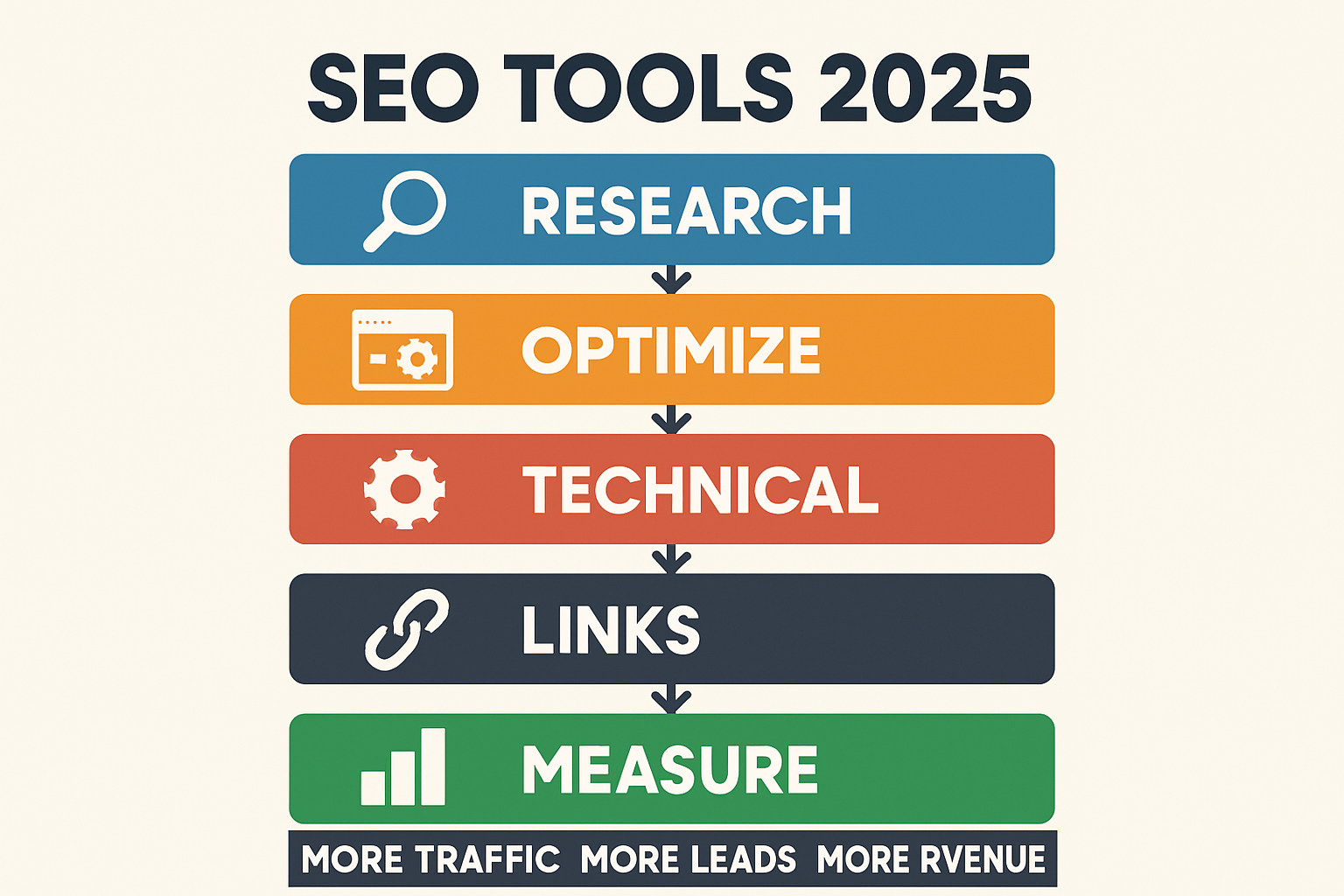
Research: demand discovery, competitor gap analysis, entity/topic modeling.
Optimization: briefs, semantic coverage, internal links, schema, on-page testing.
Technical audits: crawling, rendering, indexation, CWV, structured data.
Link building: backlink analysis, prospecting, digital PR, risk monitoring.
Measurement: rank tracking, SERP features, dashboards, alerts, ROI.
Expectation setting for 2025: advanced SEO tools should surface search intent, support AI-assisted writing with quality controls, and integrate with analytics to tie keyword gains to business outcomes.
How to Choose the Best SEO Tools for Your Business
Great stacks are goal-first, not feature-first. Use this simple framework to select the best SEO tools without overspending.
Align Tools to Goals: Traffic, Leads, Revenue
Acquisition: keyword research, competitor analysis, SERP feature tracking. KPIs: non-brand organic sessions, impressions, clicks.
Engagement: content optimization, internal links, UX. KPIs: time on page, scroll depth, topic coverage.
Conversion: CRO-friendly on-page SEO, intent alignment, FAQ/FAQPage schema. KPIs: MQLs, demo requests, assisted revenue.
Trust and authority: backlink quality and topical relevance. KPIs: referring domains, authority metrics, link velocity.
Reliability: site health and Core Web Vitals. KPIs: indexed pages, CWV pass rates, errors resolved.
Must-Have Capabilities Checklist
Keyword discovery and clustering with intent tagging and difficulty estimation.
Content briefs and optimization using semantic analysis and internal link suggestions.
Crawling and rendering for JavaScript, canonicalization, and indexation audits.
Rank tracking for mobile/desktop, local packs, and SERP features.
Backlink analysis for authority, anchors, and spam risk.
Dashboards and alerts that unify data across tools for proactive fixes.
AI support to automate briefs, outlines, clustering, and draft generation with human-in-the-loop controls.
Evaluating Cost, ROI, and Total Tool Spend
Expect subscription tiers by data limits, seats, and features. Add hidden costs like time-to-insight, context switching, and manual reporting. Many businesses oversubscribe tools yet underuse features.
Benchmarks: Typical monthly SEO services range from hundreds to a few thousand dollars depending on scope (seoClarity overview; Foxxr guide).
ROI math: (Additional organic revenue – total tool + labor cost) / cost. Aim for payback in 1–3 quarters.
Consolidation: a single platform with shared data model often beats 5+ point tools in both speed and accuracy.
Tip: Keep a one-page “stack charter” listing each tool’s job-to-be-done, users, and KPIs. If a tool has no owner or KPI, cut or consolidate.
Related reading: See how automation reduces spend while improving outcomes in SEO automation software: ROI‑rich benefits for content.
All-in-One SEO Platforms and Suites
All-in-one SEO platform tools centralize research, optimization, technical audits, link analysis, and reporting. They cut switching costs and unify insights—especially helpful for teams and agencies.
Top Capabilities to Expect in Complete SEO Software
Competitor analysis across keywords, content gaps, and SERP features.
Keyword discovery with clustering, intent, and expected value.
Site audits that diagnose crawl, render, and Core Web Vitals issues.
Content briefs, optimization scoring, and governance workflows.
Backlink checker, toxic link detection, and digital PR support.
Reporting with automated dashboards and stakeholder-ready summaries.
Collaboration: roles, permissions, comments, and approvals.
When an Enterprise SEO Platform Makes Sense
Thousands to millions of URLs, multi-domain, or multilingual governance.
Complex workflows: change approvals, ticketing, SLAs, and audit trails.
Data sovereignty, SSO, and custom integrations.
Cross-functional teams (SEO, content, product, PR) needing shared truth.
The Case for Consolidation: All SEO Tools in One
Consolidating your SEO toolkit reduces duplicated costs, eliminates conflicting metrics, and speeds up decision-making. With one shared data model, insights cascade: keyword demand informs content briefs, which drive technical requirements and link targets—then flow into dashboards automatically.
Keyword Research and Rank Tracking
Modern workflows combine search volume with intent, SERP analysis, and entity coverage. The goal: clusters that map to the buyer journey and content that wins multiple SERP features.
Discovering Topics and Search Intent at Scale
Topic modeling: group keywords by entities and problems, not just phrases.
SERP analysis: decode formats Google prefers (how‑to, comparison, video, FAQ) to guide content types.
Gap analysis: compare your coverage with competitors to find quick wins and cornerstone topics.
Primer: Google’s SEO Starter Guide reinforces that even basic SEO best practices improve visibility—your tools should make those best practices fast and repeatable.
Tools to Find SEO Keywords and Build Clusters
Start with seed topics from sales calls, site search, and competitor sitemaps.
Expand with suggestions, People Also Ask, and related entities.
Cluster by intent and similarity; assign one primary keyword per URL.
Prioritize by potential: volume, difficulty, SERP volatility, and business fit.
Create a 90‑day content roadmap with briefs, internal links, and owners.
Deep dive: Competitor Keyword Research: Tools, Tactics, Results.
Rank Tracking, SERP Features, and Alerts
Track daily or weekly across mobile and desktop; segment by country and city.
Monitor SERP features: FAQ, video, images, Top Stories, and SGE/AI overviews.
Set alerts for position drops, new competitors, and lost SERP features.
Use geo-grids for local visibility and map pack rankings.
Backlink Checker and Link Analysis
Authority still matters. Link analysis tools help you understand your profile, benchmark competitors, and run safer digital PR.
Auditing Your Link Profile and Competitors
Assess referring domains, topical relevance, and anchor diversity.
Compare link velocity and content types earning links (data, tools, research).
Flag toxic patterns (spam anchors, PBN footprints) and remediate.
Prospecting and Digital PR Workflows
Build prospect lists by topic and publication; align with editorial calendars.
Pitch content hooks with unique data or tools; synchronize with newsroom cycles.
Track reply rates, placement likelihood, and authority gains.
Link Monitoring, Disavow, and Risk
Set alerts for new and lost links; validate followed vs. nofollowed.
Document outreach history and disavow rationale for governance.
Protect against negative SEO with regular audits and risk scoring.
Technical SEO and Site Audits (2025 Edition)
Technical SEO tools analyze crawlability, rendering, Core Web Vitals, and structured data—areas many sites underinvest in.
Crawling, Log File Insights, and JavaScript SEO
Use crawlers to find broken links, canonical conflicts, and thin or duplicate content.
Analyze server logs to catch crawl waste and orphaned content.
Run JS rendering checks for hydration issues, blocked resources, and delayed content.
Core Web Vitals, Page Speed, and Mobile SEO
Measure CWV with lab and field data; set performance budgets per template.
Fix LCP with optimized media and critical CSS; stabilize CLS with reserved space.
Audit mobile parity, tap targets, and above‑the‑fold content.
The Best SEO Audit Tools in 2025: Unfair Advantages
Want a deeper comparison of features like JS rendering, CWV lab/field parity, structured data validation, and automation? Read The Best SEO Audit Tools in 2025: Unfair Advantages.
On-Page Optimization and Content Tools
On-page SEO optimization tools help you build briefs, cover entities, deploy schema, and reinforce topic authority across your site.
Content Briefs, Optimization, and Testing
Generate briefs with required entities, questions, and internal links.
Optimize drafts against top SERP competitors and intent patterns.
Test titles, intros, and FAQ sections; measure engagement and conversions.
Explore top options in Best SEO content writing tools to rank faster in 2025.
Schema, Internal Links, and Topic Authority
Use schema for eligibility in rich results and to clarify entities.
Build hub-and-spoke internal link structures to cement topical depth.
Map internal links to clusters and intent to guide users and bots.
Free On-Page SEO Tools You Should Use
Title and meta analyzers to improve CTR and length.
Heading structure checkers for logical hierarchy.
Schema validators and readability checkers.
Local SEO and Multi-Location
Local stacks emphasize listings, reviews, map pack performance, and geo-targeted content.
Listings, Reviews, and Map Pack Rankings
Audit NAP consistency and primary category accuracy.
Automate review requests; reply with empathy and keywords.
Track map pack rankings and photo views alongside conversions.
Local Rank Tracking and Reporting
Use geo-grids and neighborhood-level rank snapshots.
Benchmark against local competitors and share roll‑up dashboards.
Tie phone calls, directions, and bookings to keyword clusters.
Platform-Specific SEO: WordPress, Shopify, Magento, and More
Each CMS has strengths and quirks. Configure plugins and apps to enforce SEO best practices by default.
WordPress SEO Tools and Plugins
Sitemaps, schema, and redirects in one reliable plugin.
On‑page editors with content scoring inside WordPress.
Image optimization and lazy loading for CWV gains.
Shopify and Magento SEO Essentials
Handle faceted navigation with canonical rules and noindex on parameter traps.
Deploy structured data per template (product, collection, reviews).
Optimize apps and extensions to avoid render-blocking scripts.
LinkedIn, YouTube, and App Stores
LinkedIn: keyword-rich headlines, featured links, and creator mode.
YouTube: titles with entities and hooks, chapters, and custom thumbnails.
ASO: semantic title + short description, high‑intent keywords, and ratings velocity.
AI-Powered SEO: Strategy, Content, and Automation
AI accelerates research and production while humans safeguard strategy, voice, and accuracy.
What AI Can Do Today (and What It Can’t)
Great at: pattern detection, clustering, outline/brief generation, content drafts, and summarization.
Needs human oversight: editorial judgment, E‑E‑A‑T, fact-checking, and brand voice.
Best practice: pair AI with authoritative sources and SME review to scale quality.
Introducing SEOsolved: 10-Minute Weekly SEO That Scales
SEOsolved is an AI-powered platform that automates competitor analysis, discovers hundreds of high-intent keywords, builds a custom content roadmap, and generates in-depth, optimized, credibly sourced articles—often within 30 minutes.
Problem: Slow research. Solution: Automated competitor and SERP analysis finds 500+ keywords fast.
Problem: Empty content calendar. Solution: Auto‑built roadmap with briefs aligned to revenue topics.
Problem: Costly production. Solution: 30–60 optimized articles/month with sources, ready to edit and publish.
Problem: Tool sprawl. Solution: A complete SEO tool with research, briefs, and drafts in one place.
Teams use SEOsolved to rank on Google and AI assistants while reclaiming 80+ hours per month. Want to see it on your site? Stat Ranking Today.
Comparing AI SEO Platforms vs Traditional Stacks
Dimension | AI Platform | Traditional Stack |
|---|---|---|
Cost | One subscription; fewer overlaps | Multiple tools; higher total spend |
Speed | Hours to insights and drafts | Days to assemble data and briefs |
Output | Briefs and drafts at scale | Manual briefs; slower production |
Governance | Centralized workflows | Fragmented processes |
SEO Tool Stacks by Company Stage
Choose a right-sized stack now and a clear upgrade path for later.
Startup Stack: Best Free Online SEO Tools
Google Search Console and Analytics for measurement and diagnostics.
Page speed and structured data checkers for quick technical wins.
Lightweight on-page analyzers and a simple rank tracker.
One content brief template and a weekly publishing cadence.
SMB Stack: Best Value, Best Professional SEO Tools
Keyword research and clustering with intent + potential scoring.
Content briefs and optimization scoring integrated with your CMS.
Site crawler with JS rendering and CWV insights.
Backlink analysis and prospecting; monthly digital PR campaigns.
Dashboards with alerts tied to business KPIs.
Agency and Enterprise Stack: Governance and Scale
Multi-client, multi-domain management with roles and permissions.
Automated reporting and SLAs; change logs and approvals.
Advanced integrations: first‑party data and BI tools.
Free vs Paid: When to Upgrade Your SEO Toolbox
Free tools are fantastic to validate traction. Upgrade when they block speed, accuracy, or collaboration.
The Best Free SEO Tools List (Google and Beyond)
Google Search Console and Analytics 4 for performance and coverage.
PageSpeed Insights, Lighthouse, and Rich Results Test for technical.
Bing Webmaster Tools for supplemental crawl and query data.
Basic on-page and schema validators to improve content quality.
Learn the fundamentals directly from Google’s SEO Starter Guide.
Signs You’ve Outgrown Free Tools
Data caps or sampling prevent trustworthy decisions.
Manual clustering and brief creation consumes too much time.
Teams need shared workflows, comments, and approvals.
You want content volume and quality that require automation.
Building an SEO Operating System
Tools do not win on their own. Turn them into processes with ownership, measurement, and iteration.
90-Day Plan: Research, Build, Optimize, Scale
Days 1–30 (Research): audit site health, map competitors, cluster keywords, and define 3–5 outcome KPIs.
Days 31–60 (Build): publish briefs and 1–2 cornerstone pieces weekly; implement schema and internal links.
Days 61–90 (Optimize & Scale): improve CWV, expand clusters, launch PR hooks, and automate reporting.
For a deeper look at automation’s impact on throughput, see SEO automation software: ROI‑rich benefits for content.
Dashboards, KPIs, and SEO Monitoring Tools
Track outcomes: non‑brand sessions, MQLs, assisted revenue, and CWV pass rates.
Set alerts for index drops, ranking volatility, and broken templates.
Standardize weekly and monthly reviews; annotate releases and campaigns.
Data Hygiene, Security, and Compliance
Govern access by role; enforce SSO and change tracking.
Prefer first‑party tagging and privacy‑first measurement.
Document your data sources, transforms, and definitions in a glossary. A public example of scope: SEO glossary.
Trends and Predictions for Top SEO Tools in 2025
Expect more entity-savvy features, SGE/AI Overviews monitoring, and privacy-first analytics. Winning teams will automate low-level tasks and invest more time in strategy and brand.
SGE, Zero-Click SERPs, and Entity SEO
Track presence in AI-generated answers and optimize entities with structured data.
Publish authoritative summaries, FAQs, and sources to earn citations.
Build brand signals across sites, profiles, and knowledge graphs.
Automation, First-Party Data, and Privacy
Automate research, briefs, and monitoring; reserve humans for editing and PR.
Adopt server-side tagging and privacy-safe modeling.
Stay current with credible overviews like these SEO trends.
FAQs: Common Questions About SEO Tools
What is included in a typical SEO tool stack? Research, content optimization, site audits, rank tracking, backlink analysis, and reporting.
How long until I see results? Technical fixes can lift performance in weeks; content and links often take 2–4 months to materially impact rankings.
Are suites better than point tools? Suites reduce friction and unify data; point tools can be best-in-class for niche jobs. Many teams blend both.
Can AI write high-quality content? AI drafts speed output, but human editing and sourcing ensure E‑E‑A‑T and brand fit.
How much should I budget? Calibrate spend to potential revenue gain and team capacity; consider consolidation to lower total cost.
Get Started: Automate Your SEO with SEOsolved
Ready to turn SEO into a reliable growth engine without hiring a large team? Let SEOsolved analyze your site, uncover 500+ keywords, and generate a monthly content engine in minutes.
Try It Now — Stat Ranking Today
Start free analysis, review your roadmap, and publish your first optimized articles. Stat Ranking Today.
Implementation Checklist
Add your URL and target market.
Review the keyword map and clusters.
Approve the content calendar and briefs.
Connect analytics for outcome tracking.
Publish, monitor, and iterate weekly.
Also see: Ranked.ai Reviews Alternatives: Smarter SEO in 2025 for a perspective on AI approaches.
Further reading: Explore tool categories and strategy angles to round out your plan: an overview of types of SEO and a refresher on fundamentals in Google’s SEO Starter Guide.