
Your fastest path to predictable organic growth is hiding in plain sight: your competitors’ data. This playbook shows you exactly how to turn competitor SEO analysis into rankings, traffic, and revenue—without guesswork.
Inside, you’ll learn a repeatable framework, tool workflows, AI accelerators, and ready-to-use templates. Use it to benchmark rivals, find keyword gaps, reverse-engineer backlinks, and ship a 30–90 day plan that moves the needle.
What Is Competitor SEO Analysis and Why It Matters
Definition: Competitor SEO analysis is the systematic process of identifying who competes with you on search results (SERPs), auditing their traffic, keywords, links, and on-site strategy, then converting those insights into a prioritized plan to win rankings and share of voice.
It matters because search is a zero-sum game: every click your rival earns is one you didn’t. Analyzing rivals reveals what topics and intents drive results, where they’re vulnerable, and which moves will produce ROI fastest.
Reduce guesswork: build a content roadmap from proven SERP demand.
De-risk execution: prioritize opportunities with achievable difficulty.
Accelerate results: target gaps where you can outrank quickly.
Improve efficiency: focus resources on what the market rewards.
As benchmarking shows, measuring yourself against competitors clarifies what “good” looks like and where the leverage is.
Outcomes You Can Expect
Clear “who we’re fighting” list: direct SERP rivals for each priority topic.
Traffic and visibility estimates from competitor web traffic analysis.
A prioritized content backlog mapped to funnel stages and search intent.
Quick-win ranking gains from keyword gap opportunities.
Link prospect lists from intersect and pattern analysis.
Dashboards and KPIs for ongoing competitor SEO tracking.
Core Concepts and Definitions
Direct SERP competitors: Any domain outranking you for target queries—often not your business rivals. See this insight echoed by AgencyAnalytics.
Benchmark: A comparable metric baseline (traffic, keywords, link velocity) used to evaluate relative performance over time.
Share of Voice (SoV): Your portion of total estimated traffic across a defined keyword set vs. competitors.
Apples-to-apples: Normalize by region, language, time frame, and site size before comparing.
How to Compare SEO Competitors: A Proven Methodology
Use this step-by-step process to check competitors’ SEO consistently and make better decisions faster.
Identify True SERP Competitors
List your most important topics and seed keywords.
Search incognito and log the top 10–20 ranking domains per topic.
Remove non-actionable giants (e.g., Wikipedia) unless they own your intent.
Prioritize 3–5 domains that repeatedly appear across your target set.
For a quick start, SEORAF recommends Googling priority keywords and focusing on a small set of consistent SERP rivals.
Gather Baseline Metrics
Keywords and rankings: Top pages, top terms, intent mix.
Estimated traffic and SoV: Trend lines, seasonal shifts.
Backlinks: Referring domains, link velocity, anchors.
Technical health: Speed, Core Web Vitals, indexation.
Content signals: Depth, freshness, internal linking.
Build a Tracking Framework
Define KPIs: SoV, new top-10 keywords, non-brand traffic, link growth.
Create dashboards and a weekly update cadence.
Document hypotheses and outcomes to refine strategy.
Review competitors quarterly; refresh keywords monthly.
Tools Landscape: Semrush, Ahrefs, Moz, SpyFu, and SE Ranking
Each platform excels at different parts of competitor analysis. Choose by task and budget, then standardize your workflows. For broader context on the ecosystem, see our guide to SEO tools in 2025.
Task | Best Fits | Notes |
|---|---|---|
Keyword + SERP gaps | Semrush, Ahrefs, SE Ranking | Robust overlap reports; export for clustering. |
Backlink intersect | Ahrefs | Deep link index and anchor analysis. |
Authority + SERP features | Moz | DA/PA and SERP overlays for quick comparisons. |
PPC + SEO intel | SpyFu | Organic + paid angle for competitive strategy. |
Rank tracking + reporting | SE Ranking | Straightforward monitoring and automation. |
Semrush Competitor Research Essentials
Organic Research: discover competitor keywords and top pages.
Keyword Gap: find keywords they rank for that you don’t.
Position Tracking: monitor SoV shifts across a keyword set.
Tip: Train teams via Semrush Academy to standardize workflows.
Ahrefs for Keyword & Backlink Recon
Site Explorer: export top pages and keywords for intent mapping.
Content Gap: surface opportunity terms you’re missing.
Link Intersect: domains linking to competitors but not you.
Anchors report: catch over-optimization risks and patterns.
Moz Workflows for SERP & Authority
DA/PA to gauge competitiveness at domain and URL levels. As Embryo notes, higher DA generally correlates with better ranking potential.
On-page grader and SERP overlays to compare results quickly.
SpyFu for PPC + SEO Intelligence
Blend organic and paid data to understand full-funnel intent coverage.
Use exported terms to validate commercial value and SERP difficulty.
Considering alternatives? See our list of SpyFu alternatives.
SE Ranking for Monitoring and Reporting
Track competitor positions, SoV, and cannibalization.
Automate weekly and monthly reports for stakeholders.
Data Collection and Auditing: Getting the Foundation Right
Garbage in, garbage out. Standardize how you collect data to avoid bias and misleading comparisons.
Crawl Competitor Sites
Capture titles, H1s, schema, internal links, and load times.
Flag thin or duplicate content and orphaned pages.
Note content types that dominate rankings (guides, tools, glossaries).
Measure Visibility and Traffic
Use multiple sources for competitor web traffic analysis; triangulate estimates.
Track SERP features owned: featured snippets, PAA, videos, top stories.
Normalize by country and language to keep comparisons fair.
Normalize Metrics for Apples-to-Apples
Fix the analysis window (e.g., last 90 days) for all domains.
Compare by content type and intent, not just raw keyword counts.
Create size-adjusted ratios (e.g., referring domains per 100 indexed pages).
Competitor Keyword Research: Tools, Tactics, Results
Your goal is to build a keyword universe grounded in competitor performance and search intent—then prioritize by difficulty, volume, and business value. For a deeper dive, see our guide: Competitor Keyword Research.
Harvest Head, Mid, and Long-Tail Terms
Export top terms by URL to see what actually drives traffic.
Pull long-tail questions and modifiers from PAA and autosuggest.
Don’t ignore branded comparisons if they convert and you can add value.
Cluster by Intent and Funnel Stage
Informational: how-to, definitions, best practices, trends.
Commercial: alternatives, vs, pricing, features.
Transactional: buy, sign up, templates, tools.
Map content types to intent: guides, calculators, case studies, demos.
Validate Difficulty, Volume, and Business Fit
Score by keyword difficulty and domain authority landscape.
Confirm sufficient volume and intent alignment with your offer.
Estimate time-to-rank and link needs; prioritize quick-win clusters first.
Keyword Gap Analysis: Steal Search Share in 30 Days
Keyword gap analysis finds terms your competitors rank for but you don’t. Turn those gaps into a sprint plan. Explore our detailed walkthrough: Keyword Gap Analysis.
Identify Quick-Win Gaps
Intersect your domain with 3–5 SERP competitors.
Filter for KD below your current authority threshold and decent volume.
Flag terms where competitors rank positions 4–20 (easier to leapfrog).
Group by intent; prioritize commercial pages with high ROI potential.
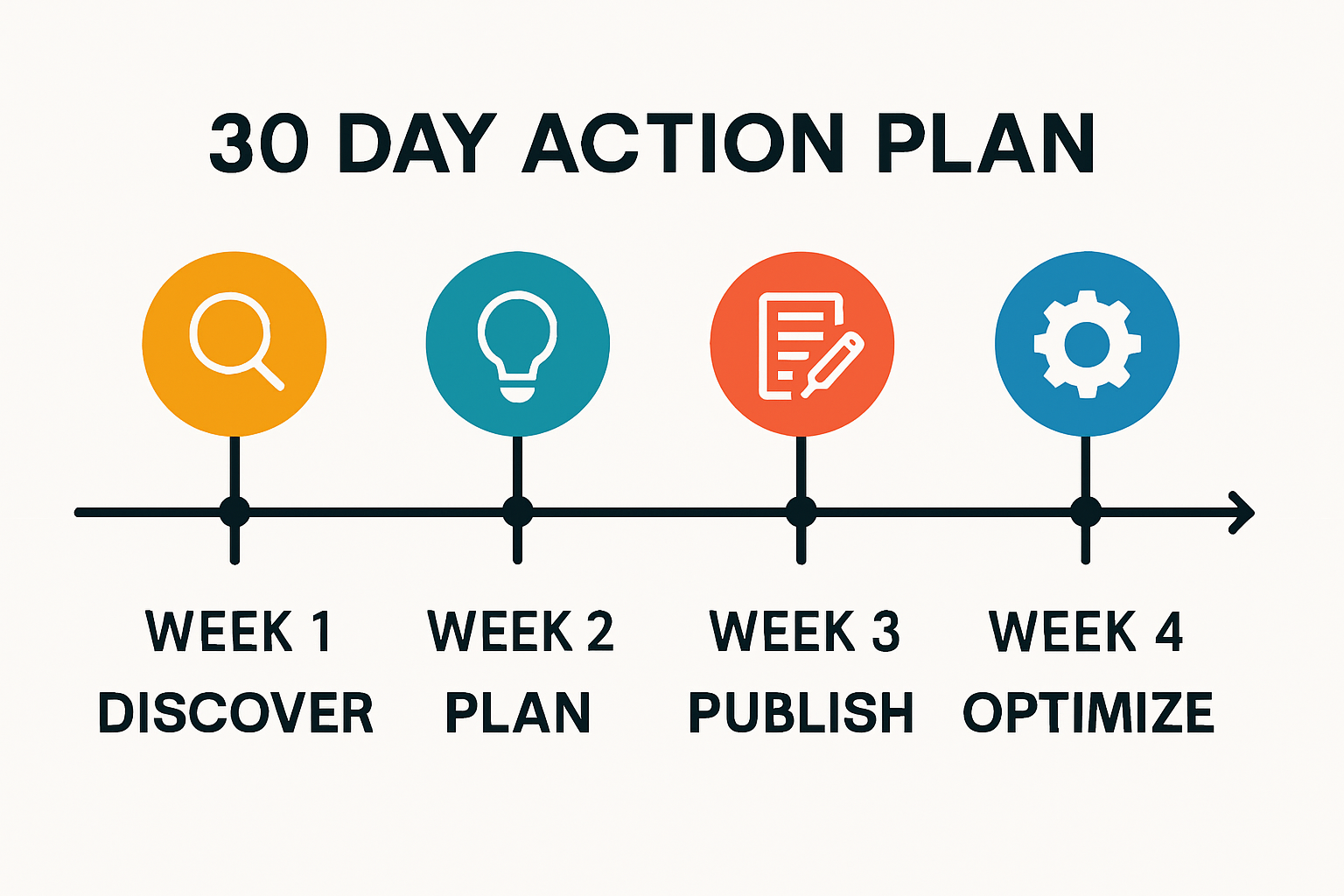
Build a 30-Day Action Plan
Create briefs for 8–12 prioritized topics (mix of quick wins and strategic plays).
Publish or refresh 2–3 pieces per week; include internal links to hubs.
Secure 5–10 relevant backlinks to your top 3 targets.
Track positions, CTR, and SoV weekly; adapt based on early movement.
Track Share-of-Voice Gains
Monitor SoV at the cluster level to see which themes compound.
Estimate captured traffic from position improvements.
Feed learnings into next month’s backlog and briefs.
Analyzing Competitor Backlink Profiles
Reverse-engineer how competitors earn links, then build white-hat campaigns that fit your niche. As many agency guides note, quality and relevance beat raw counts; see this overview of backlink evaluation from AgencyAnalytics.
Link Intersect: Who Links to Them But Not You
Export referring domains across top competitors; find intersections.
Prioritize sites that frequently link to similar content types.
Craft outreach with a clear value exchange and credible assets.
Anchor Text and Page-Type Patterns
Identify anchor distributions; avoid over-optimization risks.
Note which formats attract links: data studies, tools, templates, glossaries.
Use DA/PA and topic relevance to qualify targets. Reference: DA guidance from Embryo.
Digital PR and Partnerships
Package proprietary data and insights into press-worthy narratives.
Co-create resources with partners and industry communities.
Turn repeat linkers into ongoing relationships and contributor programs.
On-Page and Content Benchmarking
Compare content depth, freshness, topical authority, and SERP feature coverage to identify what “rankable” looks like for your niche.
E-E-A-T and Topical Authority
Check author bios, credentials, and real-world experience signals.
Audit topical coverage breadth vs. competitors’ clusters.
Cite reputable sources; use first-party data where possible.
SERP Features: Snippets, People Also Ask, Videos
Structure answers with concise definitions, lists, and tables.
Add FAQ sections and schema-friendly formatting.
Include short videos for how-tos and product explainers when relevant.
Content Depth, Internal Linking, and Refresh Cadence
Benchmark word count and structure; page-one content often exceeds 1,400 words per Embryo.
Build hub-and-spoke clusters; keep updates on a 3–6 month cycle.
Ensure every new page links to and from relevant hubs.
Technical SEO Competitive Benchmarking
Technical gaps can block rankings even with great content. Compare your speed, Core Web Vitals, schema, and crawl efficiency to the SERP leaders.
Speed, Core Web Vitals, and Mobile UX
Measure LCP, INP, CLS against competitors; remove render-blocking scripts.
Use responsive images, modern formats (WebP/AVIF), and lazy-loading.
Benchmark mobile parity and tap targets; fix UX friction.
Structured Data, Sitemaps, and Indexation
Compare schema coverage (Article, FAQ, Product, Breadcrumb, HowTo).
Ensure clean XML sitemaps and rapid indexation for new content.
Fix parameter-based duplication and canonicalization issues.
Architecture and Crawl Efficiency
Shallow, logical architecture beats deep, siloed structures.
Identify orphan pages; add internal links or deindex if low-value.
Consolidate thin pages; redirect to canonical, stronger assets.
AI Competitor Analysis: Automate Insights in 7 Steps
AI compresses the time from data to decision while improving signal quality. For a complete workflow, read AI Competitor Analysis.
1) Ingest Competitor Domains and SERP Data
Aggregate keywords, rankings, links, and content by competitor domain and topic cluster. Standardize source fields and time windows.
2) Normalize and De-duplicate
Unify variations (plurals, casing, params), remove duplicates, and align regions/languages for accurate comparisons.
3) Pattern Detection and Clustering
Use embeddings to group semantically similar queries and identify topic gaps, link patterns, and content formats winning the SERP.
4) Opportunity Scoring
Score terms by difficulty, impact, and content effort; surface quick wins and high-ROI strategic themes with a simple weighted model.
5) Content Roadmap Creation
Programmatically generate briefs with H2/H3 outlines, internal link targets, FAQs, and source prompts mapped to business objectives.
6) Draft High-Quality Articles with Sources
Generate first drafts that include credible citations and on-page best practices; route to editorial for review and SME input.
7) Monitor, Learn, and Iterate
Track SOV and rankings; test titles, intros, and internal links; refresh content based on competitor moves and new SERP clues.
Where SEOsolved Fits
SEOsolved automates this end-to-end:
AI competitor analysis: scans SERPs and rival domains to pinpoint who you’re really competing with.
Keyword discovery at scale: reveals hundreds of ranking keywords and intent clusters you can win.
Tailored content roadmap: prioritized plan aligned to your authority and goals.
Article generation with sources: high-quality, SEO-optimized drafts in minutes—ready for review.
Result: strategy-to-publish in as little as 30 minutes, so you rank faster on Google, ChatGPT, and beyond.
From Analysis to Action: Roadmaps, Content, and Links
Turn insights into an execution engine that ships, learns, and compounds gains.
Build a Quarterly Search Plan
Month 1: quick-win gaps, on-page fixes, internal link hubs.
Month 2: authority-building content, digital PR, link intersect outreach.
Month 3: strategic pillars, refresh top performers, technical enhancements.
Create Briefs and Drafts Efficiently
Standardize briefs with target query, angle, H2/H3s, FAQs, sources, and internal links.
Leverage AI for first drafts; enforce editorial QA and SME review.
Use our piece on competitor keyword research to enrich briefs.
Strengthen Internal Linking and Hubs
Build pillar-cluster architectures that concentrate topical authority.
Automate audits to find orphan pages and missed contextual link ops.
Refresh and expand hubs quarterly as new gaps emerge.
Reporting and Deliverables: Templates, Excel, and PDFs
Package insights so leaders can make decisions quickly and teams can execute confidently.
SEO Competitor Analysis Template (Editable)
Use this structure for stakeholder-ready readouts:
Executive summary: wins, risks, and next 30–90 days.
Competitor set and rationale.
Visibility and SoV trends.
Keyword gaps and prioritization.
Content roadmap and brief summaries.
Backlink strategy and targets.
Technical findings and fixes.
KPI dashboard and cadence.
Excel/Sheets Tracker
Tabs: keywords, rankings, gaps, content pipeline, links, tech issues.
Include status fields, owners, due dates, and impact estimates.
Use conditional formatting to flag slipping pages and new opportunities.
PDF Deliverables and Business Plans
Export executive overviews for board decks and planning docs.
Attach appendix with data tables and methodology notes.
Store versions in a knowledge base to compare quarter over quarter.
SEO Competitor Analysis Example: A Practical Walkthrough
Scenario: a B2B SaaS startup in project management is losing rankings to three resource-heavy blogs. Goal: expand SoV on core how-to and comparison queries within 90 days.
Scenario Setup and Hypotheses
Competitors identified via SERP overlap across 150 target keywords.
Hypothesis 1: long-tail “how to collaborate” queries under-served by rivals.
Hypothesis 2: intersect analysis reveals dozens of mid-authority link prospects.
Hypothesis 3: internal link hubs missing; content depth inconsistent.
Key Findings and Insights
Gap clusters around “templates,” “workflows,” and “integrations.”
Backlink patterns favor data-led guides and downloadable resources.
Technical: competitor B has slow INP; opportunity to leapfrog on UX.
Actions, Timeline, and Expected Impact
Publish 10 gap pages, including two downloadable templates.
Ship two data mini-studies for PR and intersect outreach.
Build a collaboration hub; add 50+ contextual internal links.
Fix INP and LCP regressions sitewide; add FAQ schema.
Expected outcome: increased SoV in target clusters and improved ranking stability. See also our article on AI automation to accelerate these steps.
Mistakes, Ethics, and Risk Management
Ethical, brand-safe execution beats shortcuts. Use competitors to inform strategy—not to copy.
Copying vs. Paraphrasing vs. Original Value
Do not copy; it dilutes brand and risks legal issues.
Paraphrase only when adding unique insights, data, or structure.
Lead with original value: proprietary data, fresh angles, expert commentary.
Data Quality and Bias
Triangulate across tools; each estimates traffic differently.
Validate outliers with manual SERP checks and fresh crawls.
Document assumptions and normalize metrics.
Over-Reliance on a Single Tool
Use at least two sources for keywords and links to reduce blind spots.
Cross-check authority metrics (DA/DR) and focus on real outcomes: rankings and traffic.
Consider alternative stacks when budgets or needs change.
Ongoing Competitor SEO Tracking and Governance
Institutionalize monitoring so you can respond to competitor moves and algorithm shifts quickly.
KPIs and Dashboards That Matter
Share of Voice by cluster and market.
New top-10 keywords and traffic from prioritized themes.
Link growth to strategic pages and referring domain quality.
Core Web Vitals and crawl efficiency.
Alerts, Cadence, and Ownership
Weekly: keyword movement, cannibalization, quick fixes.
Monthly: gap discovery, content refresh plan, link progress.
Quarterly: strategy review, competitor set refresh, roadmap reset.
Assign clear owners for content, links, and technical streams.
Iteration Loops and Knowledge Base
Record test results, wins, and failed bets to scale what works.
Keep a living glossary and playbook accessible to teams.
Export learnings into your next quarterly plan.
Try SEOsolved: Automate Your SEO Content Strategy
SEOsolved turns competitor data into a ready-to-execute plan and high-quality articles—fast.
What You Get with SEOsolved
Competitor SEO analysis that identifies true SERP rivals and intent gaps.
Hundreds of keywords discovered and clustered by business value.
A tailored content roadmap with briefs and internal linking guidance.
SEO-optimized drafts with credible sources ready for editorial polish.
Who It’s For
Businesses and startups that need results without building a large SEO team.
Entrepreneurs who want a done-with-you engine from research to publishing.
Teams that prefer a single workflow over stitching multiple tools together.
CTA: Stat Ranking Today
Stat Ranking Today with SEOsolved and accelerate rankings across Google, ChatGPT, and other search engines.
FAQs
How many competitors should I analyze?
Start with 3–5 true SERP competitors per topic cluster for clarity and speed. Expand once you see consistent patterns. See guidance from SEORAF.
How often should I refresh competitor analysis?
Light refresh monthly; deep dives quarterly. Increase cadence after algorithm updates or major product launches.
Which tool is best for competitor analysis?
Match the job to the tool: Ahrefs for backlinks, Semrush for keyword gaps, Moz for SERP/authority, SE Ranking for tracking, SpyFu for PPC+SEO insights.
Is competitor SEO analysis legal and ethical?
Yes—when using public data and creating original content. Focus on unique value; don’t copy competitors’ work.
Can AI replace expert judgment?
AI accelerates research and drafting, but humans guide strategy, quality, and brand voice. Use AI for speed; experts for decisions.
Further Reading and Sources
Why benchmarking matters in SEO: Sociummedia
Defining SERP competitors and evaluation factors: AgencyAnalytics
Practical checklist for finding SEO competitors: SEORAF
Authority metrics and content-length observations: Embryo
How to identify SEO competitors: Brafton