
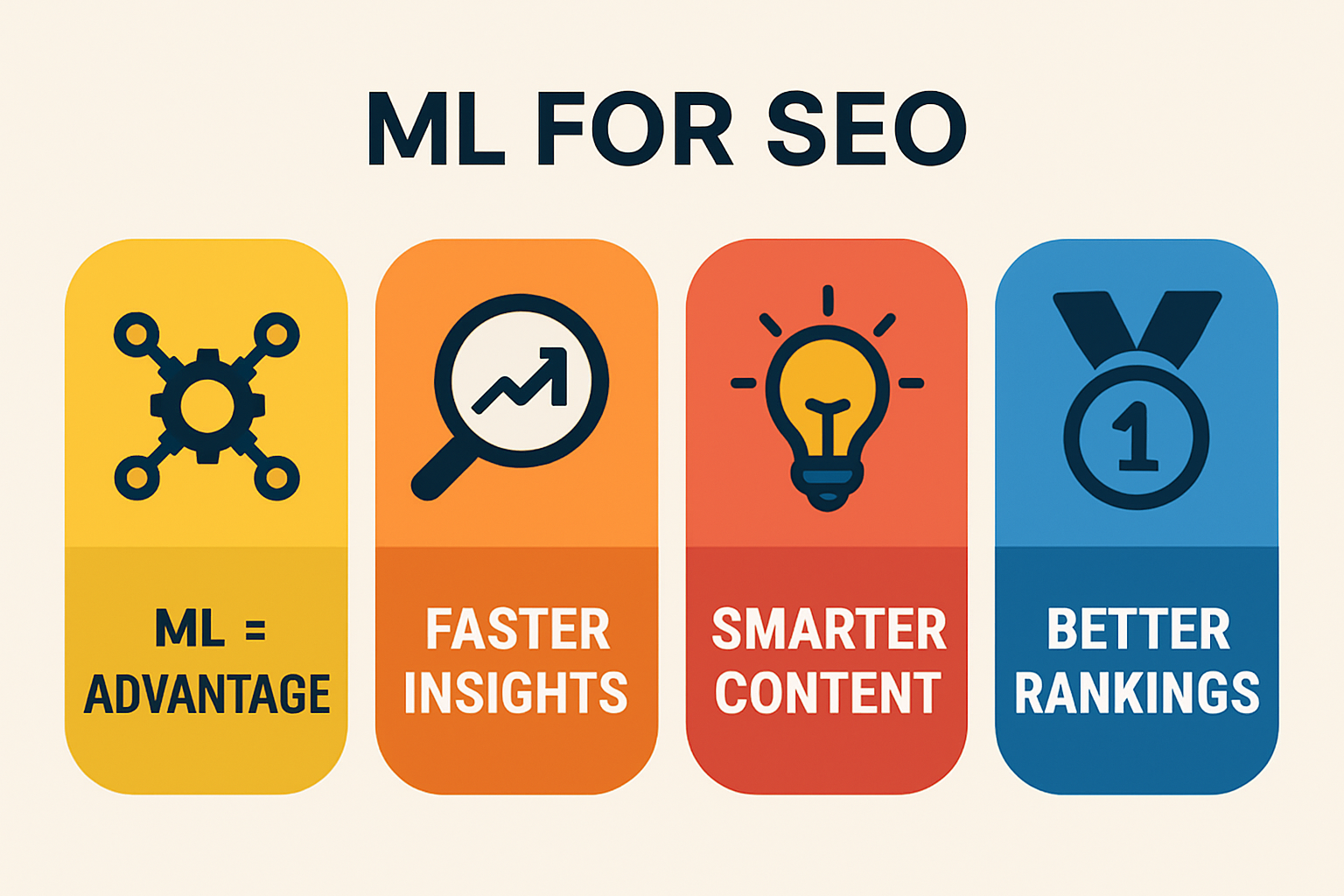
SEO has changed. Algorithms learn, SERPs adapt in real time, and AI search experiences reward the best match to user intent—not just keywords. If you want compounding visibility, you need machine learning for SEO.
In this guide, you’ll learn what ML in SEO really means, which data and models matter, and seven proven workflows you can run today. You’ll also see where DIY makes sense, when to buy, and how SEOsolved helps lean teams go from competitor insights to published articles in about 30 minutes.
Why Machine Learning for SEO Matters
Search engines increasingly rely on machine learning to interpret queries, evaluate content quality, and personalize results. Google introduced machine learning into its core algorithm with RankBrain to interpret queries it had never seen before, changing how relevance is determined across the long tail of search.
Modern ranking systems adjust based on engagement and satisfaction signals. When users consistently click a result and stay engaged, similar content can rise; quick bounces may slip. As a result, SEO today is about modeling intent, covering entities, and improving experience—not chasing exact-match keywords.
- Align with AI-driven ranking signals and SERP evolution
- Map content to intent, not just terms
- Measure entity coverage and topical authority (EEAT)
- Move faster with automation while keeping humans in the loop
For teams competing in AI-powered search and conversational answers, SEO using machine learning is no longer optional—it’s the operating system of modern SEO.
Further reading: how machine learning reshaped Google results, and ways AI is optimizing content and personalization.
What “Machine Learning in SEO” Really Means
Definition: Machine learning in SEO is the use of statistical models to detect patterns in search, content, links, and behavior data to make better decisions—what to create, how to optimize, and where to improve technical health.
- Classification (supervised learning): Sort things into labels. Example: assign keywords to intent categories (informational, commercial, transactional, navigational).
- Clustering (unsupervised learning): Group similar items without predefined labels. Example: keyword clustering into topics and subtopics.
- Regression (supervised): Predict a numeric value. Example: forecast organic sessions or CTR from position and snippet features.
- Similarity and embeddings: Measure semantic closeness. Example: recommend internal links or detect duplicate pages.
- Anomaly detection: Flag unusual behavior. Example: identify crawl spikes, 4xx/5xx surges, or Core Web Vitals regressions.
How ML Powers SEO: Data, Models, and Signals
The secret is pairing the right data with the right model—and a feedback loop that learns from outcomes.
Data You Need (and Where to Get It)
- Keyword lists: export from your tools, competitors’ ranking keywords, PPC terms.
- SERP snapshots: titles, snippets, People Also Ask, video/news images, features at scale via SERP APIs.
- Competitor URLs: crawl top 10–20 per topic; capture headings, entities, internal links.
- On-page content: HTML, headings, schema, FAQs, and word/entity coverage.
- Backlinks: referring domains, anchor text, trust signals.
- Analytics & Search Console: impressions, clicks, CTR, position, landing pages.
- Server logs: crawl frequency, status codes, robot hits, rendering anomalies.
Information retrieval signals like keyword frequency and inverse document frequency still matter for relevance at the text level, even as semantic models advance.
ML Techniques That Map to SEO Tasks
- Clustering → keyword/topic groups; pillar–cluster architecture.
- Classification → search intent labeling; URL type routing.
- Regression → traffic and ranking forecasts; seasonality impact.
- Semantic similarity → internal link suggestions; dedup and canonicalization.
- Anomaly detection → log file analysis; Core Web Vitals monitoring.
Engagement metrics like CTR and dwell time can serve as training signals for ranking models, making it vital to test titles, intros, and on-page experience.
7 Proven ML-Powered Workflows That Move Rankings
Below are practical, step-by-step workflows you can run with a lightweight Python stack, spreadsheets plus APIs, or a platform. Each is scoped to deliver measurable impact.
Workflow 1: Keyword Discovery via Topic Modeling and Clustering
- Compile keywords: export from GSC, PPC, and competitor ranking terms.
- Normalize and deduplicate: lowercase, strip brand terms, remove noise.
- Create features: start with TF–IDF for a baseline; upgrade to embeddings for semantics.
- Cluster: use k-means (TF–IDF) or HDBSCAN/UMAP (embeddings) to reveal topics and subtopics.
- Label clusters: name by the dominant phrase and intent (e.g., “best X tools”).
- Size the opportunity: sum volume per cluster; capture SERP features and difficulty.
Tip: Add competitor gap flags to identify clusters where rivals rank and you don’t. This becomes your topic roadmap.
Workflow 2: Search Intent Classification for Content Mapping
- Collect training examples: label a few hundred queries across informational, navigational, commercial, transactional.
- Train a simple classifier (logistic regression) or use rules as a baseline.
- Score all keywords and map to content types: guides, comparisons, product pages, FAQs.
- Close the loop: compare predicted intent with top 10 SERP layouts and adjust if mismatched.
This dramatically accelerates content routing. For additional approaches, see this overview of keyword and content classification with ML.
Workflow 3: Content Gap Analysis and Roadmap Prioritization
- For each cluster, compute a weighted score: opportunity = volume × intent value ÷ difficulty × authority fit.
- Estimate authority fit by comparing your topical coverage and referring domains to competitors.
- Flag quick wins: high volume, lower difficulty, strong internal link support.
- Package as a 4–8 week sprint backlog with owners and publish targets.
Use text relevance signals and SERP coverage to avoid thin or off-topic content. A structured score keeps debates objective.
Workflow 4: Entity-Driven Content Briefs and On-Page Optimization
- Extract entities and categories from top-ranking pages for a cluster.
- Create a brief: required entities, H2/H3 outline, questions to answer, and credible sources to cite.
- Draft content, then evaluate semantic coverage and readability; iterate to close gaps.
- Add schema (FAQ, HowTo, Product) when appropriate and ensure unique value beyond competitors.
Deepen your understanding of semantic coverage and topical authority with our guide on Semantic SEO. For practical on-page improvements, see the 2025 AI playbook for content optimization.
Workflow 5: Internal Linking Suggestions with Semantic Similarity
- Generate embeddings for each published URL and new draft.
- Compute nearest neighbors to find semantically related pages.
- Suggest anchors that naturally match the target’s primary topic and intent.
- Balance link flow: cap outbound links per page, emphasize pillar-to-cluster relationships.
Automated internal linking is one of the fastest ways to improve crawlability and topical authority. Dive deeper into building clusters with our guide to Automated Internal Linking.
Workflow 6: Technical SEO Anomaly Detection from Logs and CWV
- Collect daily timeseries for 4xx/5xx rates, crawl hits, and Core Web Vitals.
- Apply rolling z-score or isolation forest to flag anomalies.
- Drill into affected URLs, templates, and deploy diffs to locate root causes.
- Automate alerts to Slack/Email with links to evidence and owners.
Machine learning also helps identify spam or duplication patterns across URLs and content, reducing index bloat and preserving crawl budget.
Workflow 7: Predictive SEO—Traffic and Rankings Forecasts
- Aggregate keyword groups by topic and current average position.
- Build regression models to predict CTR from position and SERP features.
- Model traffic under realistic ranking lift scenarios (e.g., P5→P3).
- Translate forecasts into revenue proxies to prioritize roadmap items.
Forecasts help secure stakeholder buy-in and resource allocation. For context, companies train ranking models on engagement signals; these principles also guide SEO forecasting.
Build vs. Buy: Tools for SEO Using Machine Learning
Should you assemble a DIY stack or use an end-to-end platform? It depends on your team’s skills, timeline, and maintenance appetite.
DIY Stack Essentials (Affordable and Flexible)
- Python + notebooks (Jupyter/Colab) for quick experiments.
- Vector embeddings for similarity search and clustering.
- SERP and keyword APIs for data ingestion at scale.
- Dashboards to monitor leading indicators and anomalies.
Use this approach if you have technical bandwidth and want maximum control. For tool selection and content generation options, see our AI writing tools buyer’s guide.
When a Platform Makes Sense
- You need results in weeks, not quarters.
- Your team is lean and can’t maintain custom code.
- You want competitor insights, keyword discovery, and content generation in one flow.
- You need governance for briefs, sourcing, and publishing at scale.
Comparison (snippet-ready)
| Criteria | Build (DIY) | Buy (Platform) |
|---|---|---|
| Speed to Value | Weeks–months | Days–weeks |
| Flexibility | Maximum, but requires coding | High, within product constraints |
| Maintenance | Ongoing (APIs, models, dashboards) | Low (vendor-managed) |
| Total Cost | Lower upfront; higher ongoing | Predictable subscription |
| Team Requirements | Data + engineering | Marketer + editor |
Where SEOsolved Fits in Your ML SEO Stack
SEOsolved is an AI-powered platform that automates core ML SEO workflows: competitor analysis, keyword discovery, prioritized content roadmap, and generation of high-quality, SEO-optimized articles with credible sources—often in as little as 30 minutes. This helps you rank across Google, ChatGPT, and other search engines.
From Competitor Insights to Content Roadmap
Start by analyzing the domains currently winning your SERPs. SEOsolved aggregates competitors’ ranking keywords, identifies topic gaps, and scores opportunities by volume, difficulty, and intent value. In one workflow, you go from insights to a prioritized roadmap. To see the underlying approach, read our framework for AI competitor analysis.
Generate SEO-Optimized Articles with Credible Sources
From each roadmap item, SEOsolved creates entity-rich briefs and drafts aligned to search intent. It includes headings, questions, and citations so your content meets EEAT standards. For tactical on-page tips, revisit the content optimization playbook.
Fast Execution for Lean Teams
Lean teams can publish faster by consolidating data, modeling, and drafting in one place. If accelerating from research to publication is your constraint, a platform reduces handoffs and maintenance. Ready to move? Start ranking today.
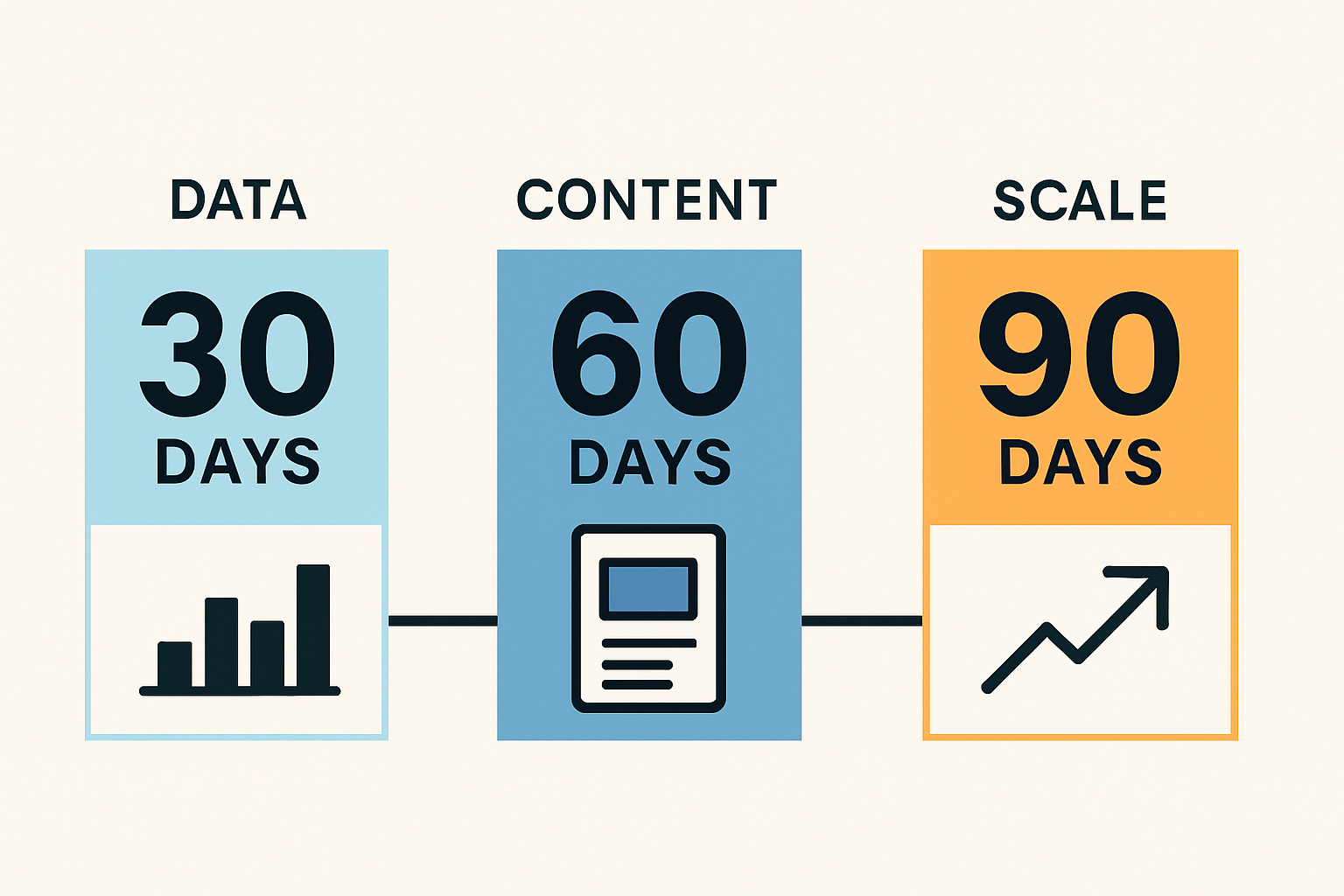
Step-by-Step Implementation Roadmap (30/60/90 Days)
Days 0–30: Data Foundation and Quick Wins
- Centralize data (keywords, SERPs, GSC, analytics, logs).
- Run first keyword clustering and intent mapping.
- Publish 2–4 optimized pages addressing clear intent gaps.
- Set up anomaly alerts for 4xx/5xx and Core Web Vitals.
Days 31–60: Content Roadmap and Internal Links
- Score and prioritize clusters for the next 6–8 weeks.
- Build an internal link map using embeddings and ship topic clusters.
- Add FAQ/HowTo schema to relevant pages.
- Begin title/meta A/B tests to lift CTR.
Days 61–90: Forecasts, Experiments, and Scale
- Launch predictive models for traffic and CTR by topic group.
- Systematize briefs and templates to scale content production.
- Review entity coverage and refresh underperformers.
- Package a QBR: what worked, what to test next.
Measuring Impact: KPIs and Experiment Design
Define success upfront and use controlled comparisons wherever possible (pre/post or holdout groups by URL cluster).
Leading Indicators
- Impressions and share of voice by cluster
- Entity coverage and semantic similarity to top results
- Internal link flow and crawl frequency
- Core Web Vitals stability
Lagging Indicators
- Rankings by topic and intent
- Organic sessions and CTR
- Conversions and assisted revenue
- Content ROI by cluster
Snippet checklist: 1) choose a cluster, 2) set baselines, 3) ship improvements, 4) measure leading → lagging, 5) iterate or scale.
Quality, Compliance, and Risk Mitigation
AI-assisted content must meet EEAT standards and search engine policies. Build safeguards into your editorial and technical workflow.
Human-in-the-Loop Editorial Standards
- Accuracy and originality review by a subject-matter editor.
- Verify claims against credible sources; cite where useful.
- Ensure voice and brand consistency across pages.
- Check intent match and entity coverage before publishing.
Technical Safeguards
- Run dedup and plagiarism scans; fix near-duplicates with canonicals.
- Monitor for unexpected template changes or rendering issues.
- Audit URL patterns for spammy or thin content that risks deindexing.
Mini-Case: Applying ML SEO at a B2B SaaS
Inputs and Constraints
- Baseline: 18k monthly organic sessions; flat growth.
- Constraints: lean team (1 marketer, 1 content contractor), limited engineering time.
- Personas: ops managers and product leads searching for workflow automation.
Workflows Chosen and Outputs
- Keyword clustering exposed 12 priority topic groups.
- Intent classification routed 4 clusters to comparison pages, 6 to guides, 2 to product pages.
- Entity-driven briefs produced 8 draft articles with sources.
- Internal link map connected new guides to existing docs and features pages.
- Forecast suggested a realistic +12–18% traffic lift over 90 days if top 30 keywords improved two positions.
Measurement Plan
- 30 days: impressions + coverage of entities; ship 4 pages.
- 60 days: cluster-level rankings, internal link flow; ship 6 more pages.
- 90 days: traffic and conversion deltas; refresh underperformers.
Get Started: Launch ML-Powered SEO with SEOsolved
Try SEOsolved: Analyze Competitors, Build Your Roadmap, and Publish
Automate the hard parts: analyze competitors, discover ranking keywords, build a tailored content roadmap, and generate SEO-optimized articles with credible sources—often in 30 minutes. Start ranking today.
Call to Action
Ready to operationalize machine learning and SEO in one workflow? Try SEOsolved now.
FAQ
What is machine learning for SEO?
It’s the application of models like classification, clustering, and regression to search, content, and behavior data to improve rankings and traffic.
Which ML techniques should I start with?
Begin with keyword clustering, intent classification, and anomaly detection; then add forecasting for traffic and CTR by topic.
Do I need to code to use ML for SEO?
No. A platform can automate workflows end to end. If you have bandwidth, a Python + API stack offers more customization.
How quickly can I see results?
Quick wins often appear within 30–60 days from clustering, intent mapping, and internal linking; larger lifts come as content scales.
How does SEOsolved help?
It analyzes competitors, discovers ranking keywords, builds a prioritized content roadmap, and generates credible, optimized articles fast.
Citations and Further Reading
- RankBrain and ML signals shaping SERPs
- AI is transforming SEO: optimization, trends, personalization
- Information retrieval, TF–IDF, and relevance scoring
- ML regression for SEO forecasting
- Industry ML examples and performance prefetching
- Quality signals and engagement as training data
- ML patterns for spam/duplicate detection
- Practical ML applications in daily SEO
- Keyword intent classification at scale