
Still playing 2019 SEO? In 2026, AI-driven search and zero-click SERPs demand a different game. This advanced SEO guide shows you how to compound authority, scale content safely, and win profitable visibility.
We’ll define what “advanced” means today, audit your foundations, map topical authority, engineer SERP features, and deploy AI-assisted workflows. You’ll also see how SEOsolved accelerates the hardest parts—research, roadmap, and writing—in under 30 minutes.
What Advanced SEO Means in 2026
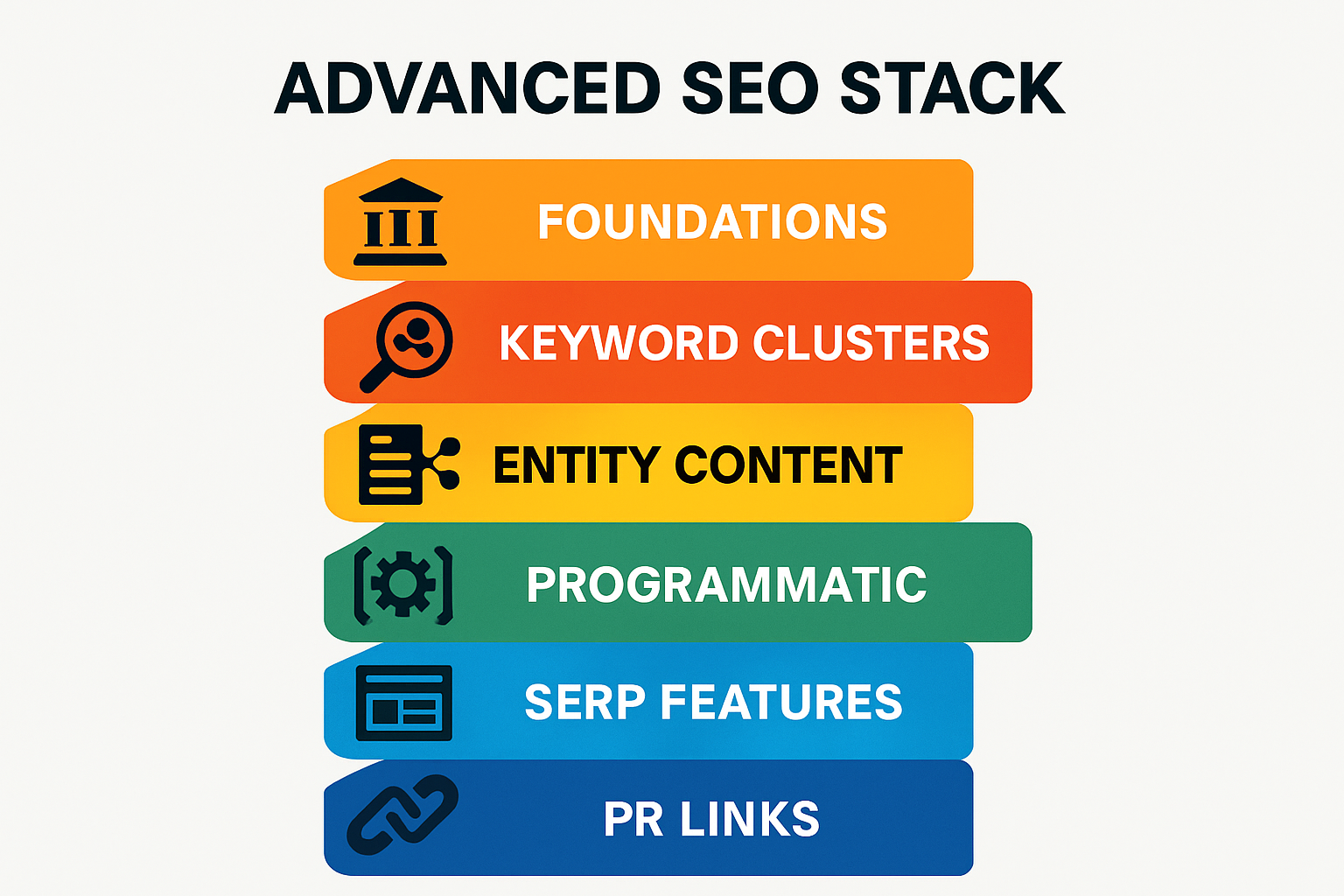
Definition: Advanced SEO in 2026 is the systematic use of entities, intent clustering, programmatic quality, and technical excellence to earn durable, multi-surface search visibility—not just blue links.
Search engines lean on AI to reward useful experiences and topical depth. Old tricks fade; discipline and data win. Industry analyses echo this shift, from semantic focus (semantic SEO and intent) to rigorous technical standards (crawlability, Core Web Vitals, structured data) and content format matching (SERP-led depth and type).
Where Advanced Begins vs. Basics
Basic SEO | Advanced SEO |
|---|---|
Keywords one-by-one | Intent clusters + topical maps |
Title/meta edits | Entity-first content and schema |
Manual posts | Programmatic quality at scale |
Fix issues as found | Log-driven prioritization and CWV at scale |
Link requests | Digital PR and data-led assets |
Types of SEO That Matter for Scale
Technical: Crawl efficiency, CWV (LCP/CLS/INP), structured data, and clean architecture. See modern expectations for technical SEO quality and AI-driven results here.
Content/Entity: Topic clusters, semantic coverage, and consistent on-page signals that reinforce entities. Learn more about Semantic SEO.
Off-page/PR: Linkable assets and safe anchor profiles tied to relevance and authority.
Programmatic: Templates, unique modules, canonical governance, and strict deduplication.
Foundation Check: Are You Ready to Go Advanced?
Scale exposes cracks. Before launching advanced plays, confirm your site’s crawlability, data access, and governance.
Baseline Audit and Readiness Checklist
Indexation: Confirm intended URLs are indexed; block low-value areas via robots/meta robots as needed.
Status codes: Eliminate 4xx/5xx, looped or long redirect chains.
Sitemaps: Provide XML sitemaps that match canonical intent; avoid legacy submission tactics.
Architecture: Keep content within three clicks and use short, descriptive URLs (3-click guidance).
Structured data: Add Organization, Article, FAQ, and HowTo where relevant to reinforce meaning (technical SEO factors).
Content quality: Deindex thin/duplicate content; consolidate near-duplicates.
Core Web Vitals: Baseline LCP/CLS/INP and set targets.
Data Stack and Access
GSC + GA4: Query coverage, impressions, clicks, and sitewide behavior.
Log files: Identify crawl waste, traps, and priority routes.
Positioning tools: Use a search engine positioning tool for rank/feature monitoring and opportunity spotting.
Research platforms: Use SEMrush/Ahrefs/Keyword Planner for gaps and intent depth (keyword gap analysis).
SOPs: Document naming, redirects, and publishing workflows to prevent drift.
Advanced Keyword Intelligence and Topic Authority
Move from keywords to coverage. Advanced SEO maps intent groups, aligns formats to SERPs, and builds hubs that earn links naturally. Content planning should match how searchers speak and what the SERP already rewards (format + depth).
Intent-Driven Keyword Clustering
Collect queries from gaps, GSC, and community vernacular.
Label intent (informational, commercial, transactional, navigational).
Group by task (e.g., “learn,” “compare,” “buy”).
Choose the winning format from SERP patterns: guide, checklist, calculator, tool (dominant format).
Create hubs (pillar + spokes) with clear internal links.
Define success by coverage, impressions, and assisted conversions—not rank alone.
Using Google Trends and Communities
Spot spikes early and learn real phrasing. Pair Trends with community threads (e.g., Reddit) to discover emerging “jobs to be done” and long-tail angles. Natural-language phrasing increasingly wins in voice/search contexts (optimize for spoken queries).
Google Search Operators for Deep Research
site:domain.comto see indexed scope and content gaps.intitle:"topic"orinurl:topicto audit competitor angle saturation.filetype:pdfto surface overlooked research/whitepapers.Use
-termandORto refine and compare intents.
Build a Topical Map and Roadmap
Convert clusters into a quarterly publish plan that sequences authority: start with definitional hubs, expand into how-tos, then comparisons and tools. Automate internal links to pass context across spokes—see Automated Internal Linking. For compounding outcomes, align with an Evergreen Content Strategy.
Entity SEO and Semantic Optimization
Entities reduce ambiguity. Mark up who you are, what each page covers, and how pages connect. This boosts relevance and retrieval in AI-driven search (semantic intent).
Schema and Knowledge Graph Fundamentals
Organization for brand identity and Knowledge Panel eligibility.
Article/BlogPosting for content clarity and rich results.
FAQ to capture additional SERP real estate.
HowTo for step-based tasks where eligible.
Ensure consistency across canonical URLs, redirects, and sitemaps to avoid mixed signals (canonical alignment).
On-Page Semantic Signals
Use descriptive titles and H1/H2s that clarify entity and task.
Integrate synonyms and related entities naturally within context.
Answer the core question within the first 100–150 words.
Match format and depth to dominant SERP expectations.
Leverage this content optimization AI playbook for repeatable quality.
Internal Linking for Entity Reinforcement
Design links from hubs to spokes (and back) using concise, contextual anchors. Cluster-aware links signal breadth and authority—avoid orphan pages, and audit link depth regularly.
Programmatic SEO Without Thin Content
Programmatic SEO can 10x surface area—but only if you protect uniqueness and intent separation. Use templates with unique modules, datasets, and expert inputs. Avoid boilerplate mass pages that dilute authority (advanced techniques).
When and Where to Use Programmatic Pages
Location/service matrices with localized proof points.
Product/SKU catalogs with specs, reviews, comparisons.
Calculators/tools with embedded logic and sharable outputs.
Data indices refreshed on a schedule for newsworthiness.
Templates, Deduplication, and Canonicals
Separate intents (learn vs. compare vs. buy) into different URLs.
Inject unique modules: quotes, stats, FAQs, local data, UGC.
Use canonical tags to consolidate similar URLs and standardize domains/paths (canonical best practices).
Measuring Impact and Pruning
Track coverage and impressions in GSC by template.
Monitor log files for crawl frequency and priority routes.
Deindex/prune underperformers after sufficient data windows to protect crawl budget.
SERP Feature Engineering and Zero-Click Strategy
Engineer content for the SERP you want: featured snippets, PAA, images, video, and sitelinks. Match the SERP’s dominant format and depth to improve eligibility (format dominance).
Featured Snippets and PAA Capture
Answer the core question in 40–60 concise words near the top.
Use ordered lists for steps and tables for comparisons.
Add FAQs targeting PAA expansions and long-tail variants.
Link out to credible sources to strengthen E-E-A-T.
For repeatable on-page execution, see our AI-driven optimization guide.
Video and Image Surfaces
Produce how-to videos matching query clusters; add key moments (timestamps).
Use descriptive filenames, alt text, and structured data where eligible.
Design simple, text-light graphics to explain processes.
Brand SERP, Knowledge Panels, and Sitelinks
Consolidate brand signals with Organization schema and consistent profiles (structured data benefits).
Ensure navigational pages are crawlable and represented in sitemaps.
Keep site architecture shallow and logical for sitelink eligibility.
Technical Leverage for Scale
Technical upgrades multiply ROI across the site. Prioritize crawl efficiency, performance, and modern discovery.
Crawl Budget and Log-File Insights
Audit logs to find crawl waste (parameters, filters, infinite spaces).
Prioritize valuable routes and reduce faceted traps.
Monitor coverage vs. indexation to guide deindexing and canonicals.
Core Web Vitals and Edge Enhancements
Optimize LCP via image compression, preloading hero assets, and server-side rendering.
Stabilize CLS with fixed dimension media and reserved space.
Improve INP by limiting long tasks and deferring non-critical JS.
Consider CDN edge caching and smart delivery patterns for speed at scale (performance focus).
Sitemaps vs. Legacy Submission
Modern discovery is sitemap-led, supported by clean internal linking—avoid outdated “SEO submission software” and prioritize accurate sitemaps, canonical signals, and robots directives (crawlability & indexation).
Advanced Link Earning and Digital PR
Earn coverage by publishing assets that journalists and communities naturally cite. Balance anchors to grow safely.
Linkable Assets That Journalists Want
Original surveys or indices refreshed annually.
Calculators and tools that solve a recurring pain.
Definitive guides that outmatch SERP depth and format.
Anchors, Relevance, and Risk Management
Favor branded and partial-match anchors within topical context.
Avoid aggressive exact-match patterns; maintain source diversity.
Reinforce link targets with on-page relevance and internal links.
Alltop and Topic Discovery
Use Alltop to spot niche publications and trending themes, then pitch data-led angles tied to your clusters. Pair with competitor gap analysis to prioritize high-authority targets (gap analysis).
Content Velocity, Refreshes, and Decay Recovery
Velocity compounds only if quality and governance keep pace. A disciplined cadence beats sporadic spikes (discipline drives results).
Plan Velocity Without Sacrificing Quality
Set weekly targets per cluster (e.g., 1 hub + 3 spokes) based on resources.
Gate publishing with briefs, checklists, and expert review.
Automate internal linking at publish to avoid orphaning.
Refresh Frameworks and Republishing
Find decaying posts via impressions down and position drift.
Update stats, examples, and add FAQs; re-align with current SERP format.
Improve on-page semantics and entities; expand with missing subsections.
For a repeatable process, pair semantic upgrades with this Semantic SEO guide.
Consolidation and Pruning
Merge overlapping posts into a stronger canonical.
Redirect legacy URLs; update internal links.
Prune non-performing content after evaluation windows.
AI-Assisted SEO Workflows That Scale Quality
AI accelerates research and drafting; humans provide judgment and expertise. In 2026, advanced stacks blend both to handle data volume and opportunity windows (AI SEO evolution).
Where AI Helps vs. Human Judgment
Great for AI: Keyword clustering, SERP pattern analysis, briefs, outline generation, internal link suggestions.
Human-essential: E-E-A-T, original insights, examples, nuanced positioning, and risk review.
Guardrails: Fact-checking, source citations, and style QA to maintain trust.
How SEOsolved Streamlines Advanced SEO
SEOsolved is an AI-powered platform that analyzes competitors, uncovers hundreds of ranking keywords, builds a tailored content roadmap, and generates high-quality, SEO-optimized articles with credible sources—in as little as 30 minutes. That means less wrangling of tools and more publishing momentum.
Problem: Slow research and fragmented tools. Solution: Centralized competitor and keyword analysis.
Problem: Hard-to-prioritize clusters. Solution: Automated topic maps and publish sequencing.
Problem: Inconsistent on-page quality. Solution: Generative briefs and drafts with sources.
Problem: Weak internal links. Solution: Cluster-aware link suggestions.
Stat Ranking Today and turn weeks of manual work into a 30-minute workflow.
Implementation Sprint with SEOsolved
Use this 7-day sprint to produce a roadmap and publish optimized articles that target clusters and SERP features:
Day 1: Run a domain and competitor scan; export gaps and intent clusters.
Day 2: Approve clusters; map hubs/spokes and internal link paths.
Day 3: Generate briefs; align formats with SERP leaders.
Day 4: Draft 3–5 spokes with schema-ready outlines and FAQs.
Day 5: Publish first hub; interlink spokes; add citations.
Day 6: Optimize for snippets/PAA; add tables and step lists.
Day 7: Submit sitemaps; QA logs; set refresh checkpoints.
Need tooling too? Explore our overview of modern stacks in SEO tools in 2025.
Measurement, Experimentation, and Governance
What gets measured scales. Build a dashboard of leading indicators and codify processes so improvements stick.
North-Star Metrics and Leading Indicators
Coverage: Indexed pages within target clusters.
Visibility: Impressions and average position by intent stage.
Engagement: CTR, scroll depth, repeat visits.
Revenue: Assisted conversions and pipeline influence.
Experiment Design and SEO Split Tests
Define one variable (e.g., title pattern, FAQ block) and a control.
Run at the template or cluster level for statistical power.
Measure over consistent windows; avoid seasonality bias.
Roll out winners with change logs and QA.
Governance, Documentation, and SEO Ops
Create SOPs and QA checklists for publishing, redirects, schema, and interlinking.
Maintain a change log for releases and experiments.
Review quarterly to align with algorithm and SERP shifts (quarterly planning).
90-Day Advanced SEO Action Plan
Month 1: Audit, Strategy, and Clustering
Complete technical audit and fix critical crawl/index issues.
Build topic map and prioritize 2–3 authority hubs.
Publish first hub with 3–5 spokes and clean internal links.
Month 2: Production, Internal Links, and SERP Features
Increase velocity: 2 hubs + 6–10 spokes aligned to SERP formats.
Automate internal links within clusters and to money pages.
Engineer snippets/PAA: add definitions, steps, and comparison tables.
Month 3: Programmatic Scale, PR, and Experiments
Launch 1–2 programmatic templates with unique modules.
Deploy a data-led asset for digital PR; pitch relevant press.
Start controlled tests on titles, FAQs, or layouts; roll out winners.
Want the fastest path from audit to action? Stat Ranking Today with SEOsolved and compress weeks into days.
FAQs: Advanced SEO Answers
What is SEO and how does it work at an advanced level?
Advanced SEO coordinates crawling, indexing, and ranking via entities, intent clusters, structured data, and internal links. It matches SERP formats, scales quality, and earns authority through digital PR.
Can I do SEO myself and still be advanced?
Yes—use AI for research, clustering, briefs, and drafts, then add expert review and governance. Platforms like SEOsolved condense heavy lifting so solo marketers ship faster with quality.
Quick SEO tips vs. advanced techniques: what moves the needle?
Tips create short bumps; advanced systems compound: topical maps, programmatic quality, SERP engineering, and rigorous technical standards.
How do I search-optimize my website without “submission software”?
Focus on clean sitemaps, canonicals, internal linking, and log-informed fixes. Legacy submission tools are outdated—invest in crawlability and structured data.
How fast can I see results from advanced SEO?
Timelines vary by competition, but teams often see early coverage and impression lifts within weeks as clusters publish, with durable gains over 3–6 months.
Advanced SEO in 2026 rewards disciplined systems, not hacks. Build entities, clusters, and quality at scale—and let AI handle the heavy lifting while your experts provide insight. Ready to accelerate? Stat Ranking Today with SEOsolved.