If your growth depends on organic visibility, 2026 is the year your AI SEO strategy becomes your competitive moat. This guide shows exactly how to plan, build, and scale SEO with AI—from research to GEO—so you can win across Google and AI chat experiences.
Inside, you’ll get a step-by-step framework, technical deep dives, predictive models, buyer’s guide criteria, and implementation templates. We’ll also show how SEOsolved automates the hardest parts so you can execute fast with fewer resources.
What Is AI SEO? Definitions and Core Concepts
AI SEO definition: AI SEO is the application of artificial intelligence—large language models (LLMs), embeddings, classification, clustering, and automation—to plan, create, optimize, and measure organic content at scale. It blends human editorial judgment with machine-driven research and production to improve visibility across traditional results and generative answers.
Put simply, AI and SEO converge to make search strategy faster, smarter, and more adaptive to dynamic SERPs. An AI-first approach enables you to discover opportunities faster, build authority with entity-aware content, and measure what matters beyond blue-link rankings.
AI vs. Traditional SEO: How the Playbook Has Changed
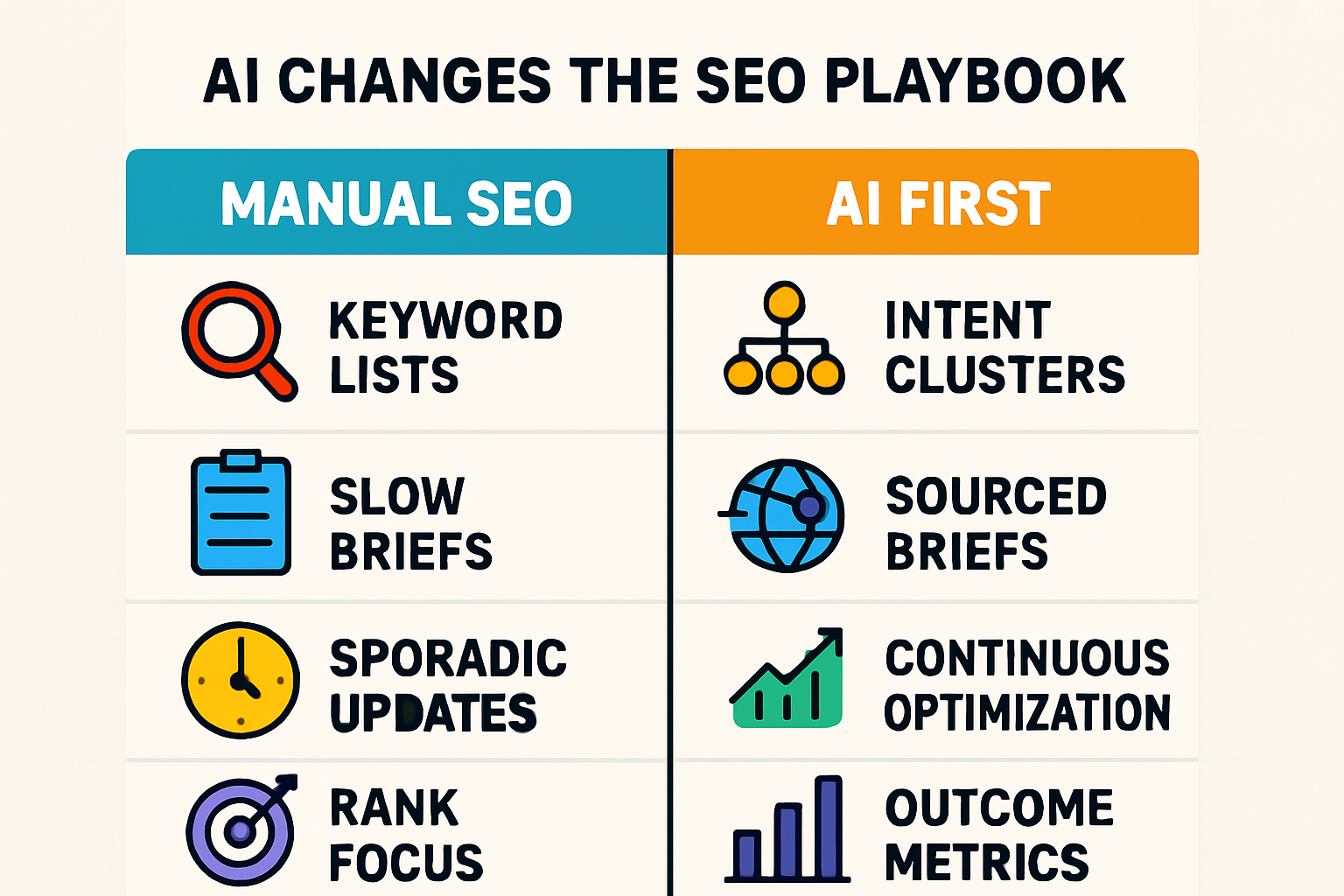
Legacy SEO relied on manual keyword lists, slow content briefs, and guesswork in optimization. Modern AI SEO compresses these steps and surfaces deeper insights:
- Research: Manual keyword-by-keyword → AI clustering that maps intent and entities across thousands of terms in minutes.
- Content: Ad hoc briefs → AI-assisted briefs with sourced claims, on-page SEO, internal links, and schema suggestions.
- Optimization: Periodic edits → Continuous, evidence-driven adjustments using AI to analyze headers, SERP shifts, and dwell time.
- Measurement: Rank-only view → Outcome-based dashboards tying queries to pipeline, revenue, and LTV.
Core AI Building Blocks Used in SEO
- LLMs: Draft and refine content, generate briefs, meta data, and variations at speed—always with human review for brand, accuracy, and compliance.
- Embeddings/Vectors: Power semantic search, topic clustering, and internal linking suggestions based on meaning rather than exact-match keywords.
- Classification: Auto-tag queries by intent (informational, commercial, transactional) and stage of funnel.
- Clustering: Group related topics to design hub-and-spoke architectures that build topical authority.
When you combine these components, you can plan a content universe, not just a list of posts—a crucial shift for 2026.
Why AI Matters Now: Trends Shaping 2025–2026
Search is evolving into answer engines. Generative results, zero-click experiences, and multimodal inputs are redefining how people discover and decide. Organizations leveraging AI report faster adaptation and personalization to shifting algorithms and user behavior, accelerating time-to-value for SEO programs.
Generative Search and AI Overviews
AI-generated answers now intercept a growing share of queries. Visibility means earning citations inside AI Overviews and chat interfaces, not just page-one links. You need content that’s structured, source-backed, entity-rich, and snippet-ready to be pulled into these summaries.
Entity-First Indexing and Knowledge Graphs
Search engines increasingly index by entities—people, places, products, and concepts—and the relationships between them. Structured data, consistent naming, and a clear hub-and-spoke architecture help models associate your brand with target topics. This is foundational to any ai seo strategy aiming to improve authority and recall in generative answers.
Building an AI SEO Strategy: A Step-by-Step Framework
Use this practical sequence to connect strategy to outcomes and scale using AI for SEO.
1) Define Business Goals, Audiences, and Constraints
Anchor decisions to revenue and pipeline, not vanity metrics. Clarify ICPs, JTBDs, regions, compliance, and tone rules. Identify mission-critical topics where you must establish topical authority in the next two quarters.
2) Build a Clean Data Foundation
Audit analytics, Google Search Console, CRM, and content repositories. Normalize naming conventions, taxonomies, and UTM rules. Ensure permissions, data freshness, and entity tags are reliable—AI is only as good as the data you feed it.
3) Research at Scale with AI
Cluster queries, map intent, and extract competitor gaps at speed. Build a two-layer plan with evergreen core terms and seasonal spikes; analyze volume, trend, and difficulty; and flag long-tail sub-questions that feed answer engines.
4) Content Roadmapping and Prioritization
Translate insights into a 90-day roadmap balancing head, mid, and long-tail demand. Prioritize by business impact, difficulty, and likelihood of earning AI Overview citations. Group content into clusters with clear hubs and spokes.
5) Create and Optimize Content with AI
Adopt a human-in-the-loop workflow: AI drafts from strong briefs, editors inject expertise and stories, then AI assists with on-page optimization, internal links, and schema. Publish quickly and iterate based on real user signals.
6) Technical Enhancements and Structured Data
Harden site speed, mobile UX, rendering, and structured data. Use product, article, FAQ, and how-to schema where appropriate. Keep filenames descriptive and consistent, attach alt text, and ensure content is accessible.
7) Measurement, Testing, and Iteration
Instrument KPIs that ladder to outcomes. Set an experimentation cadence. Monitor not just rankings but CTR, dwell time, scroll depth, and post-click behavior; refine titles, descriptions, and headers based on evidence.
Snippet: 7-step AI SEO framework
- Define outcomes and ICPs.
- Clean your data layer.
- Cluster and map intent at scale.
- Prioritize a quarterly roadmap.
- Produce human-edited, AI-assisted content.
- Upgrade technical performance and schema.
- Measure, test, and iterate continuously.
The Technical Side of AI in SEO
Understanding how modern models work helps you align strategy to retrieval and ranking behavior.
Embeddings, Vectors, and Semantic Search
Embeddings turn text into vectors so models can compare meaning. For SEO, this powers semantic clustering and smart internal linking. Think “concept coverage” rather than exact-match repetition. Build hubs that exhaust core entities and sub-topics to improve topical authority.
LLMs, Prompting, and RAG for Content Quality
Use retrieval-augmented generation (RAG) to ground LLM outputs in your source-of-truth pages, reducing hallucinations and improving factuality. Maintain a prompt library with tone, audience, compliance guardrails, and citation requirements.
Entity Extraction, Topic Clustering, and Internal Linking
AI can extract entities from your corpus, group them by theme, and suggest hub-and-spoke structures. This supports navigable site architecture and reinforces your knowledge graph footprint with consistent naming, headings, and schema.
Crawlability, Rendering, and Log Analysis with AI
Apply AI to server logs to identify crawl waste, unrendered content, and duplication. Prioritize fixes that unblock discovery and indexation and route crawl budget to your highest-value clusters.
Predictive SEO and AI Forecasting
Forecast demand and returns so your roadmap anticipates market shifts rather than reacting to them.
Demand Forecasts and Seasonality Models
Model expected traffic swings and content needs with two layers: evergreen demand and seasonal spikes. Use trends and difficulty to plan publishing cadence and refresh windows.
Scenario Planning and Risk Management
Simulate algorithm and SERP changes: What if AI Overviews expand? What if a new feature compresses organic clicks? Prepare alternate content and schema strategies for each scenario.
Estimating Share of Search and SERP Real Estate
Quantify the impact of moving from position 6 → 3, earning a People Also Ask, or appearing in an AI Overview. Model share of voice across classic results and generative surfaces to guide investment.
AI Generative Engine Optimization (GEO): Win 2026 Rankings
Generative Engine Optimization focuses on being cited and summarized by AI systems. For a deep dive, see our guide to AI Generative Engine Optimization (GEO) for 2026.
What GEO Is and How It Differs from Classic SEO
- Objective: Earn trustworthy citations in AI answers vs. only ranking a page.
- Signals: Entities, freshness, structured claims, and clear summaries.
- Formats: FAQs, checklists, mini-answers, data-backed snippets, and schema-enriched sections.
Structuring Content for AI Overviews and Chat Answers
- Open with a bold one-sentence definition or takeaway.
- Use bullet lists and numbered steps for scannability.
- Embed FAQs and concise summaries with citations.
- Enrich with entities, schema, and internal links to relevant hubs.
Refreshing, Citations, and E-E-A-T Signals
Keep pages updated, cite authoritative sources, and surface author credentials. Encourage real user reviews and incorporate them into content to strengthen trust signals over time.
Optimizing Your AI-Generated Content for Performance
The aim is speed without sacrificing accuracy, originality, or UX.
Prompt and Brief Frameworks that Drive Quality
Standardize briefs: audience, intent, sources, key entities, outline, internal links, and schema targets. Maintain a prompt library to produce consistent, on-brand drafts your editors can polish rapidly.
Factuality, Citations, and Source Integration
Ground claims with reputable sources. Use RAG workflows to cite your own pages and trusted external references. Avoid generic statements; prefer verifiable, current data and examples.
On-Page Optimization and Internal Linking
Optimize titles, meta descriptions, headers, and anchors to match intent. Use contextual internal links to hubs to lift relevance and crawl efficiency. Add FAQ and HowTo schema where it clarifies answers.
Brand Voice, Accessibility, and UX Considerations
Protect brand tone and inclusivity at scale. Keep paragraphs short, maintain clear headings, and ensure mobile readability. Alt text and semantic HTML improve accessibility and help models understand your content.
SEO Automation Software: ROI-Rich Benefits for Content
Automation multiplies throughput where judgment is repeatable and rules-based. For a full breakdown, see our take on SEO automation software ROI.
Time Savings and Throughput Gains
- Keyword clustering and gap analysis at scale.
- Brief generation, internal linking suggestions, and schema drafts.
- On-page checks: titles, descriptions, and header alignment to intent.
Cost Efficiency and Opportunity Cost
Automation reduces time-to-publish so you capture seasonal spikes and emerging topics quickly. It also lets scarce experts focus on strategy, editing, and distribution.
Risk Controls and Governance
Use guardrails: prompt standards, citation requirements, fact-check workflows, tone/style QA, and compliance checks. Track revisions and approvals to protect brand integrity at scale.
Choosing the Right AI SEO Platform: A 2026 Buyer’s Guide
Your platform should align with strategy, data, and editorial workflows. Explore our deeper AI SEO platform buyer’s guide for detailed criteria.
Capabilities Checklist
- Competitor analysis and gap discovery.
- Large-scale keyword clustering and intent mapping.
- Tailored content roadmap building.
- High-quality article generation with credible sources.
- Schema, internal linking, and on-page optimization assistance.
- Tracking inclusion in AI Overviews and generative answers.
Integration, Data, and Workflow Fit
Look for connectors to your analytics, GSC, CMS, and DAM. Outputs should slot into existing editorial and design processes with minimal friction and clear governance.
Security, Support, and Total Cost
Assess data handling, PII protections, SOC/ISO attestations, onboarding, and training. Weigh subscription cost against the velocity and quality lift you can realistically achieve.
International SEO Services: AI Playbooks to Win Globally
Expanding internationally compounds complexity—AI helps you prioritize markets, localize intent, and scale governance. See our guide to international SEO services and AI playbooks.
Market Prioritization Using AI Signals
Use demand, competition, and unit economics to pick target countries. Model projected ROI by cluster, factoring translation costs and regulatory hurdles.
Localization vs. Translation
Go beyond direct translation. Adapt to local SERP features, compliance, and idioms. Local experts should validate tone, claims, and examples.
Hreflang, Entities, and Regional Knowledge Graphs
Implement hreflang and ensure consistent entity references per region. Align structured data to local standards where relevant.
Ethical Considerations and Best Practices for AI SEO
Responsible AI builds user trust and reduces risk.
Transparency and Disclosure
Disclose AI assistance where material. Clarify how human editors review and approve content, especially for YMYL topics.
Bias, Hallucinations, and Fact-Checking
Maintain a fact-check checklist. Require citations for sensitive claims. Use diverse sources to detect bias and avoid overfitting to a single viewpoint.
Copyright and Data Privacy
Respect licensing, handle PII carefully, and restrict training or storage of sensitive client data. Keep audit trails of prompts, drafts, and approvals.
KPIs, Dashboards, and Measurement
In the AI era, measure visibility across classic SERPs and generative experiences—and tie it to business outcomes.
From Rankings to Outcomes
- Pipeline and revenue influenced by organic.
- Lead quality and LTV by cluster.
- Brand search volume and share of search.
Tracking AI Overview and Generative Mentions
Monitor inclusion rates, citation share, and position in AI Overviews or chat answers for your core entities and pages.
Experimentation Frameworks
Run A/B and multi-armed bandit tests on titles, intros, and FAQ sections. Iterate based on CTR, dwell time, and post-click conversions.
AI SEO Playbooks and Templates
Use these reusable assets to accelerate execution.
AI Content Brief Template
Include: audience and intent, target entities, primary/secondary keywords, outline, sources to cite, internal links, schema, FAQs, and compliance notes.
Prompt Library for Research and Drafting
Standardize prompts for keyword clustering, outline creation, draft generation, and on-page SEO recommendations. Keep variants for tone and region.
Technical Audit Checklist (AI-Assisted)
- Core Web Vitals, mobile UX, and rendering checks.
- Internal link integrity, orphan pages, and crawl budget issues.
- Schema coverage and duplication cleanup.
Example Workflows: From Idea to Indexed
Three practical, end-to-end examples you can adapt to your model.
B2B SaaS: Problem-Solution Clusters
- Cluster around jobs-to-be-done and pain points.
- Create pillars for core problems; build spokes for sub-questions and integrations.
- Embed ROI examples and implementation steps to support mid-funnel intent.
Ecommerce: Category, PLP, and PDP Enhancements
- Improve taxonomy with AI-driven entity grouping and synonyms.
- Generate concise buying guides and comparison snippets.
- Add FAQ and product schema to support generative answers.
Local Services: Geo-Pages and Entity Reinforcement
- Scale unique location pages with localized intents and citations.
- Maintain NAP consistency and structured data.
- Collect reviews and integrate them on-page to reinforce trust.
How SEOsolved Operationalizes Your AI SEO Strategy
SEOsolved is an AI-powered platform that automates SEO content strategy and blog generation so you can execute with speed and confidence. It analyzes competitors, discovers hundreds of ranking keywords, builds a tailored content roadmap, and generates high-quality, SEO-optimized articles with credible sources in as little as 30 minutes—positioning your content to perform on Google, ChatGPT, and beyond.
Competitor Analysis and Gap Discovery
Use SEOsolved to mine competitor coverage, entity footprints, and content freshness. Pinpoint topics you should own and where you can outrank with structured, source-backed answers. For a framework, see our AI competitor analysis guide.
Keyword Discovery at Scale
SEOsolved clusters thousands of queries into coherent topics, mapping search intent and long-tail sub-questions to accelerate planning for hubs and spokes.
Tailored Content Roadmap
Get a prioritized, data-driven roadmap that balances head terms, mid-tail, and long-tail content across the funnel—aligned to business goals, not vanity KPIs.
High-Quality Article Generation with Sources
Generate on-brand drafts with citations, schema suggestions, and internal link targets. Editors simply review, enrich with expertise, and publish.
Rank on Google, ChatGPT, and Beyond
SEOsolved aligns content to GEO best practices—clear summaries, FAQs, structured data, and entity-rich coverage—so your pages are more likely to be cited in AI answers and rank in traditional SERPs.
Call to Action
Stat Ranking Today — automate your ai seo strategy and publish source-backed content in minutes.
Implementation Timeline: 30-60-90 Day Plan
Here’s a realistic rollout plan that balances quick wins with durable platform building.
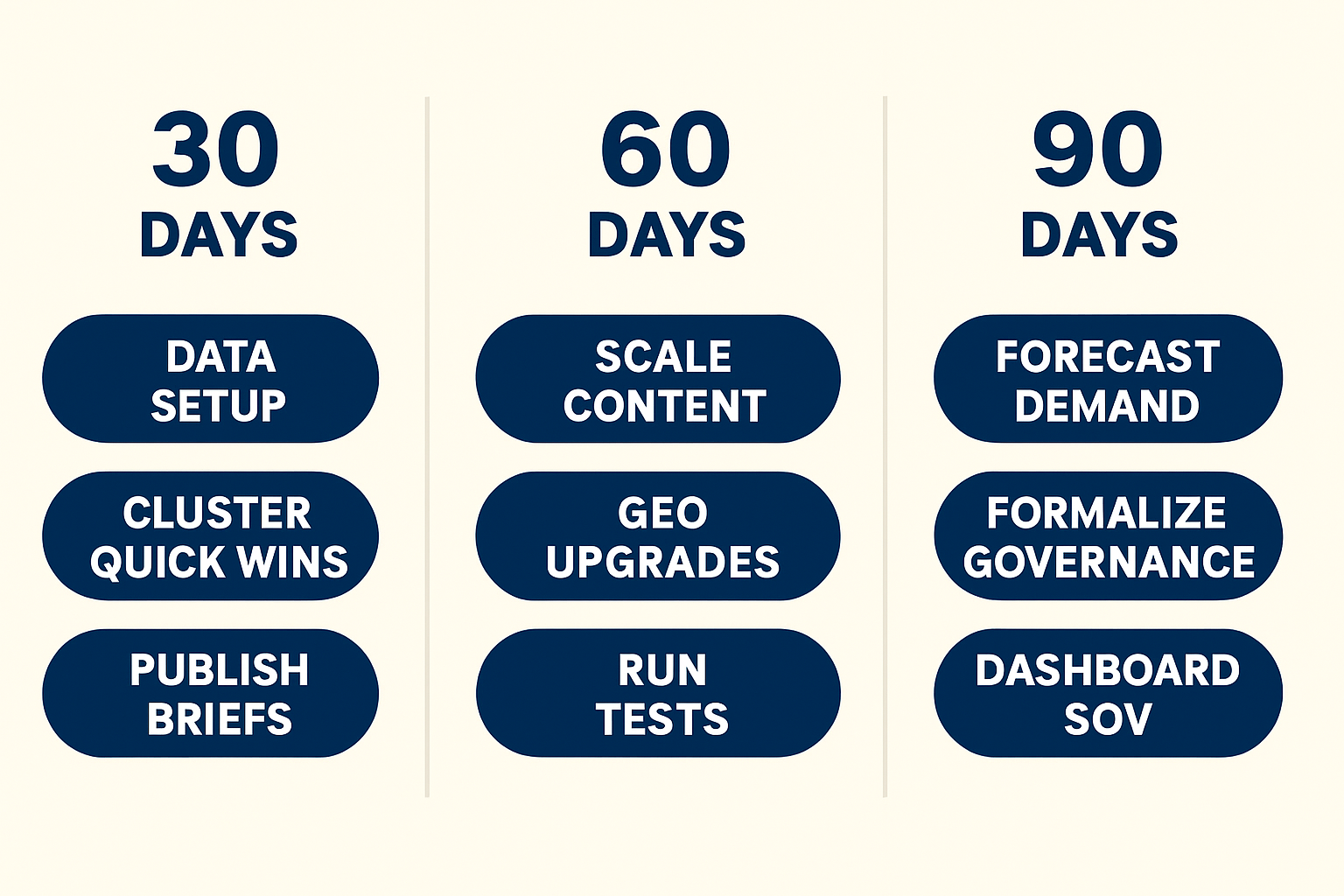
Days 1–30: Foundation and Quick Wins
- Stand up data connections (GSC, analytics, CRM) and standardize naming.
- Run AI clustering to identify 3–5 priority clusters and quick-win long tails.
- Publish 4–8 briefs and initial posts with FAQs, schema, and internal links.
- Fix high-impact technical issues affecting Core Web Vitals and crawlability.
Days 31–60: Production and Optimization
- Scale content production with human-in-the-loop QA and source citations.
- Enhance hub pages, add spokes, and expand FAQs for GEO inclusion.
- Begin experimentation: titles, intros, and schema variants.
Days 61–90: Scale, Forecast, and Govern
- Forecast demand and seasonality; lock a two-quarter roadmap.
- Formalize governance: prompts, review checklists, and approval flows.
- Instrument dashboards for share of search and generative citations.
FAQ: AI and SEO
What is AI SEO and why does it matter?
AI SEO uses models like LLMs and embeddings to research, create, and optimize content faster and more accurately. It matters because generative answers and entity-first indexing reward structured, source-backed content built at scale.
How to use AI for SEO without hurting quality?
Adopt human-in-the-loop workflows: strong briefs, RAG for factual grounding, editor reviews, compliance checks, and evidence-based optimization. Automate repeatable tasks and keep strategy and editing human-led.
Will AI-generated content be penalized?
Search engines reward value, originality, and intent alignment—not authorship method. Ensure accuracy, add unique insights, cite sources, and provide a great user experience.
Which metrics should I track first?
Start with CTR, dwell time, scroll depth, conversions, and inclusion in generative answers. Tie clusters to pipeline and revenue to prioritize work that drives outcomes.
Practical Tips, References, and Checklists
To operationalize quickly, adopt these actionable practices from industry sources:
- Target Core Web Vitals thresholds—LCP under 2.5s, CLS under 0.1, and a fast interaction metric—and keep mobile readability high.
- Run a weekly AI-assisted content audit, map 2–3 clear keyword targets per page, and maintain a revisions window to capture new questions.
- Build a scalable content map: consistent filenames, descriptive headers, and intent-matched sections for each page.
- Set a monthly measurement checklist: monitor CTR, dwell time, ranking shifts, and add a quick revenue/lead metric per cluster.
- Adopt a two-layer keyword plan: evergreen core topics plus seasonal spikes, and use tools for volume, trend, and difficulty.
- Audit every page’s title tags, meta descriptions, and structured data with AI assistance; generate multiple variants and refine with human edits.
- Make evidence-driven adjustments beyond clicks by analyzing post-click behavior and schema effectiveness.
Want a shortcut to all of the above? Stat Ranking Today with SEOsolved and operationalize your AI SEO strategy in hours, not months.
Sources and Industry Signals Worth Watching
Across surveys of SEO teams, distinct approaches are emerging—one segment of AI-heavy adopters already leans on automation for scale. Meanwhile, answer engine optimization (AEO) emphasizes mini-answers and schema to help AI pick your content. Long-tail clusters and sub-questions continue to be reliable entry points for GEO.