
Chasing rankings without seeing the keywords your competitors already win is like running a race blindfolded. The right competitor keyword research tool reveals the terms, intent, and gaps you can exploit—fast.
In this guide, you’ll learn what these tools do, how to choose between free and paid solutions, the best options in each tier, a free-only workflow you can run today, and when automation tools like SEOsolved accelerate your entire pipeline from research to publish.
What Is a Competitor Keyword Research Tool (and Why It Matters in 2026)?
A competitor keyword research tool shows the search queries other sites rank for, how they rank, and where you can overtake them. It differs from a general keyword tool by starting from competitor domains or URLs—not just seed terms—so you uncover real SERP winners, not guesses.
Why it matters: It reveals proven demand, validates search intent, and quantifies gaps you can fill for faster wins.
What’s new in 2026: More SERP features (e.g., AI overviews), intent shifts by niche, and higher stakes for content velocity mean better tools and tighter workflows pay back quickly.
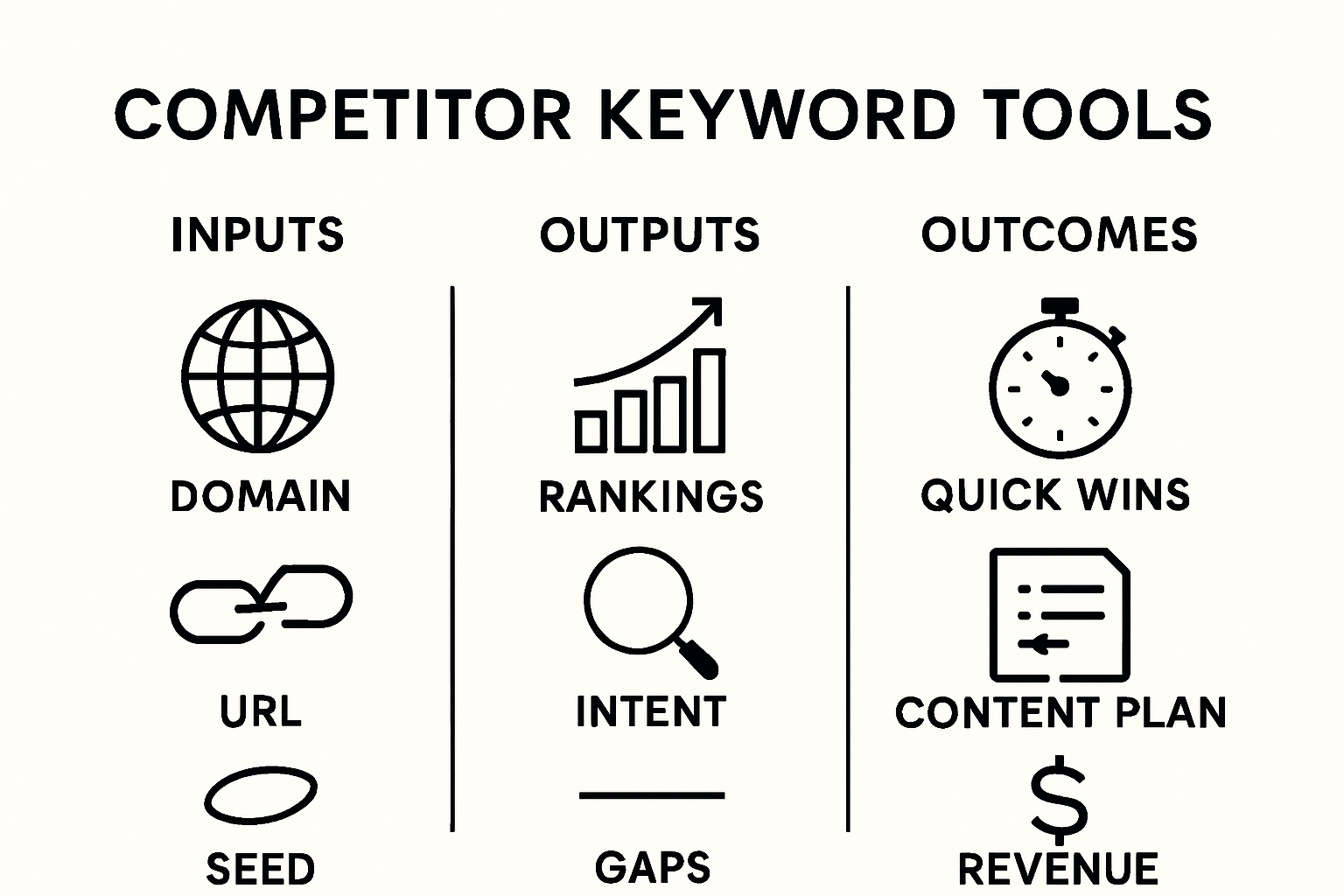
Free tools can validate ideas and surface obvious gaps. Paid platforms add depth: fresher data, richer SERP features, bigger exports, and faster analysis—critical when your pipeline depends on consistent content production.
How to Choose: Evaluation Criteria for Free and Paid Options
Use this framework to shortlist the right competitor keyword tool for your goals and budget:
Data freshness: How quickly are rankings and volumes updated? Weekly vs. monthly can change priorities.
Coverage and competitive index: Size of the keyword index, markets, and ability to measure competition accurately.
SERP features + intent: Does it show featured snippets, People Also Ask, shopping, AI summaries, and intent labels?
Difficulty and value proxies: Keyword difficulty, CPC, CTR estimates, and traffic potential.
Export limits: Daily credits, rows per export, and historical data windows.
Integrations: Sheets, BI tools, CMS, and task managers to move from insight to execution.
Budget and role fit: Solo vs. team seats, and whether rank tracking and auditing are included.
Best Free Competitor Keyword Research Tools
These free or freemium utilities are reliable for directional competitor insights. Use them together to offset individual limits.
Google Keyword Planner (Free): Mining Competitor Seed Terms
Use Google Ads’ Keyword Planner even without active ad spend. In “Discover new keywords,” paste a competitor URL or domain. Filter by location and language, then:
Sort by Top of page bid to infer commercial value.
Filter for modifiers like “best,” “vs,” or product terms to find buyer-intent queries.
Export ideas and cluster by theme for content planning.
Ahrefs Free Tools: Keyword Generator + SERP Checker
With Ahrefs’ free tools, validate difficulty and inspect the SERP. Drop in a keyword to see related terms and a snapshot of top pages to confirm intent and link competition.
Semrush (Free Tier): Domain Overview and Keyword Gaps
Use limited daily credits to pull a competitor’s top keywords and run basic Keyword Gap against your site. Export what you can, then cross-validate with other tools.
Ubersuggest (Free Tier): Quick Wins by SD and Volume
Scan a competitor domain and sort by low SEO Difficulty with reasonable volume. Add terms with transactional modifiers to your quick-win list.
Moz Keyword Explorer (Free Tier): SERP Analysis for Intent
Paste a target keyword and review SERP features, organic CTR, and intent. Use Priority scoring to stack-rank topics for near-term production.
Similarweb (Free): Top Keywords and Referrals Snapshot
Grab a directional view of top keywords and referral sources for competitors. Treat this as market context that enriches your primary analysis.
Note: Many free tiers cap daily queries and exports; expect to combine outputs across tools and sessions for a complete picture.
Step-by-Step: Free Competitor Keyword Analysis Workflow
Run this free-only workflow to extract, validate, and prioritize competitor keywords without paying for a subscription.
1) Identify True SERP Competitors (Not Just Business Rivals)
Search your core topics and log the domains ranking in the top 10–20 across multiple queries.
Prioritize sites with similar content type, audience, and intent (not just big publishers).
Document 5–10 domains and 15–30 standout URLs for deeper analysis.
Deep dive: See our Competitor SEO Analysis: The 2026 Ultimate Playbook for a repeatable SERP competitor discovery process.
2) Extract Competitor Keywords and Phrases
Use Semrush free tier (Domain Overview) to collect top keywords a rival ranks for.
Use Ahrefs free tools to validate related terms and check SERP volatility.
In Google Keyword Planner, paste competitor URLs to expand the list.
Aggregate in a sheet; dedupe and tag by theme.
3) Classify by Intent and Funnel Stage
Informational: how-to, what-is, definitions. Fit: guides and hub pages.
Commercial: best, vs, alternatives. Fit: comparison pages, listicles.
Transactional: pricing, near me, buy. Fit: product and signup pages.
For a structured approach, read Competitor Keyword Research: Tools, Tactics, Results.
4) Score Difficulty vs. Value
Difficulty: Use KD from Ahrefs or Ubersuggest as a directional signal; note domain authority gaps.
Value: Use CPC and SERP clickability (organic CTR) as proxies; prefer terms with clear buyer intent.
Fit: Favor topics aligned to your existing topical authority and product.
5) Build a Content Gap List and Quick-Win Plan
Run a simple gap check: terms competitors rank for that you don’t.
Create two queues: Quick Wins (low KD, high intent) and Strategic Plays (pillar or hub topics).
Turn each into briefs with target intent, SERP features to win, and internal link targets.
Want a template? Try our guide on Keyword Gap Analysis: Steal Search Share in 30 Days.
Time-saver: If manual stitching feels slow, automation can compress this entire workflow from days to minutes.
Best Paid Competitor Keyword Research Tools (When You Need Depth)
Paid platforms offer deeper data, faster workflows, and bigger exports—ideal once you’re producing content at scale.
Semrush: Keyword Gap, Topic Research, and SERP Features
Multi-domain gap analysis to reveal you vs. rivals opportunities.
Robust SERP feature tracking and topic ideation to plan clusters.
Useful when you need breadth across markets and frequent refreshes.
Ahrefs: Site Explorer and Content Gap at Scale
Backlink-informed keyword discovery and rich SERP data.
Content Gap and Top Pages quickly expose replicable plays.
Great for assessing competitiveness and link needs up front.
SpyFu: PPC + SEO Competitor Overlap
Blend paid and organic insights to find commercially proven queries.
Spot high-value terms where rivals spend and rank.
SE Ranking: Affordable All-in-One with Rank Tracking
Solid for SMBs that need monitoring plus research without enterprise costs.
Serpstat: Modular Pricing and Competitive Research
Scalable modules for teams growing research depth over time.
Similarweb: Market-Level Keyword Intelligence
Validate total addressable market and category-level keyword trends.
SEOsolved: From Competitor Keywords to Complete Content Strategy
Automates competitor analysis to discover hundreds of ranking keywords.
Builds a tailored content roadmap aligned with your goals.
Generates SEO-optimized, source-backed articles—ready to publish.
Stat Ranking Today with an end-to-end workflow that compresses research, planning, and drafting into one platform.
SEOsolved Deep Dive: Automate Research to Publish in 30 Minutes
SEOsolved is an AI-powered platform for teams that need speed and accuracy without stitching together five different tools.
Analyze Competitors and Discover Hundreds of Ranking Keywords
Drop in your domain and 3–5 competitors; get a ranked list of opportunities mapped to intent.
Surface head terms and long-tail variants competitors actually rank for.
Build a Tailored Content Roadmap from Your Gap List
Turn gaps into a prioritized calendar by difficulty, value, and funnel stage.
Auto-generate internal linking suggestions to existing assets.
Related read: AI Competitor Analysis: Automate Insights in 7 Steps.
Generate SEO-Optimized Articles with Credible Sources
Create outlines and full drafts aligned to target keywords and intent.
Integrate credible citations and FAQs to maximize SERP coverage.
Compare platforms with our 2026 Buyer’s Guide.
When to Choose SEOsolved Over Piecemeal Tools
You need repeatable briefs and publish-ready drafts on a weekly cadence.
You want one place to move from keyword to outline to article without copy-paste.
Your team must show pipeline impact, not just rankings.
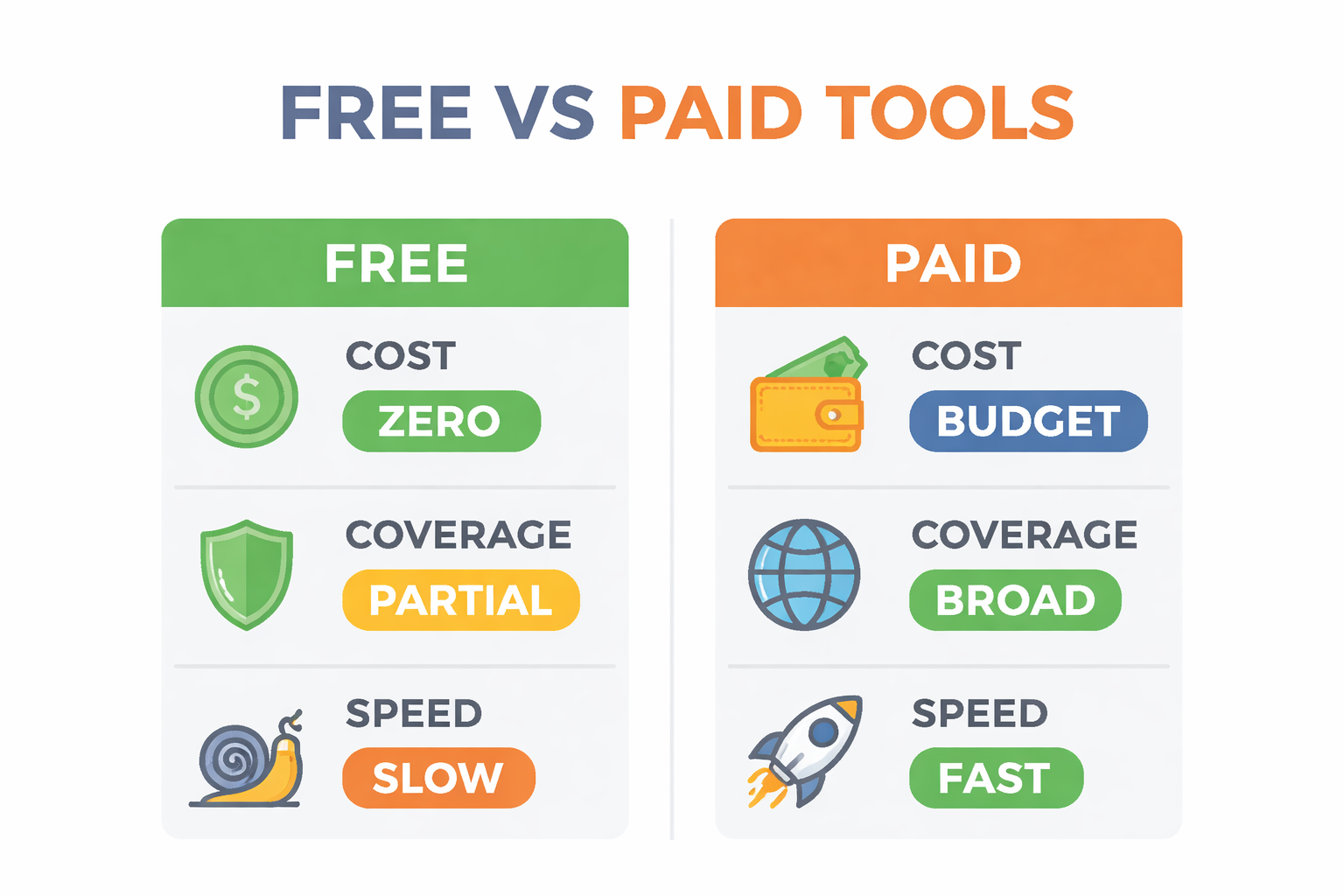
Free vs. Paid: Cost, Coverage, and Speed Trade-Offs
Here’s a quick comparison to decide if—and when—to upgrade.
Factor | Free Stack | Paid Platform |
|---|---|---|
Cost | $0, but time-intensive | $$–$$$ with faster throughput |
Coverage | Partial datasets, limited exports | Broader indexes, historical data |
Freshness | Slower refresh cycles | More frequent updates |
SERP Features | Basic or none | Rich feature and intent data |
Speed to Insight | Manual stitching | One-click gaps and clustering |
When Free Is Enough (Solo and Early-Stage)
You publish 2–4 posts/month and target low-KD long-tail terms.
You’re validating product–market fit and need directional data only.
You’re comfortable piecing together multiple free exports.
When Paid Pays Back (Growing Pipelines)
You need larger exports, fresher data, and SERP feature tracking.
Your content velocity is 6–12+ posts/month and tied to pipeline goals.
You must report on gaps closed, rankings gained, and revenue impact.
Hybrid Stack: Pair One Paid Platform with Free Utilities
Use one primary platform for depth and exports.
Supplement with free SERP lookups, GKP for value proxies, and browser-based checks.
Automate content production where it saves the most time (briefs and drafts).
Action Templates: From Keywords to Content Briefs
10-Point Keyword Vetting Checklist
Confirm primary intent (informational/commercial/transactional).
Check SERP features and clickability (news, shopping, snippets, AI summaries).
Validate KD vs. your domain strength.
Estimate value via CPC and potential conversions.
Map to a funnel stage and product angle.
Scan top results for content type and length.
Identify entities and subtopics required to compete.
Note internal link targets and supporting clusters.
Set a differentiation angle (unique data, POV, format).
Define success metrics (rank, CTR, leads).
Content Brief Outline for Commercial-Intent Topics
Goal + Reader: Who, pain point, desired action.
Primary/secondary keywords: With intent labels.
Required entities and FAQs: Include comparisons and objections.
Outline: H2/H3s aligned to SERP expectations.
Evidence: Quotes, stats, and credible sources.
Internal links: Related hubs and product pages.
CTA: Trial, demo, or download with clear next step.
Measurement: Track Rankings and Revenue Impact
Track outcomes weekly and report monthly. Recommended KPIs:
Rank and visibility: Positions, impressions, and share of voice for target clusters.
Traffic quality: Organic CTR and engaged sessions.
Pipeline impact: Assisted conversions, demo requests, and influenced revenue.
Production velocity: Briefs created, articles shipped, time to publish.
Tie each published page back to target keywords, the gap it closes, and the revenue action it supports.
FAQs: Free vs. Paid Competitor Keyword Research
What is the best free competitor keyword research tool?
No single tool wins every scenario. Combine Google Keyword Planner for value signals with Ahrefs/Semrush free views for rankings and SERPs.
How do I perform competitor keyword analysis for free?
Identify SERP competitors, extract their ranking terms using free tiers, classify by intent, score difficulty vs. value, and create a gap-driven brief list.
When should I upgrade to a paid competitor keyword tool?
Upgrade when you need bigger exports, fresher data, SERP feature tracking, and faster turnaround for a 6–12+ posts/month cadence.
How do I turn competitor keywords into content?
Use a standardized brief: goal, audience, keywords by intent, required entities, internal links, differentiation angle, and a clear CTA.
Can automation replace manual research?
Automation accelerates repeatable steps—gap discovery, clustering, briefs, and drafts—freeing time for strategy and editing.
Conclusion and Next Step
Free tools can surface plenty of competitor-driven opportunities when you’re early. As you scale, deeper data and speed matter—especially when content velocity ties to pipeline. If you’re ready to compress research, planning, and production into a single workflow, try automation.
Try SEOsolved to Automate Research and Content
SEOsolved analyzes competitors, discovers hundreds of ranking keywords, builds a tailored content roadmap, and generates SEO-optimized, source-backed articles in as little as 30 minutes. Stat Ranking Today.