Founders ask this every week: Should we invest in SEO or turn on ads? The right mix can cut CAC and stabilize growth. This guide compares organic vs paid traffic, shows real costs and timelines, and gives you a 12-week execution plan with a simple CAC calculator—so you can scale smart without burning cash.
We’ll define where paid and organic search results appear, set expectations by quarter, outline stage-based budget splits, and show how to operationalize SEO fast with SEOsolved while keeping targeted PPC running for quick wins.
TL;DR: The Smart Balance for Organic vs Paid Traffic
- When to use paid now: Need pipeline this week, validating offers, or entering a competitive SERP. Expect immediate impressions and clicks once live.
- When to build organic: You want compounding, defensible traffic and lower CAC over time through content that ranks and earns trust.
- Recommended early mix (first 3–6 months): 60% PPC / 40% SEO if you need quick pipeline; flip to 30% PPC / 70% SEO after PMF as content compounds.
- Payback reality: PPC yields fast tests but plateaus; SEO ramps slowly but compounds into durable CAC and revenue efficiency.
- Action: Stand up an SEO content engine now while you run focused PPC for bottom-funnel capture.
Stat Ranking Today — launch an automated SEO content strategy with SEOsolved.
What Is Organic vs Paid Traffic? Where Results Appear
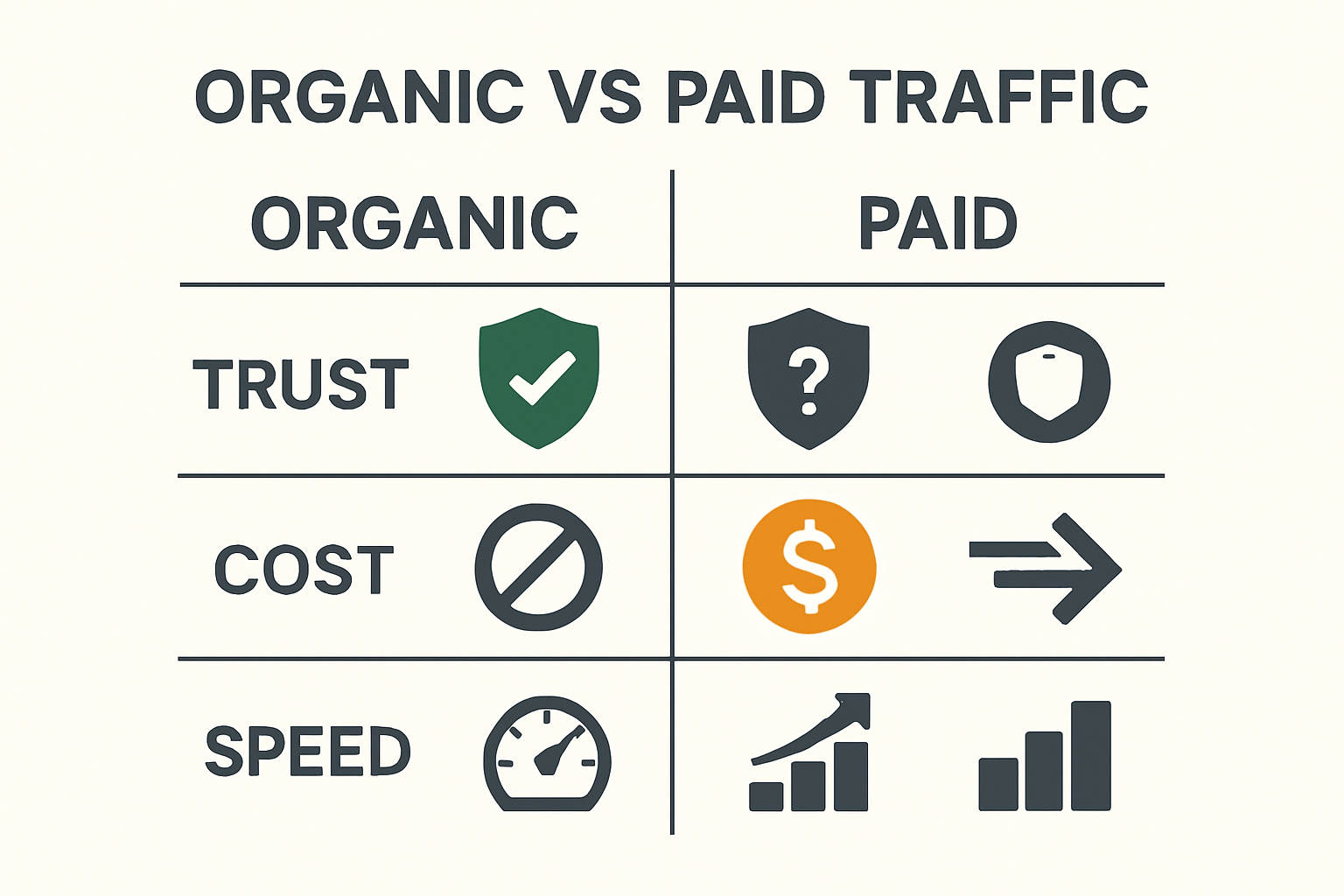
Organic traffic comes from unpaid listings on the SERP. Paid traffic comes from ads (e.g., Google Ads) placed via auctions. Users typically see ads at the top and bottom, with organic results in the main list and features like People Also Ask.
Many users perceive organic results as more trustworthy and may skip ads, which can lift CTR and engagement for organic rankings. External analyses note this credibility effect and the time SEO needs to build momentum, while paid ads can deliver immediate visibility once campaigns launch.
- Users often trust organic listings more and may bypass ads, improving organic CTR and conversions. Source
- Paid traffic is immediate once campaigns go live; organic typically takes weeks or months to build. Source Source
Organic Traffic: Search-Driven Visits Without Ad Spend
Organic growth is powered by SEO content, topical authority, and satisfying search intent. When you rank, you earn compounding traffic without paying per click. Evergreen articles and pillar pages become assets that build over time.
- Compounds: Every new article can rank, earn links, and lift related pages via internal linking.
- Durable CAC: After content ranks, incremental traffic keeps coming with minimal marginal cost.
- Authority flywheel: Topical clusters build credibility and improve sitewide rankings.
Want a framework to build assets that last? See our guide on evergreen content strategy that compounds.
Paid Traffic: PPC and Sponsored Placements
PPC buys visibility through auctions. You pay by CPC or CPM, and where you appear among paid and organic search results depends on your bid, Quality Score, and relevance.
- Immediate switch-on: Traffic flows as soon as you launch.
- Precision targeting: Control audiences by location, device, and intent via keywords and match types.
- Cost control: Bid caps and budgets, but CPC can rise with competition.
Ready to squeeze more from your spend? Explore 21 PPC optimization tactics to cut CAC.
Cost Structures Compared: What You Actually Pay For
Forecast budgets by breaking out fixed, variable, and hidden costs across channels.
| Channel | Primary Costs | Hidden/Variable | Notes |
|---|---|---|---|
| Organic (SEO) | Content creation, editing, on-page/technical, tools | Link earning, subject-matter expertise hours | Compounds; marginal cost per click trends to near-zero |
| Paid (PPC) | Media spend (CPC/CPM), creative production, landing pages | CPC volatility, ad fatigue refresh, agency fees | Immediate traffic; scales with spend and market competition |
Organic SEO Costs: Content, Tools, and Time
- Content production: Briefing, writing, editing, design. Costs vary by expertise and depth.
- On-page & technical: Schema, internal links, core web vitals, topic clustering.
- Time-to-rank: SEO is a compounding asset; expect months for strong growth. Source
How SEOsolved helps: It analyzes competitors, discovers ranking keywords, builds a tailored content roadmap, and generates credible, SEO-optimized articles in as little as 30 minutes—reducing manual costs while preserving quality.
Scale internal links faster with our guide to automated internal linking.
PPC Costs: Bids, Auctions, and Creative Refresh
- CPC volatility: Auctions react to competitor bids and quality signals; CPC can creep as you scale.
- Quality Score: Relevance, expected CTR, and landing page experience reduce CPC.
- Ad fatigue: Creative and audiences wear out—budget for refreshes and landing page tests.
Balanced strategies combining PPC and organic can lower total cost per lead substantially. Case studies report up to a 63% lower CPL when both work together. Source
Time-to-Value: Speed vs Compounding
PPC is fast. Ads can produce leads the day you launch. SEO compounds. Organic results build gradually but reduce marginal CAC over time.
- Paid search provides immediate results once live. Source
- Organic growth requires consistent content and optimization, often taking months. Source
- Using both creates a full-funnel strategy: capture demand now and build authority for tomorrow. Source
Expected Timelines: 0–3, 3–6, and 6–12 Months
- 0–3 months: PPC live in days; test 3–5 offers and 2–3 landing pages. SEO: research, production, publish 8–16 articles, initial indexing, early long-tail impressions.
- 3–6 months: PPC: scale winners, prune losers, add retargeting, stabilize CAC. SEO: first rankings on long-tail, initial backlinks, growing non-brand clicks and assisted conversions.
- 6–12 months: PPC: audience saturation risks, CAC creep without creative refresh. SEO: compounding traffic from clusters, multiple page-one rankings, durable CAC improvements.
Plateaus and Diminishing Returns in PPC
As you scale, you expose new, lower-intent or saturated audiences—CAC creep is common. Mitigate with creative rotation, granular audiences, and landing page speed and relevance improvements.
- Refresh creative every 4–6 weeks and expand variations.
- Use audience layering and negative keywords to maintain intent.
- Continuously test landing page UX and messaging.
See our PPC optimization masterclass for a full checklist.
Metrics That Matter: From Clicks to Revenue
Align your team around a few core metrics that predict profitable growth across channels.
- CAC: Customer acquisition cost (all-in, by channel).
- LTV: Lifetime value per customer.
- LTV:CAC: Efficiency ratio (aim ≥ 3:1 when possible).
- Conversion rate: Visit-to-lead and lead-to-customer by source.
- ROAS: Revenue divided by ad spend for paid media.
- Payback period: Months to recoup CAC from gross margin.
Core Formulas: CAC, LTV:CAC, and Payback
CAC formula: CAC = (Channel Costs in Period) / (New Customers from Channel)
LTV (simple): LTV = ARPU × Gross Margin × Average Months Retained
LTV:CAC: LTV:CAC = LTV / CAC
Payback period (months): Payback = CAC / (ARPU × Gross Margin)
Example: If CAC is $250, ARPU is $100/month, and gross margin is 80%, payback = 250 / (100 × 0.8) = 3.125 months. LTV assuming 12 months retention: $100 × 0.8 × 12 = $960; LTV:CAC = 3.84.
Attribution and Assisted Conversions
Organic and paid influence each other. Users may see an ad, search later, and click an organic result—or the reverse. To avoid double-counting:
- Use simple multi-touch rules early (e.g., 40/20/40 first/linear/last) and compare to last-click.
- Report assisted conversions by channel and branded vs non-branded search.
- Test incrementality by pausing brand campaigns selectively and observing organic changes.
Paid ads can amplify high-performing organic content, and insights from paid tests can improve SEO topics and copy. Source
Build a Hybrid Mix: Channel Allocation by Stage
Use PPC for speed and SEO for scale—then rebalance as you approach product-market fit (PMF) and beyond.
Pre-Launch and Launch: Validate Fast with Paid
- Spin up targeted PPC to test messaging, offers, and pricing quickly.
- Run landing page experiments to improve conversion rates before heavy content investment.
- Seed foundational SEO: publish core pillar pages and 6–10 problem-led articles.
Need to get SEO moving while you test ads? SEOsolved can analyze competitors, discover hundreds of keywords, and generate your first batch of articles—fast. Stat Ranking Today
Post-PMF Scale: Lean into Organic Pillars
- Expand pillar pages and topical clusters that map to your best-converting intent.
- Build product-led SEO assets (templates, calculators, use cases) for durable rankings.
- Shift budget toward SEO as rankings and assisted conversions rise.
Plan your hub-and-spoke approach with our guide to evergreen, compounding content.
12-Week Execution Plan: From Zero to Search-Ready with SEOsolved
This step-by-step plan stands up an SEO program in parallel with selective PPC for demand capture.
Weeks 1–2: Competitor Analysis and Keyword Discovery
- Use SEOsolved to analyze competitors and find search gaps by intent and difficulty.
- Prioritize quick-win keywords for early rankings plus strategic topics for authority.
- Validate paid angles using PPC test campaigns and pull winning messages into briefs.
Further reading: competitor keyword research tools and tactics.
Weeks 3–6: Content Roadmap and Article Generation
- SEOsolved builds a content roadmap and generates SEO-optimized drafts with sources.
- Editorially refine for brand voice; add product proof, screenshots, and CTAs.
- Publish 2–3 articles per week across clusters; ensure schema and on-page basics.
Weeks 7–12: Publish, Internal Links, and Conversion Paths
- Implement automated internal linking to strengthen topic clusters.
- Add contextual CTAs, lead magnets, and bottom-funnel links; monitor conversions.
- Run limited PPC for high-intent keywords and retargeting while organic matures.
Set up scalable internal links with this internal linking playbook.
CAC Calculator: Estimate Organic vs Paid in 5 Steps
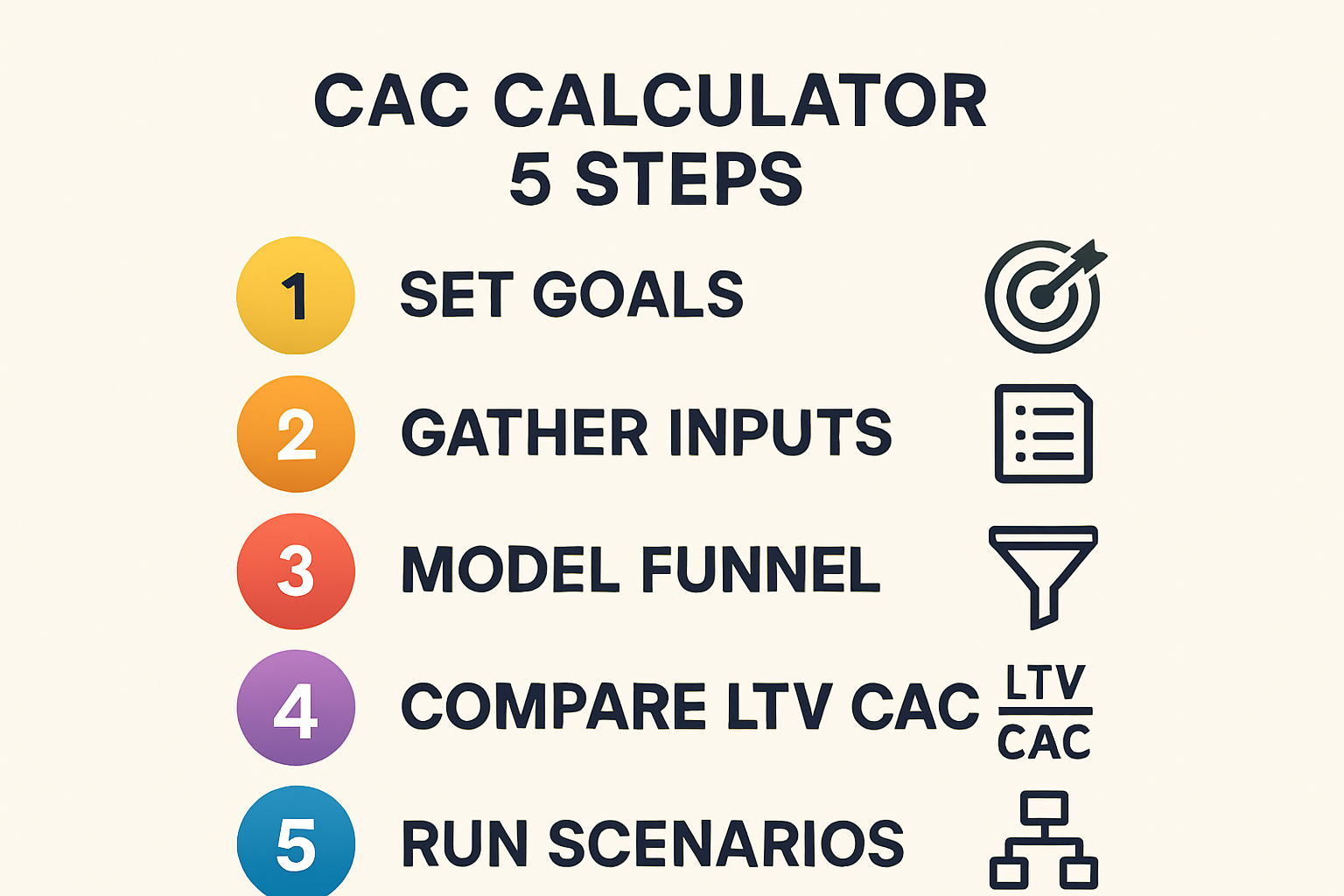
- Set goals: Target CAC, LTV:CAC, and payback window.
- Gather inputs: CPC, CTR, CVR, AOV/ARPU, gross margin, content costs.
- Model funnel: Impressions → clicks → leads → customers for each channel.
- Compare LTV vs CAC: Ensure LTV:CAC ≥ 3:1 when possible; watch payback.
- Run scenarios: Test CPC up/down 20%, CVR ±25%, and content velocity.
Sample Scenario: B2B SaaS with $1,000 LTV
Assumptions
- LTV = $1,000; gross margin = 80%; target payback ≤ 4 months.
- Organic: Content cost $400/article, 12 articles/quarter; visit-to-lead 2.0%; lead-to-customer 20%.
- PPC: CPC $4.00; CTR 3%; visit-to-lead 4.0%; lead-to-customer 15%.
Quarterly outputs (illustrative)
- Organic (after 3 months, early ramp): 6,000 visits → 120 leads → 24 customers; content cost = $4,800; CAC ≈ $200.
- PPC (spend $12,000): 300,000 impressions → 9,000 clicks → 360 leads → 54 customers; CAC ≈ $222 (spend only).
- LTV:CAC: Organic ≈ 5.0; PPC ≈ 4.5; both inside 4-month payback at 80% gross margin.
Takeaway: PPC delivers volume now; organic closes the gap over time and can drop below $150 CAC as rankings compound.
Case Study: Cutting CAC by 38% with a Hybrid Approach
Composite example: A Series A B2B SaaS spent $45k/month on PPC with a $310 blended CAC. By launching a content engine (3 articles/week, internal linking, CRO improvements) and narrowing PPC to highest-intent terms plus retargeting, blended CAC fell to $192 in 7 months—a 38% reduction—with steadier lead flow and shorter payback.
This mirrors broader findings: a balanced strategy often wins. One report cites 60% of leads from organic and 40% from paid for a cost-effective equilibrium, and another highlights 63% lower CPL via a combined approach. Source Source
Risks and Pitfalls (and How to Avoid Them)
Organic Risks: Algorithm Volatility and Execution
- Mitigate volatility: Diversify topics, build E-E-A-T with expert input and references, and avoid thin content.
- Quality > quantity: Focus on depth, intent match, and unique insights.
- Durability: Favor evergreen topics and update content quarterly.
Organic is a long-term, ongoing strategy—plan for continuous improvement. Source
Paid Risks: Budget Burn and Platform Dependence
- Cap CAC with bid limits and target ROAS; watch audience saturation.
- Refresh ad creative and landing pages to combat fatigue.
- Diversify channels—do not rely on a single network.
Paid ads excel at precise targeting; SEO has limited audience controls beyond keywords. Source
Decision Framework: Choose Organic, Paid, or Both
Use this quick matrix to prioritize your mix today:
- Go heavier on paid if your sales cycle is short, you need pipeline now, and you have proven high-intent keywords.
- Go heavier on organic if LTV is high, the buying journey is research-heavy, and competitors win via content.
- Run both if you must hit near-term targets while building authority for sustainable CAC.
- Reassess quarterly as rankings rise and PPC incrementality changes.
How to Evaluate Partners and Tools
What to Expect from a PPC Agency
- Structured setup: conversion tracking, feed/tag hygiene, and audience architecture.
- Testing cadence: ad variants, landing pages, and budgets aligned to CAC goals.
- Reporting: channel-level CAC, ROAS, incrementality, and clear next steps.
- Questions to ask: How do you cap CAC? How do you measure incrementality? What’s your creative refresh plan?
What to Expect from an SEO Platform (SEOsolved)
- Automated competitor analysis to reveal search gaps and content priorities.
- Keyword discovery at scale, grouped by intent and cluster.
- Content roadmap generation with briefs and publication cadence.
- High-quality article generation with credible sources in minutes, ready for editorial polish.
SEOsolved enables teams to rank on Google and AI search while lowering manual production time—so you can publish more, faster, without sacrificing quality. See our AI SEO platform buyer’s guide for evaluation criteria.
FAQs: Organic vs Paid for Startups
Does running PPC hurt my organic rankings?
No. PPC and SEO are separate systems. They can inform each other but don’t directly impact rankings.
Should I bid on my brand name?
Often yes—brand ads are cheap insurance and can protect against competitors, while organic captures the rest.
How long until SEO pays off?
Expect early signals within 8–12 weeks and stronger gains by 4–6 months with consistent publishing.
Can paid and organic cannibalize?
Sometimes. Test pausing brand ads in strong organic positions and measure net impact before reallocating.
What’s a good LTV:CAC?
Many B2B SaaS teams target ≥ 3:1 with payback under 12 months (ideally 3–6 months for faster cycles).
Conclusion and Next Step
PPC wins on speed; SEO wins on compounding. The smartest path is a hybrid: use paid for immediate traction while you build organic assets that lower CAC for the long run. With SEOsolved, you can operationalize SEO in weeks—not quarters—and let your content work 24/7 alongside efficient PPC.
Stat Ranking Today — generate your content roadmap and publish SEO-optimized articles within minutes.