SEO for agencies has changed. AI search, entity-driven rankings, and tighter executive scrutiny mean your process must scale from intake to ROI—without adding headcount. This playbook shows how to build an agency SEO operating system that delivers pipeline, not pageviews.
Inside: a proven framework from discovery through reporting, a Google-first research stack, platform playbooks (WordPress, Squarespace, Shopify), social SEO, ethical links, vertical blueprints, a 90-day launch plan, and how to use AI—especially SEOsolved—to speed results without losing quality.
Why SEO for Agencies Demands a Different Playbook in 2026
Unlike in-house teams, agencies juggle diverse industries, CMSs, and buyer journeys—while being measured on pipeline, CAC payback, and renewals. AI overviews, entity signals, and multi-surface SERPs (web, video, social, chat) raise the bar for completeness and credibility. As Clearscope’s 2026 guidance notes, brands that win “build not just pages, but knowledge,” and authority now comes from completeness, not length.
Meanwhile, research shows AI-assisted results are reshaping discovery. Surfer reports that AIO still appears in only ~13% of queries and that small players can beat giants. This is a window for agencies that standardize a repeatable system and deploy it across clients fast.
In this context, the SEO optimizer meaning is bigger than a plugin; your “optimizer” is the orchestrated workflow—from keyword intent to content, distribution, and iteration—that compounds results. That’s the heart of effective SEO for agencies in 2026.
Scale-ready process: A documented OS that any strategist can run.
Google-first research: Lean on GSC/GA4 and SERP truth, not guesswork.
Full-funnel content: Cover evaluative, comparative, and use-case intent.
Distribution + digital PR: Turn expertise into links and mentions.
Executive narrative: Tie work to revenue and retention.
When done right, seo optimization online shifts from tactics to a client-wide growth engine powered by a measurable seo optimizer workflow.
The Business Case and Client Expectations
Executives don’t buy rankings; they buy pipeline reliability. Your promise should be:
Qualified traffic tied to ICP and intent, not vanity visits.
Assisted and direct conversions with clear attribution paths.
Sales cycle impact (shorter time-to-first-meeting, better acceptance rates).
Retention uplift from helpful, credibility-building content.
Set expectations for minimum viable momentum (3 months), initial ROI indicators (keyword growth, landing page lift), and time-to-value for meaningful revenue. Frame seo for agencies as an ongoing program that compounds.
Core Metrics That Matter for Agencies
Standardize your KPI stack and dashboards:
Qualified sessions by intent (from GA4), mapped to funnel stage.
Query, page, and country trends from Google Search Console.
Assisted conversions and CAC payback modeled from GA4 goals/events.
Content efficiency: new pages to qualified leads ratio.
Use seo optimization Google Analytics and seo optimization Google Search Console reports to build a monthly narrative: what grew, why it grew, what we’ll do next.
Related read: build exec-friendly dashboards fast with a GA4 content dashboard.
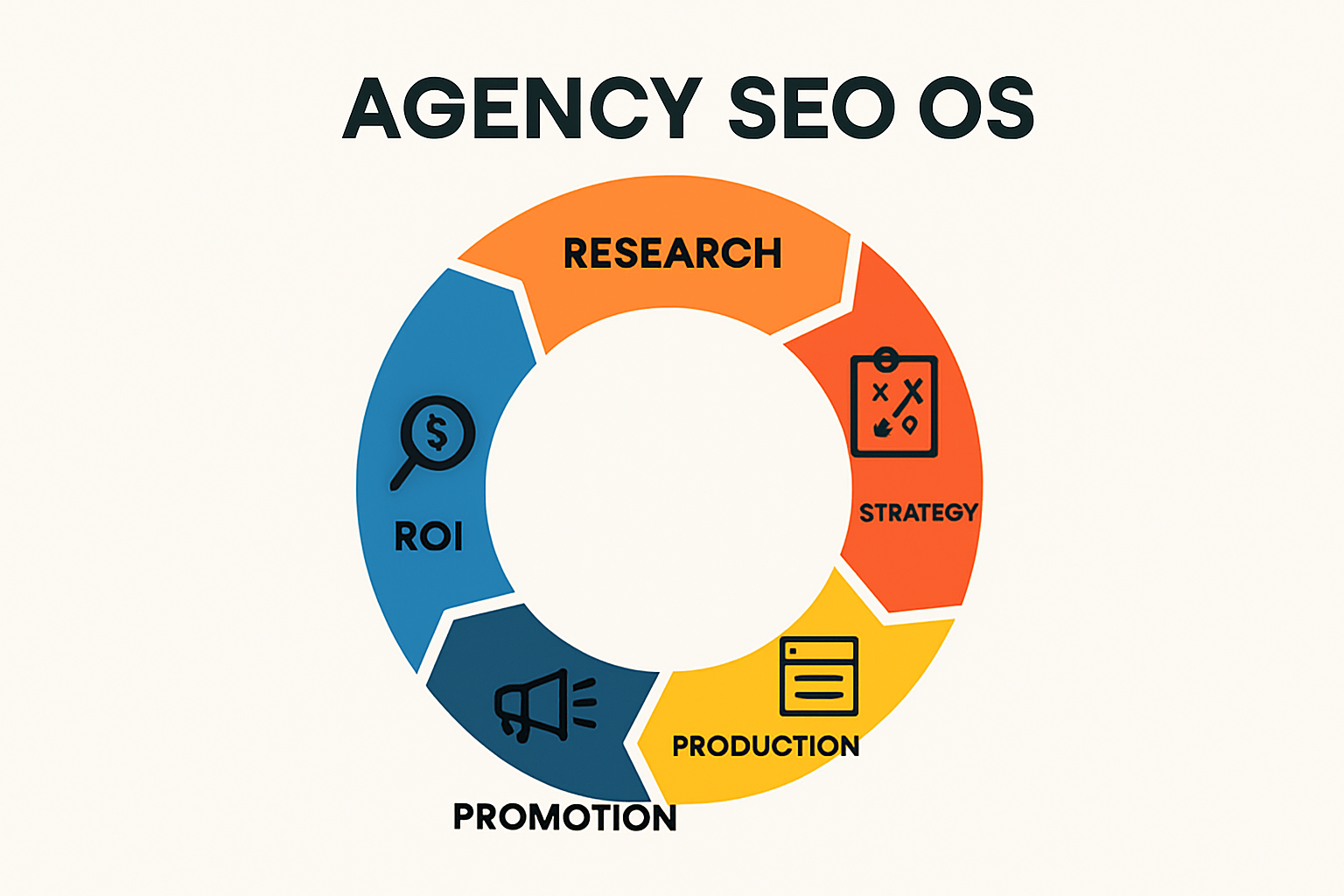
The Agency SEO Operating System: From Intake to ROI
Use this reusable OS to deliver predictable outcomes across clients. Document it in your SOP wiki, then templatize it in your project tool.
Discovery & Competitive Gap Analysis
Intake: ICP, sales objections, current funnel, CMS, and constraints. Collect conversion events early.
Query intent mapping: Build a seed list from Google Suggest, People Also Ask, and competitor top pages.
Competitor audit: Strengths by topic, linkable assets, and SERP feature ownership.
Technical pass: Crawlability, indexation, CWV, and page experience.
Fast wins: Internal links to pages ranking 8–20; title/meta revamps; snippet rewrites.
Go Google-first. Prioritize seo google tools and other seo optimization tools Google offers before paid suites. Where relevant, cite competitors’ strategies observed on SERPs rather than opinions. If you need a primer on a modern tool stack, see AIOSEO’s take on agency software (your stack should support the whole client lifecycle), including a call to start with a research powerhouse and to choose a scalable execution layer for WordPress here.
Strategy & Content Roadmapping
Turn insights into a monthly plan that ships:
Topic clusters by intent: awareness, evaluation, and decision. Use SERP features to shape angles.
Content brief templates tied to SERP truth and sources.
Roadmap: 4–8 posts/month + 1 linkable asset + 1 page refresh cadence.
Distribution plan: LinkedIn, communities, partners, email, and PR.
For deeper research workflows, see our guide on SEO tools in 2025 and how to blend seo optimization tools online with first-party data. Also useful: content optimization with AI.
Production, Publishing, and QA
Quality gates prevent regressions across CMSs. Minimum standard:
Editorial: brief adherence, expert quotes, citation links, E-E-A-T statements.
On-page: headings, schema, internal links, and media optimization.
Technical: canonical correctness, indexation, sitemaps, CWV. Remember: sites that pass Core Web Vitals see ~24% higher engagement and mobile users abandon quickly when slow (Netpeak).
Go-live: change log entry, monitoring alerts, and rollback plan.
Working in WordPress? See our guidance on stable setups and plugins below, plus this primer on automated content creation.
Promotion, Links, and Iteration
Distribution is part of production. Ship with a playbook:
Owned: newsletter, LinkedIn posts, founder threads.
Community: Reddit, Slack/Discord groups, and forums (mine seo optimization reddit for topic gaps).
PR: expert commentary, data studies, and resource hooks.
Iteration: refresh pages that reach page 1–2, shore up internal linking, and expand FAQs.
Repeat monthly; compounding authority is the engine of seo optimization online.
Research Stack: Google-first, Data-Rich, Fast
Build a cost-effective stack that puts seo google tools and ground-truth SERP data at the center, supplemented by validated online research.
Google Search Console + GA4: Setting the Baseline
Benchmark before you build. In week one, establish:
GSC: queries, impressions, clicks, CTR, top landing pages, countries, and index coverage.
GA4: content groupings, events for lead gen, assisted conversions, and revenue mapping.
Change log to tie spikes/dips to deployments or updates.
These seo optimization Google Analytics and seo optimization Google Search Console baselines fuel prioritization and realistic forecasting.
Free Google Tools and Smart Online Sources
Lean on high-signal, free inputs:
Google Trends and News: demand and seasonal context.
People Also Ask + Related Searches: outline-level questions.
Knowledge Panels and entities: disambiguation opportunities.
Patents/Docs: how Google thinks about topics and evaluation.
Complement with seo optimization tools online for SERP features, link prospects, and topical gaps. As AIOSEO notes, your software should be a cohesive stack that supports your entire client lifecycle (read more).
Mining Reddit and Communities for Intent
Forums reveal objections and language your ICP actually uses. Scrape threads for common misbeliefs and “job to be done” phrasing, then align headings and examples accordingly. UGC can be more authentic and to-the-point than brand pages (Edwards Sturm). Use those insights to power briefs, FAQs, and snippets—this is practical seo optimization online in action.
Scale Content Strategy with AI—Without Losing Quality
AI accelerates ideation, clustering, briefs, and first drafts. Humans own strategy, expertise, and final review. The goal is speed with standards, not speed at all costs.
Where AI Fits in the Agency Workflow
Definition: An seo optimizer in 2026 is the combination of AI-assisted research and content generation plus human editorial controls that deliver accurate, source-backed articles at scale—the modern seo optimizer meaning.
Ideation: cluster topics and map to intent using SERP mirrors.
Briefs: outline headings, entities, quotes, and sources.
Drafts: generate first pass, then human-edit for nuance and accuracy.
Enrichment: add expert input, proprietary data, and case examples.
QA: schema, internal links, and compliance checks.
Using SEOsolved to Automate Strategy and Articles
SEOsolved analyzes competitors, discovers hundreds of ranking keywords, builds a tailored content roadmap, and generates high-quality, SEO-optimized articles with credible sources—in as little as 30 minutes. Agencies use it to fill calendars, scale delivery, and rank on Google, ChatGPT, and other search engines.
Problem: Slow research → Solution: automated competitor analysis and keyword clustering.
Problem: Inconsistent briefs → Solution: SERP-driven briefs with sources.
Problem: Limited bandwidth → Solution: draft generation that meets editorial standards.
Problem: Unclear roadmap → Solution: prioritized content plan aligned to ROI.
Surfer notes that ChatGPT-style search already serves billions of queries and always shows sources (source). Agencies using SEOsolved publish faster with source-backed content positioned for both traditional and AI-led discovery. Ready to compress strategy-to-publish from weeks to hours?
Editorial Standards and Source Credibility
Guardrails that protect your brand and clients:
Source verification: cite authoritative reports; avoid unverified claims.
E-E-A-T signals: author bios, quotes, case studies, and revision history.
Update cadence: refresh quarterly for accuracy and SERP shifts.
Compliance: fact-check regulated verticals; legal review where needed.
AI searches can show stronger buying intent than traditional queries (3–6x) and ChatGPT is reported to drive a large share of AI traffic and sales (discussion). Ensure every AI-assisted page stands up to scrutiny—especially in YMYL categories.
Platform Playbooks: WordPress, Squarespace, Shopify
Templatize these setups for quicker onboarding and fewer mistakes.
WordPress SEO: Plugins, Frameworks, and Setup
A stable, fast baseline is non-negotiable for seo on WordPress:
Core: lightweight theme, caching + CDN, image compression, and CWV monitoring. Passing Web Vitals improves engagement by ~24% (Netpeak).
Plugins: choose one primary seo plugin WordPress (Yoast, Rank Math, SEOPress, The SEO Framework WordPress); avoid conflicts.
Sitemap & schema: enable XML sitemaps, set default schemas, and map custom types.
Editorial UX: add a seo widget WordPress in the editor to enforce checklists; document your wp seo plugin guardrails.
Publishing: SERP-aligned titles/metas, internal links, and redirects. If using easy WP SEO or similar, standardize settings across clients.
For a deeper setup guide, see our tooling guide and our post on content optimization. Most issues stem from performance or indexing, not “magic” wordpress SEO plugins. Keep it simple and documented.
Squarespace SEO: What You Can (and Can’t) Control
Squarespace is opinionated but workable for SMBs. Quick wins:
Structure: clean navigation and index pages; avoid deep nesting.
Metadata: page titles, descriptions, and image alt text.
Content: long-form pages with proper headings; pages with strong heading hierarchy show higher visibility (Netpeak).
Local: business info, categories, and consistent NAP.
Focus on what’s controllable in seo Squarespace. For non-technical clients, create a simple checklist of seo tips Squarespace to optimize SEO Squarespace without bloat. A light seo optimiser approach beats over-engineering.
Shopify SEO: Product, Collections, and Speed
Commerce wins with crawlable architecture and fast UX:
Taxonomy: logical collections and tags; avoid duplicate content.
Templates: standardized titles, rich snippets, and FAQs for products.
Internal links: related products, best sellers, and guides.
Speed: prune apps, lazy load, compress, and consider a modern theme.
SEO optimizer Shopify setups should minimize app bloat and invest in content for category-level intent. Many agencies ship a “collections guide” and a “buyer’s guide” for each top category—your evergreen moat.
Social SEO That Moves Rankings and Revenue
Social profiles and distribution feed entity signals, backlinks, and branded search—key ranking levers.
LinkedIn Company Pages and Personal Profiles
Entities: match brand name, description, and categories to the site.
Keywords: include service terms and locations in company and personal bios.
Backlinks: link homepage, key resources, and case studies.
Distribution: repurpose posts, quote experts, and tag partners.
Strong linked in SEO improves co-occurrence and trust. Treat LinkedIn search engine optimization like on-page SEO: intent, entities, and consistency. For B2B brands, SEO for LinkedIn company page is often the fastest path to higher-quality referral traffic.
Facebook Search Optimization for Local/Niche Brands
Local discovery thrives on precise naming and categorization:
Page name + category + services aligned to query demand.
About: keyword-rich but human, services list, and location.
Posts: FAQs, offers, and events mirrored from site content.
Use Facebook search engine optimization to win intent that never reaches Google’s web results—then retarget and nurture.
Vertical Blueprints: Brokers and B2B Software
Two common agency verticals with distinct SERPs and success patterns.
SEO for Brokers: Local Authority and Trust
Local packs: location pages with NAP, reviews, and FAQs.
Trust content: licensing, process explainers, fees, and comparison guides.
Reviews flywheel: outreach and schema for steady growth.
Community links: sponsorships, local news, and resources.
Most wins come from tightening location pages and building real-world trust signals—classic seo for brokers.
SEO for Software: Category Creation and Demand Gen
Topical clusters: use-cases, industries, and integrations.
Comparison pages: alternatives vs. competitors, “X vs. Y” with honest criteria.
Docs hub: how-to, setup, and API—great for long-tail and trust.
Thought leadership: POV posts on category trends and frameworks.
For SaaS leaders, our SaaS SEO playbook covers content velocity and linkable assets—the core of seo for software.
Ethical Link Building and Digital PR for Agencies
White-hat, repeatable systems de-risk scale. Focus on helpful, referenceable assets and relevant outreach.
From Unlinked Mentions to High-Value Placements
Audit: collect brand and leadership mentions; convert to links.
Partnerships: co-create resources with vendors or customers.
Data studies: publish methodologies and sources; journalists link to rigor.
Digital PR should feel inevitable, not forced. Authority accrues from value—many wins happen with seo optimization online hygiene.
Building Repeatable Outreach Systems
Prospecting: segment by topic and audience; log in a CRM.
Personalized hooks: cite their work; offer data or quotes.
Follow-up cadence: 3–5 touchpoints with fresh value.
Measurement: track placement rate and referring domains.
Templatize the entire motion with clear SOPs and QA. For more on content that earns coverage, see our guide to automated content creation at scale.
Reporting, Forecasting, and Proving ROI
Executives renew when they see causality and predictability. Turn data into a story that supports decisions.
GA4 + GSC Reporting Cadence and Narrative
Monthly: query shifts, landing page growth, assisted conversions.
Quarterly: category lift, content efficiency, and link velocity.
Highlights: wins, blockers, and next-step hypotheses.
Build a tight narrative using seo optimization Google Search Console trends and GA4 conversion paths. Keep it executive-first: what changed, why, what we’ll do next.
Forecast Models Clients Actually Understand
Use realistic assumptions and ranges. Map target ranks + CTR curves to traffic, leads, and revenue. Then tie to timeline and required scope. This is the practical side of the seo optimizer meaning—a model that explains how inputs create outputs.
Packaging, Pricing, and Outsourcing
Protect margins with productized services and clear SLAs. Evaluate bundled add-ons with a critical eye for control and transparency.
Productized SEO and Retainers
Kickoff: audits, baselines, roadmap, and 1–2 quick wins.
Monthly: content production, refreshes, and link initiatives.
Quarterly: strategy review and forecast updates.
When capacity is tight or specialization is required, engage an seo outsourcing agency for link PR, site migrations, or programmatic content—define quality gates and change control.
Evaluating Bundled “Host SEO” and Suite Tools
Hosts and suites (e.g., Bluehost SEO, Bluehost SEO tools, or HubSpot search engine optimization add-ons) promise convenience. Use this neutral framework:
Control: Can you customize metadata, schema, and sitemaps?
Transparency: Clear reports and editable settings?
Portability: Can you migrate without lock-in?
Value: Compare to focused tools and your SOPs.
If you’re reading a GoDaddy search engine optimization review and wondering if GoDaddy search engine optimization is worth it, apply the same lens. Suites can be fine for simple sites; advanced programs need finer control.
When to Use an SEO Outsourcing Agency
Turnaround: seasonal spikes or PR windows.
Capacity: ramp delivery without permanent hires.
Specialization: digital PR, programmatic SEO, migrations.
Outsourcing should extend your OS, not replace it—keep your strategy, briefs, and QA central.
Quality, Governance, and Risk Management
Protect rankings with strong QA and change control. Assign a “Google specialist” mindset across the team—curious, hypothesis-driven, and data-led.
Technical QA and Change Logs
Pre-publish: validate schema, links, indexability, and seo on WordPress settings.
Post-publish: monitor logs, GSC coverage, and CWV deltas.
Change log: who changed what, when, and why; have rollbacks ready.
Using SEO Framework WordPress or similar? Document defaults and exceptions. Small mistakes at scale are costly; QA prevents them.
E-E-A-T, Content Reviews, and a “Google Specialist” Mindset
Showcase expertise and experience in every asset: bylines, quotes, methods, and sources. As 2026 guidance puts it, authority now comes from completeness. Align production with reviewer expectations—the essence of the seo specialist Google approach.
Your 90-Day Agency SEO Launch Plan
Execute this time-bound plan to build momentum quickly across clients.
Days 1–30: Baselines, Strategy, and Quick Wins
Install and configure GSC/GA4; define goals and content groups.
Audit crawlability, indexation, speed; fix critical blockers.
Map keywords to ICP and funnel; select 3–5 clusters.
Ship 2–4 quick wins: internal links, title/meta refreshes, snippet FAQs.
Use seo google tools and other seo google free assets to validate demand and measure impact.
Days 31–60: Content Velocity and Link Earning
Publish 4–8 posts; 1 linkable asset; begin digital PR outreach.
Launch platform-specific fixes: optimize SEO WordPress, seo Squarespace, and SEO optimizer Shopify improvements.
Repurpose wins on LinkedIn and communities; collect early reviews.
Days 61–90: Optimization, Reporting, and Scale
Refresh near-page-one pages; expand FAQs from PAA.
Produce your QBR forecast and ROI narrative with seo optimization Google Analytics and seo optimization Google Search Console trends.
Codify SOPs; templatize for the next client; secure renewal.
Automate Your Content Engine with SEOsolved
Agencies that scale in 2026 combine a tight OS with AI that respects editorial standards. SEOsolved does the heavy lifting—research, competitive analysis, content roadmap, and draft generation—so your team focuses on strategy, review, and distribution.
What You Get with SEOsolved
Competitor analysis and hundreds of ranking keywords discovered automatically.
Tailored content roadmap aligned to ICP and revenue goals.
High-quality, SEO-optimized articles with credible sources—ready to edit and publish.
Delivery in as little as 30 minutes, helping clients rank on Google, ChatGPT, and beyond.
Want an agency-ready OS plus an AI engine that prints briefs and drafts on schedule? That’s SEOsolved.
Next Step: Stat Ranking Today
Spin up an AI-driven strategy and ship your first content batch this week. Use this playbook as your OS—and let SEOsolved power the throughput.
FAQs
What makes SEO for agencies different from in-house?
Agencies must scale across industries, CMSs, and goals while proving pipeline impact and renewals. That demands a standardized OS, not ad-hoc tactics.
How soon can clients see ROI from agency SEO?
Expect meaningful movement in 60–90 days. Early signals (rankings, CTR, assisted conversions) appear sooner; compounding revenue follows consistent publishing.
Where should AI fit in the agency SEO workflow?
Use AI for ideation, clustering, briefs, and first drafts. Keep humans on strategy, expert input, and final QA for accuracy and E-E-A-T.
Which platform is best for SEO—WordPress, Squarespace, or Shopify?
All can rank. WordPress offers the most control; Squarespace is simpler for SMBs; Shopify excels for ecommerce with clean architecture and speed.
How do you prove SEO’s impact to executives?
Tie GSC/GA4 data to qualified traffic, assisted conversions, and CAC payback. Present monthly narratives and quarterly forecasts with scenarios.
Further reading: SaaS SEO agency playbook • Content optimization SEO • SEO tools 2025 • Automated content creation • GA4 content dashboard