If publishing great content still isn’t moving your rankings, it’s time to upgrade your stack. This in‑depth guide shows how a modern SEO content tool unifies strategy, writing, and optimization to shorten time‑to‑publish and win durable traffic.
You’ll learn what an all‑in‑one platform should include, a practical evaluation framework, a 30‑minute hands‑on workflow with SEOsolved, and best practices to make AI‑assisted content rank in 2026.
Who This Guide Is For and What You’ll Learn
This guide is for founders, marketers, and lean teams who need a seo content tool that does more than check keywords. If you have a good product but weak organic visibility, you’ll learn how an all‑in‑one content tool can help you:
Discover high‑intent topics and build a publish order that compounds growth.
Generate credible, brand‑aligned first drafts with an AI SEO content workflow.
Optimize for on‑page factors, entities, and internal links without guesswork.
Govern quality with briefs, versioning, and editorial standards.
We’ll reference real documentation and proven guidelines, compare popular approaches, and show how to translate strategy into rank‑ready articles quickly.
What Is an All‑in‑One SEO Content Tool?
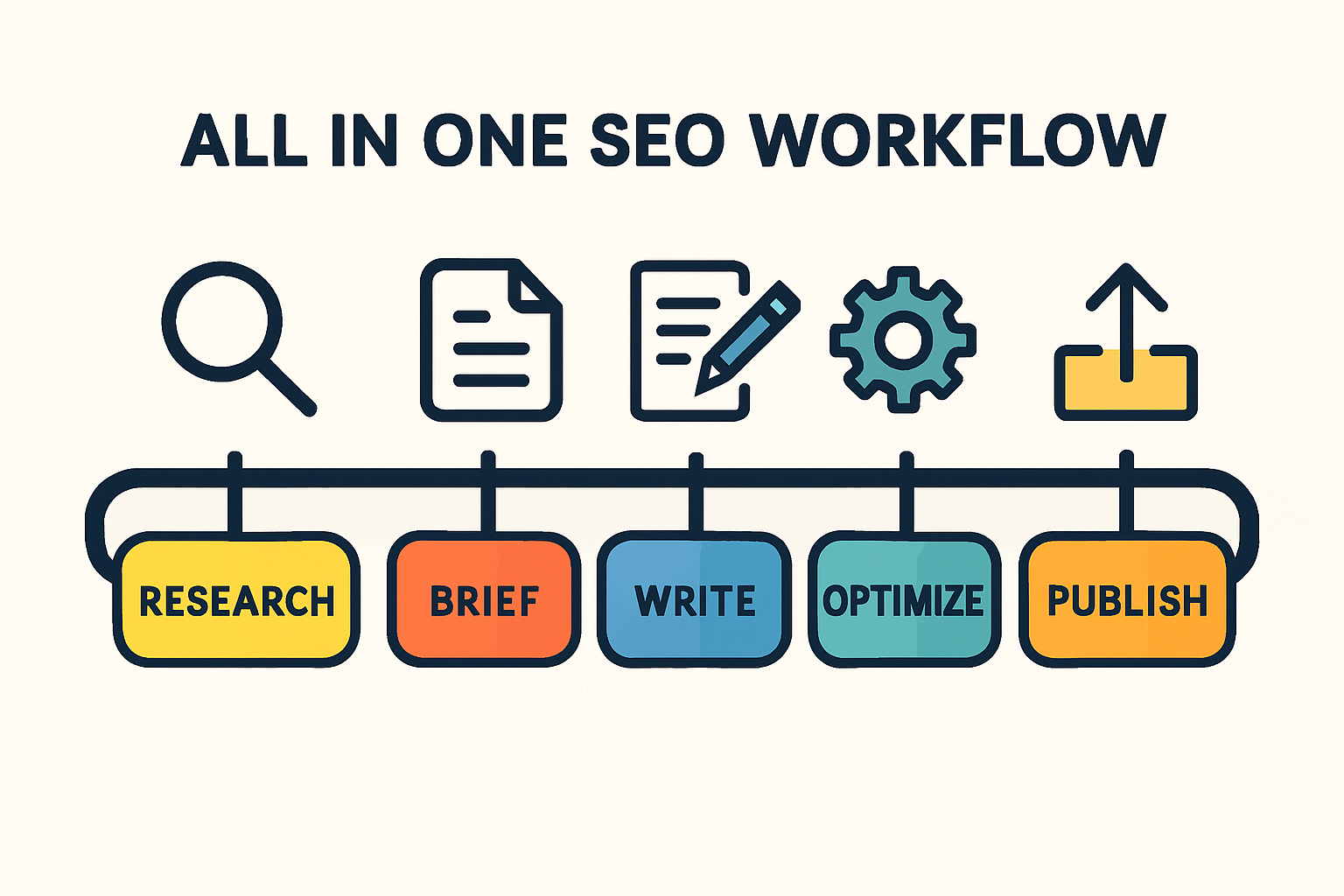
Definition: An all‑in‑one SEO content tool is a platform that unifies research, content planning, drafting, and on‑page optimization into one workflow so teams can publish faster with higher quality and consistency.
Unlike point solutions that only do keyword research or only provide a seo text tool for on‑page checks, an integrated platform connects the entire lifecycle:
Research: Competitor analysis, SERP intent mapping, and topic discovery.
Planning: Prioritized content roadmaps and briefs aligned to business goals.
Creation: AI‑assisted drafting with brand voice controls and fact sourcing.
Optimization: Entity coverage, structure, internal link suggestions, and scoring.
Publishing & validation: Clear handoffs to CMS and analytics feedback loops.
When these pieces live in one content generator for website workflow, you eliminate slow handoffs, lower error rates, and ensure each post supports your broader search strategy.
For additional context on choosing a platform, see our AI SEO Platform Buyer’s Guide (2026).
Essential Capabilities to Demand in 2026 Platforms
Use this checklist to shortlist tools. The best platforms combine a guided seo content editor with a reliable seo content generator while preserving editorial control.
Competitor Analysis and Keyword Discovery
Top tools analyze competing pages and the live SERP to surface gaps, entities, questions, and hundreds of ranking keywords you can target. Look for:
Domain and URL gap analysis: Stack your content against the current winners to generate SEO opportunities quickly.
Intent and entity clustering: Group queries by search task to avoid thin pages.
Difficulty and potential: Score topics by traffic potential and effort to prioritize.
If you’re new to this, our Competitor SEO Analysis Playbook (2026) explains how to turn gaps into a publish sequence.
Brief Builder and SEO Content Editor
Structured briefs front‑load editorial clarity. A solid seo text tool inside the editor keeps writers aligned to the brief as they draft. Demand:
Outline and angle controls: Headings, target questions, entities, and internal links.
On‑page guidance: Title length, meta description prompts, and link best practices.
Source prompts: Reminders to cite authoritative references to bolster E‑E‑A‑T.
Learn more in AI Content Brief Mastery: 2026 Guide.
AI SEO Content Generator and SEO Text Generator
An effective ai seo content generator accelerates first drafts without sacrificing accuracy. Look for:
Brand voice and style guardrails: Custom tone, terminology, and reading level.
Search intent alignment: Drafts structured to answer the SERP’s core task.
Source citation workflow: Easy insertion of reputable links and quotations.
Variant generation: Headlines, intros, and FAQ variants for testing.
Optimization Scoring and On‑Page Recommendations
Optimization should go beyond keyword counts. Expect entity coverage, internal link prompts, and section‑level suggestions. Helpful features include:
Content score: Measures coverage of entities, subtopics, and on‑page elements.
Internal link graph: Prompts for relevant interlinks to boost discoverability.
Accessibility checks: Headings, alt text, and scannability improvements.
If you’re evaluating free content optimization tools, ensure they include entity guidance and link prompts; otherwise, you’ll still have gaps versus enterprise‑grade tools like BrightEdge Content Optimizer.
From Outline to Publish: Workflow and Governance
Beyond features, your content tool must reduce friction. Strong governance looks like:
Role‑based collaboration: Strategists, writers, editors, and approvers share one workspace.
Versioning and QA: Track changes, run originality checks, and finalize in one place.
CMS‑friendly output: Clean HTML export with metadata and structured data prompts.
Tip: Pair your platform with editorial standards and a simple pre‑publish checklist to ensure every post meets your bar.
Decision Framework: Choose the Right Platform for Your Team
Use this rubric to find a seo generator tool that matches your stage, budget, and speed requirements.
Match Capabilities to Your Growth Stage
Early‑stage startups: Prioritize fast keyword discovery, simple briefs, and quality AI drafts. A combined marketing content generator + editor saves time.
SMBs: Add content roadmapping, collaboration, and optimization scoring to scale output without adding headcount.
Scaling teams: Look for governance, multi‑workspace support, and deeper analytics.
Build vs. Buy vs. Free: When Each Path Makes Sense
There’s no single right answer—only fit. Use this quick snapshot to align with your constraints.
Path | Best For | Pros | Trade‑Offs |
|---|---|---|---|
Free tools | Very lean teams validating ROI | $0 cost, low risk, basics covered | Manual stitching, limited entities, slower publish, quality variance |
Build in‑house | Engineering‑heavy orgs with unique needs | Custom fit, data ownership | High opportunity cost, maintenance burden, feature lag vs. market |
Buy suite | Teams needing speed and scale now | End‑to‑end workflow, best practices baked in | Subscription cost; requires onboarding and process change |
Quality, Compliance, and Editorial Standards
Codify your rules so AI augments, not replaces, editorial judgment. Include:
Source policy: Cite reputable references (e.g., Google Search documentation) and avoid uncited claims.
Originality checks: Run plagiarism scans and ensure unique angles to prevent cannibalization.
Tone guide: Document voice, reading level, and terminology boundaries.
Data hygiene: Log prompts, versions, and reviewer sign‑offs.
For a more detailed buyer rubric, see AI writing tools that rank in 2025.
Hands‑On Workflow: Rank‑Ready Content in 30 Minutes with SEOsolved
SEOsolved is an AI‑powered seo content tool that automates competitor analysis, keyword discovery, content roadmapping, and high‑quality draft generation with credible sources. Here’s a practical end‑to‑end sprint.
1) Analyze Competitors and Discover Keywords
Enter a seed topic or URL: SEOsolved scans the SERP, competitors, and entities in minutes.
Review gaps: See which subtopics, questions, and internal links leaders use—and where they’re weak.
Prioritize: Use difficulty and potential scores to choose targets you can win now.
Outcome: A shortlist of high‑intent targets that align with your product and audience.
2) Build a Tailored Content Roadmap
Cluster by intent: Map topics into a hub‑and‑spoke structure to publish in the right order for compounding growth.
Assign roles and deadlines: Keep owners and timelines visible so nothing stalls.
Attach briefs: Every item includes target entities, questions, and internal link targets.
Need a deeper dive on planning? Explore our brief mastery guide.
3) Generate a High‑Quality, Sourced Article
Draft with AI: Use SEOsolved’s seo content generator to produce a first draft aligned to search intent and brand voice.
Insert credible sources: Add citations to reputable docs and studies to strengthen E‑E‑A‑T.
Customize sections: Edit intros, CTAs, and examples for your audience and offers.
Example scenario (not a claim): A 3‑person team drafts a 2,500‑word article, with cited sources and internal links, in under an hour—time they can reallocate to promotion.
4) Optimize for Search Engines and User Intent
Close coverage gaps: Use entity and question prompts to ensure completeness.
Polish on‑page elements: Titles, meta descriptions, headings, and alt text.
Strengthen internal links: Connect to relevant hubs and supporting posts.
SEOsolved’s editor helps you write for Google and answer engines (e.g., ChatGPT search integrations) with clean structure and sourced claims.
5) Publish and Validate Performance
Export clean HTML: Paste directly into your CMS with metadata intact.
Interlink on publish: Add links from existing pages to your new post.
Track signals: Monitor rankings, CTR, and engagement; iterate briefs accordingly.
Get started with SEOsolved and compress strategy‑to‑publish to a single session. Stat Ranking Today.
Platform Comparison Snapshots (2026)
Here’s a neutral view to help you position options and understand fit.
BrightEdge Content Optimizer: Enterprise Context
BrightEdge Content Optimizer is typically adopted by large organizations that need tight integration with enterprise reporting, governance, and cross‑channel SEO. Strengths include enterprise permissions, dashboards, and integrations. Consider the learning curve, price point, and the need for dedicated SEO resources to fully leverage its capabilities.
SEO Content Machine: Automation‑First Perspective
SEO Content Machine focuses on automated content generation at scale. If you research SEO Content Machine reviews, examine how reviewers evaluate content quality, factual accuracy, and post‑editing time. Automation speed can be useful, but ensure outputs align with your brand standards and include credible sources.
Where SEOsolved Fits: Fast Strategy + Quality Drafts
SEOsolved is built for teams that need automated strategy, keyword discovery, content roadmaps, and high‑quality drafts quickly—without hiring a full SEO team. The platform emphasizes entity‑rich briefs, credible sourcing, and clean on‑page optimization so your articles perform in Google and in AI‑powered answer surfaces. Try it when speed and quality both matter.
Budgeting and ROI: From Free to Pro
Calculate ROI by linking time saved, output velocity, and revenue per post. Suites pay off when they increase publish cadence and average ranking position while reducing revisions.
Quantify Time Saved and Compounding Gains
Build a simple model:
Baseline: Current hours per post × hourly blended rate = content cost/post.
Acceleration: Posts/month × average time saved/post = hours saved.
Impact: Estimate incremental traffic from ranking improvements and publish velocity.
Revenue: Traffic × conversion rate × value per conversion = expected lift.
Break‑even: Subscription cost ÷ monthly revenue lift = months to payback.
When to Use Free Content Optimization Tools
Free options are ideal for validation but can bottleneck scale. Use them when:
You need to vet ideas before committing budget.
Your volume is low and deadlines are flexible.
You already have strong SEO experience in‑house.
Graduate to a suite when you need consistent briefs, faster drafting, and reliable on‑page coverage—things that pieced‑together tools rarely deliver.
Advanced AI SEO Content Writing Best Practices
AI accelerates drafting, but rankings come from pairing AI with editorial judgment and credible sources.
E‑E‑A‑T, Sources, and Factual Integrity
Anchor to reputable sources: Cite official docs such as Google Search Essentials and the Search Quality Rater Guidelines (E‑E‑A‑T).
Demonstrate experience: Add author bios, first‑hand notes, or customer scenarios that reflect practical use.
Be helpful: Structure content to answer tasks clearly; see Google’s guidance on creating helpful content.
Use structured data: Add Article schema to improve eligibility for rich results; review Google’s Article structured data.
Prompt Design and Human‑in‑the‑Loop Editing
Effective prompts and edits turn AI drafts into publishable articles:
Prompt patterns: Specify audience, goal, SERP intent, entities, and constraints (length, tone, structure).
Layered drafting: Generate outline → section drafts → transitions → title/meta variants.
Editorial pass: Fact‑check, cut fluff, add examples, and insert sources before optimization.
Scanability: Use short paragraphs and subheads; see NN/g on how users read the web for better UX (NN/g study).
Avoid Duplication and Keyword Cannibalization
Cluster topics, set a canonical owner for each keyword group, and link intentionally:
Topic clusters: One hub per intent with spokes that answer sub‑questions.
Canonical mapping: Assign a primary URL for each cluster to avoid overlap.
Internal link best practices: Use crawlable links and descriptive anchors; see Google’s link guidelines.
Implementation Checklist and Scorecard
Roll out your tool and process methodically to de‑risk adoption.
14‑Day Rollout Plan
Day 1–2: Define goals, KPIs, and publishing cadence.
Day 3–4: Import competitors and keywords; build 90‑day roadmap.
Day 5–6: Create brief templates and a style guide.
Day 7–8: Draft and optimize your first two articles.
Day 9–10: QA process: citations, originality, and internal links.
Day 11–12: Publish and interlink across your site.
Day 13–14: Review performance; refine the roadmap and briefs.
To sharpen your evaluation, see 12 Clearscope Alternatives for perspective on the landscape.
Tool Evaluation Scorecard Template
Use this lightweight scorecard to compare platforms on speed, quality, and scalability.
Criteria | Weight | Tool A | Tool B | Tool C |
|---|---|---|---|---|
Competitor analysis & keyword discovery | 20% | |||
Brief builder & editor guidance | 20% | |||
AI draft quality & source support | 20% | |||
Optimization scoring & internal link prompts | 15% | |||
Workflow, governance, and export | 15% | |||
Cost, onboarding, and support | 10% |
CTA: Launch Your Strategy with SEOsolved
Ready to ship your strategy and your next five posts faster? SEOsolved automates research, prioritization, and drafting so you can publish with confidence. Start ranking today.
FAQs: All‑in‑One SEO Content Tools
What’s the difference between a SEO content editor and a SEO content generator?
Editor: guides structure, entities, links, and on‑page checks as you write. Generator: produces first drafts and variants. Use both: draft with AI, then refine in the editor to meet intent and quality.
Can AI SEO content really rank on Google in 2026?
Yes—when it’s accurate, helpful, and well‑sourced. Pair AI with human editing, cite reputable sources, and align to intent. Follow Google’s helpful content and E‑E‑A‑T guidance.
Are there reliable SEO generator free options?
Free tools help validate ideas and learn basics. Expect manual effort and limited entity coverage. Upgrade when publish speed, consistency, and quality become bottlenecks.
How should I read SEO Content Machine reviews?
Filter reviews by your use case. Check sample outputs for factual accuracy, editing time required, and support responsiveness—speed alone isn’t enough.
Is BrightEdge Content Optimizer right for small teams?
It can fit enterprises best. Lean teams often prefer tools that emphasize fast strategy, roadmaps, and high‑quality drafts with less overhead.
Want a deeper platform overview? See our 2026 platform buyer’s guide and competitor analysis playbook.