Organic growth in 2026 demands content that’s fast to ship, credible, and built to win in AI-driven search. This playbook shows you how to design an SEO content strategy that ranks quickly, compounds authority, and scales without chaos. You’ll get a complete framework, step-by-step methods, checklists, and tool guidance—plus ways to automate the heavy lifting.
What Is an SEO Content Strategy?
Definition: An SEO content strategy is the end-to-end plan for researching topics, creating entity-rich content, structuring your site, and measuring outcomes so your audience finds you in search and takes action.
It aligns SEO & content marketing by turning business goals into a focused content plan that captures search intent and drives consistent organic traffic. A strong strategy acts as a blueprint—why you’re creating content, who it serves, what formats you’ll ship, and how success is measured—so teams produce less noise and more revenue-generating content. See guidance on treating content as a business asset and organization-wide approach in resources from Backlinko and MarketMuse.
SEO vs. Content Marketing: How They Work Together
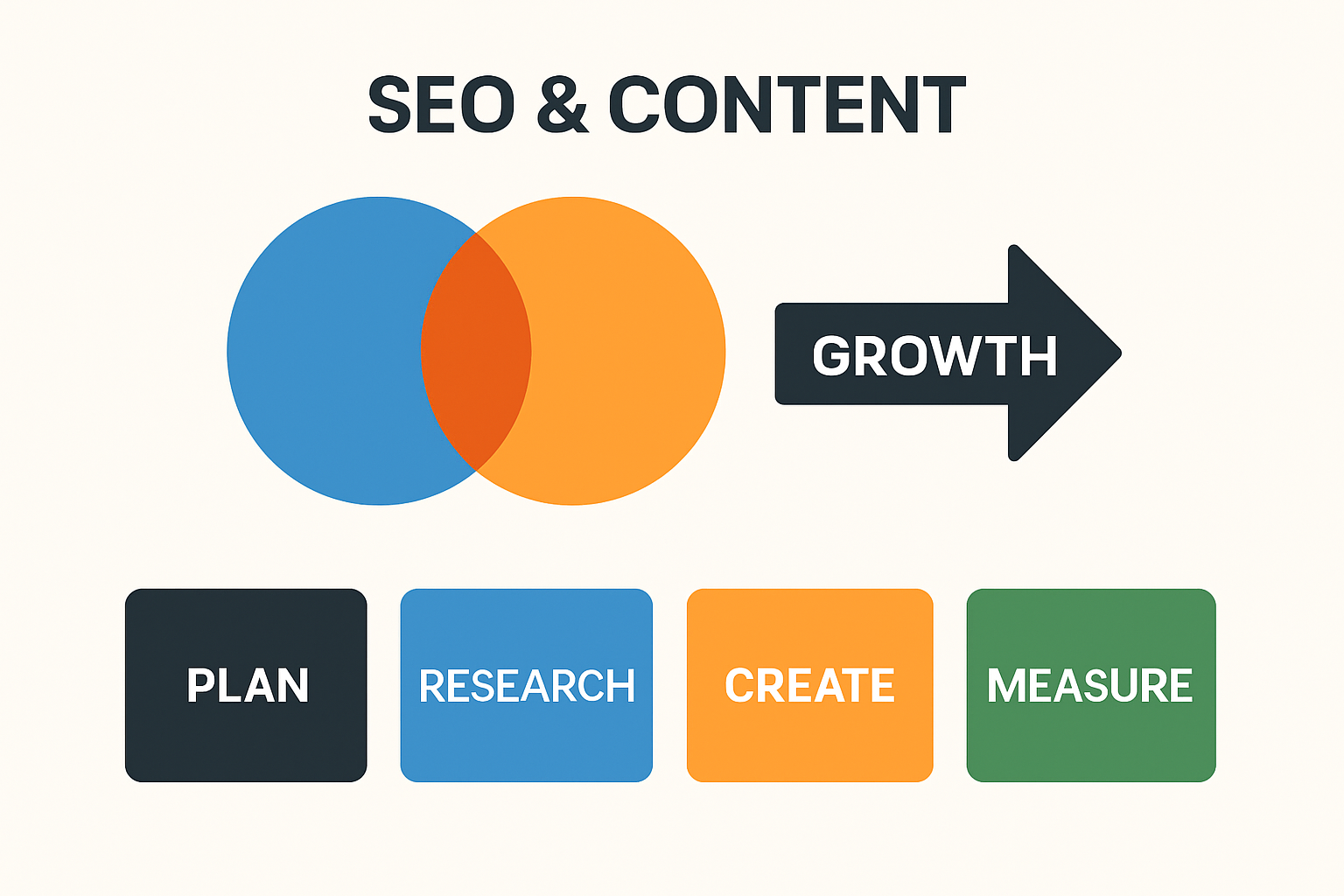
SEO makes content discoverable and indexable; content marketing makes content desirable and shareable. They’re distinct but inseparable: SEO gives content something to rank for and content marketing gives SEO something worth ranking. For deeper distinctions, see overviews from SEO.com, Linkflow, and the Content Marketing Institute.
| Focus | SEO | Content Marketing |
|---|---|---|
| Primary Goal | Visibility & indexation | Trust, engagement & demand |
| Scope | Technical, architecture, on-page | Storytelling, formats, distribution |
| Measurement | Impressions, rankings, CTR | Time-on-page, shares, leads |
| Connection | Enables search discovery | Delivers customer value |
Core Components of a Modern SEO Content Strategy
- Audience & intent research: Personas, Jobs-to-Be-Done, and query intent.
- Keyword clustering: Theme-based groups that build topical authority.
- Content architecture: Hubs, spokes, and clear internal links.
- On-page optimization: Titles, headers, semantic markup, media, and schema.
- Editorial governance: Cadence, owners, QA standards.
- Measurement: KPIs and refresh loops to fight content decay.
For deeper semantic modeling, see our guide on Semantic SEO. For internal linking at scale, explore Automated Internal Linking.
Why SEO Content Strategy Matters in 2026
Search is shifting from ten blue links to blended surfaces: AI Overviews, answer snapshots, video, and product-rich results. Generative systems reward source-backed, entity-aware content and real-world expertise. Trends emphasize authenticity and human experience—credible voices with evidence beat generic AI output, as noted by Greenlane Marketing.
From Blue Links to AI Answers: Competing in Generative Search
To appear in AI Overviews and chat assistants, create content with clear entities, relationships, and citations. Summaries, FAQs, statistics, and structured data help models extract precise answers. Learn how to align with AI systems in our AI SEO strategy guide. This also improves your inclusion in AI answers—what some practitioners call ChatGPT rankings.
Topical Authority Over Page-Level SEO
Ranking durability comes from cluster depth across a topic, supported by internal links and expert sources—not from one-off pages. A topic cluster strategy signals comprehensive expertise. Build hub pages that summarize the theme and link to detailed spokes; interlink spokes to reinforce relationships. See how to scale this with automated internal linking.
The Complete SEO Content Strategy Framework
Use this blueprint to move from research to results with minimal rework.
Define Business Goals, ICP, and Jobs-to-Be-Done
- Clarify revenue targets, product priorities, and strategic personas.
- Map pains and JTBD across the buyer journey (problem to solution aware).
- Document channels and formats your audience prefers.
Content strategy sets goals and audience; content marketing executes distribution. See definitions from WGC and MarketMuse.
Keyword Research, Clustering, and Gap Analysis
- Collect seed terms from customers, sales calls, and competitors.
- Group keywords by intent and entity to form clusters.
- Benchmark competitors to expose content gaps and linkable angles.
- Score clusters by traffic potential, difficulty, and business value.
Use a simple prioritization model of impact, ease, and strategic importance as outlined by Clickrank, and dive deeper into competitive research in our competitor SEO analysis playbook.
Mapping Content to the Funnel and Search Intent
Convert clusters into formats that satisfy intent across TOFU/MOFU/BOFU. Tailor to informational, navigational, transactional, and commercial queries to deliver exactly what users expect—an approach reinforced by HostPapa.
- Informational: Guides, glossaries, checklists.
- Commercial: Comparisons, alternatives, calculators.
- Transactional: Product pages, demos, pricing.
- Navigational: Brand pages, documentation hubs.
Information Architecture and Internal Linking
- Create pillar hub pages with table-of-contents links to spokes.
- Use descriptive, varied anchor text to avoid cannibalization.
- Add breadcrumbs and related articles for UX and crawl paths.
Reinforce semantic relationships and pass authority across the cluster. If you’re scaling fast, consider workflows like Automated Internal Linking.
Editorial Calendar, Governance, and QA
- Publish in weekly waves per cluster to capture momentum.
- Define owners, briefs, review checklists, and approval rules.
- Adopt a prioritization rubric (impact × ease × strategic fit) as suggested by Clickrank.
How to Create a Content Strategy: A Step-by-Step Guide
Follow these steps to build, launch, and iterate a program that ships quality at speed.
- Set business goals and ICP/JTBD alignment.
- Audit site health, content inventory, and competitors.
- Research keywords, cluster by intent, run gap analysis.
- Prioritize with an impact–effort–strategy matrix.
- Map clusters to funnel and formats.
- Draft information architecture and internal links.
- Create AI-assisted content briefs with sources.
- Write, optimize, and review with E-E-A-T standards.
- Publish with schema, interlinking, and promotion.
- Measure, refresh, and expand to adjacent clusters.
Audit Your Site and Competitors
- Technical audit: Core Web Vitals, crawlability, indexation.
- Content audit: URLs, performance, thin/duplicate pages.
- Competitors: Cluster coverage, link gaps, SERP features. See our competitor analysis guide.
Prioritize a Content Roadmap and Resources
Build a content roadmap that ranks opportunities by potential, effort, and strategic relevance; assign owners, timelines, and budgets. Content strategy software can centralize briefs, workflows, and status tracking.
Create AI-Assisted Content Briefs
- Specify search intent, entities, outline, and sources.
- Include SERP deconstruction: headings, FAQs, schema opportunities.
- Plan internal links and anchor text variations.
Write, Optimize, and Review
- Draft for clarity and reader outcomes, not just keywords.
- Optimize titles, headers, meta tags, and media.
- Enforce E-E-A-T with citations, bylines, and reviewer notes.
Publish, Interlink, and Promote
- Implement schema (FAQ, HowTo, Product, Video as relevant).
- Launch with internal links from hubs, spokes, and nav surfaces.
- Promote via email, social, and partner communities for early traction.
Fundamentals of SEO Content Writing
Great writing that satisfies user intent is the engine of sustainable rankings.
Match Content Types to Intent
Pick formats that resolve the searcher’s job fastest. Guides for questions, comparisons for choices, demos for buyers. This alignment increases information gain and reduces pogo-sticking.
Demonstrate E-E-A-T with Sources and Evidence
- Cite credible sources and include expert reviewers when possible.
- Add author bios, credentials, and experience signals.
- Show your work: data, screenshots, quotes, or examples.
For intent fundamentals and the interplay of SEO & content marketing, see HostPapa.
Write for Scanners: Structure, UX, and Readability
- Short paragraphs, descriptive headings, summary boxes.
- Bulleted lists for key takeaways; captions for charts.
- Accessible design: adequate contrast, large line height, mobile-first.
On-Page SEO Optimization
Use this checklist to maximize relevance and clicks.
Titles, Meta Descriptions, and CTR Boosters
- Front-load the primary topic; keep titles readable and specific.
- Meta descriptions: benefits + specificity + a gentle CTA.
- Inject numbers, brackets, or freshness qualifiers where appropriate.
Header Structure, Semantic Markup, and Schema
- Follow a logical H2/H3 hierarchy that mirrors intent.
- Use semantic HTML and add schema for rich results (FAQ, HowTo, Article).
- Mark up authors, dates, and reviews for trust signals.
Media, Internal Links, and TOC
- Compress and lazy-load images; provide transcripts for media.
- Add a table of contents for long guides.
- Place contextual internal links to hubs and related spokes.
Technical SEO That Works: 2026 Best Practices Playbook
Great content can’t rank if it can’t be crawled. For a deeper dive, bookmark our Technical SEO playbook.
Crawlability, Indexing, and Site Speed
- Ensure robots.txt and XML sitemaps are correct and updated.
- Monitor index coverage and fix soft 404s and redirects.
- Improve Core Web Vitals and Lighthouse scores.
Canonicalization, Pagination, and Duplicates
- Use canonical tags to consolidate signals.
- Handle pagination with rel="next"/"prev" patterns where relevant or strong internal links if not supported.
- Resolve parameter duplicates with rules and Search Console parameters handling.
JavaScript and Edge SEO Basics
- Prefer server-side rendering or trusted prerendering for critical content.
- Cache and rewrite at the CDN edge for speed and consistency.
- Defer non-critical JS to preserve interactivity metrics.
Search Engine Optimization for Blogs
Blogs are the backbone of topic authority when organized and maintained well.
Architecture: Hubs, Spokes, and Categories
- Group posts into clusters with a pillar hub per topic.
- Use categories for broad themes; tags for discoverability (avoid tag bloat).
- Link new posts to hubs and related posts on publish.
Evergreen Updates and Content Refresh
- Track decaying URLs and refresh with new data, sources, and internal links.
- Consolidate or redirect truly redundant content.
- Re-promote refreshed posts to re-ignite links and shares.
Author Pages, Bios, and Trust Signals
- Create rich author pages with credentials and topic specialties.
- Add expert reviewers on YMYL content; show last updated dates.
- Link to original research and credible citations.
Video SEO That Ranks: A Field-Tested 2026 Playbook
Video boosts visibility across YouTube, SERPs, and AI answers—and fuels repurposed blog content.
YouTube Keyword Research and Optimization
- Target queries with search intent, not just browse demand.
- Craft clear titles, strong thumbnails, and concise descriptions with chapters.
- Use tags and pinned comments to reinforce entities and related topics.
Transcripts, Chapters, and Structured Data
- Provide transcripts for accessibility and indexability.
- Add chapters in YouTube and mirror them on your page.
- Implement VideoObject schema and link related resources.
Repurpose Video into High-Ranking Blog Content
- Turn videos into detailed guides, checklists, and FAQs.
- Embed video in the article and add supporting graphics and quotes.
- Interlink with relevant hubs to distribute authority.
Advanced SEO Techniques: 2026 Playbook to 10x Growth
Programmatic SEO, Safely and Responsibly
- Use page templates and structured data sources—avoid thin combinations.
- Gate scale behind quality checks and internal linking coverage.
- Measure user outcomes (CTR, engagement) to prune weak pages.
Entity SEO and Knowledge Graph Optimization
- Model entities, attributes, and relationships; reflect them in content and schema.
- Leverage authoritative references (e.g., Wikidata) when relevant.
- Cross-link entity pages to strengthen topical context.
Optimize for Generative Answers and Chat Assistants
- Include concise summaries, stats, and citations high on the page.
- Mark up FAQs and use scannable sections to aid extraction.
- Publish credible, experience-backed insights to increase inclusion in AI answers.
All-in-One SEO Content Tools and Platforms
Whether you build a DIY stack or use content strategy software, the right system accelerates research, planning, and production.
Build vs. Buy: When to Use Content Strategy Software
- Build: If you have in-house SEO, analysts, and writers with time to orchestrate multiple tools.
- Buy: If you need speed-to-value, standardized briefs, and integrated workflows across research to publication.
Must-Have Capabilities for 2026
- Keyword discovery with clustering and intent detection.
- Competitor and gap analysis with content roadmap creation.
- AI content briefs with entity lists and source suggestions.
- Editorial calendar, governance, and performance tracking.
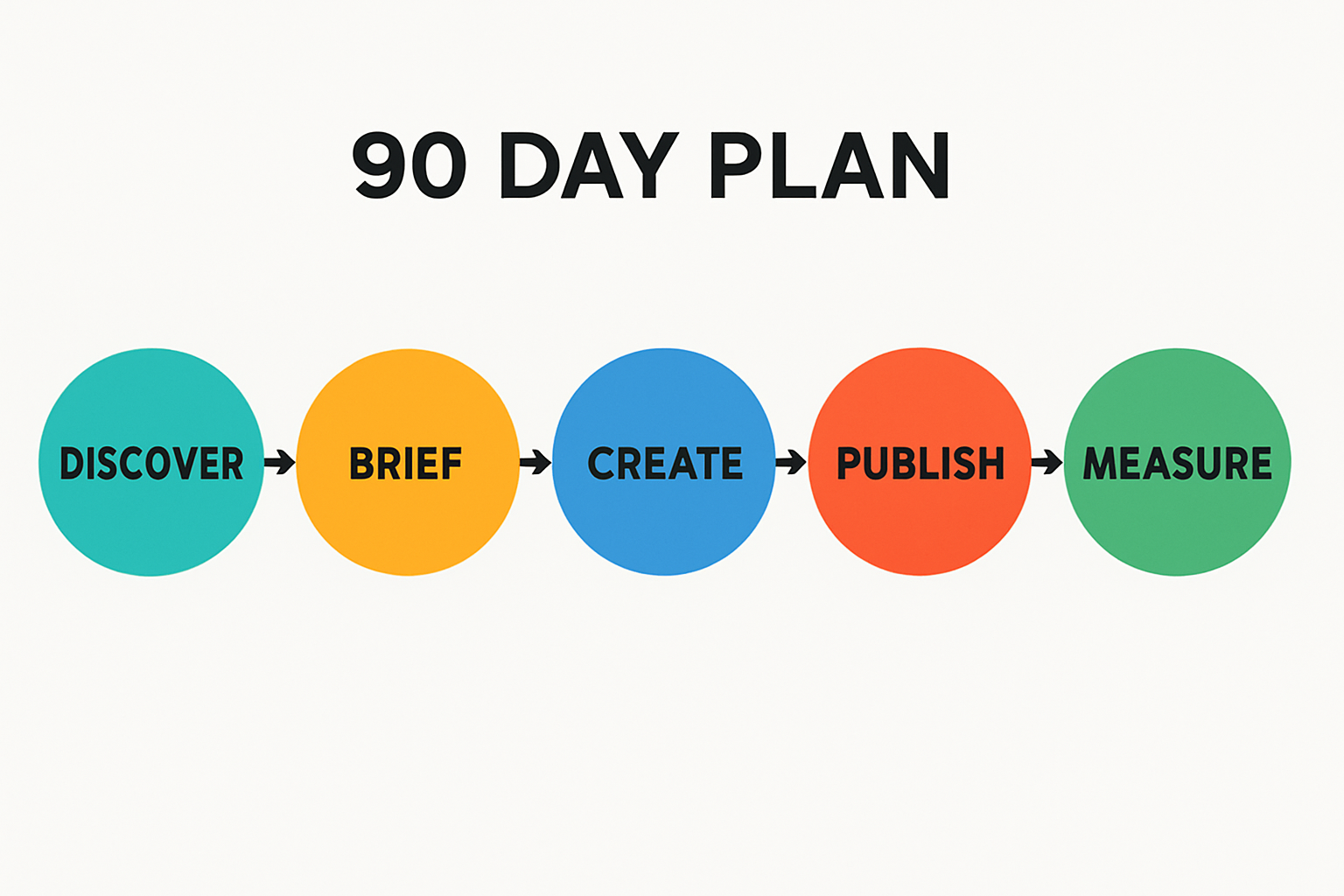
Workflow: From Keyword Discovery to Publication
- Discover and cluster keywords by intent.
- Generate briefs with entities, outline, and sources.
- Draft, optimize, and add schema.
- Publish, interlink, and monitor KPIs.
- Refresh and expand adjacent clusters.
Metrics, Forecasting, and Proving ROI
Measure leading indicators early and tie them to pipeline and revenue models for budget confidence.
North-Star Metrics and Leading Indicators
- Impressions, CTR, and average position by cluster.
- Organic sessions, assisted conversions, and SQLs.
- Content velocity, publication consistency, and refresh cadence.
Forecast Traffic, Pipeline, and Revenue
- Project traffic from search volume × CTR curves × ranking assumptions.
- Apply conversion rates and ACV to model pipeline and revenue.
- Scenario-plan best/likely/worst cases for stakeholder buy-in.
Detect and Fix Content Decay
- Track rank and click deltas over 28/90 days to surface decay.
- Refresh with new sections, sources, and links; consolidate when needed.
- Reinforce with internal links from newer, related content.
Templates, Checklists, and Examples
SEO Content Roadmap Template
- Fields: topic cluster, intent, priority, owner, status, deadline.
- Columns for target URL, internal links, schema, and KPIs.
AI Content Brief and Outline Template
- Intent, audience, and problem statement.
- Required entities, outline, FAQs, and source list.
- On-page checklist: title, meta, headers, images, schema.
Internal Linking Map Template
- Visualize hubs, spokes, and anchor text variations.
- Track link placement and recrawling opportunities.
How SEOsolved Accelerates Your SEO Content Strategy
SEOsolved is an AI-powered platform that automates key parts of SEO & content marketing: competitor analysis, keyword discovery, content roadmaps, and high-quality, source-backed articles—often in as little as 30 minutes. That means less manual research, fewer bottlenecks, and faster time-to-publish.
Automate Strategy: Competitor Analysis and Keyword Discovery
- Analyze competitors to reveal content gaps and winning angles.
- Discover hundreds of relevant keywords automatically grouped into clusters.
- Benchmark SERP features and intent to guide formats.
Build a Tailored Content Roadmap in Minutes
- Turn clusters into a prioritized roadmap aligned to your goals.
- Assign owners and due dates; track progress in one place.
- Keep velocity with weekly cluster waves for compounding results.
Generate High-Quality, SEO-Optimized Articles Fast
- Create AI-assisted briefs with entities and source suggestions.
- Produce drafts that align to search intent and E-E-A-T.
- Publish with internal links and schema to speed indexation.
Ready to accelerate strategy and production? Stat Ranking Today
Common Pitfalls and FAQs
Top 10 Pitfalls That Kill SEO Content
- Thin content: Add depth, data, and examples.
- Intent mismatch: Align format to user goals.
- Weak internal links: Build hub–spoke connections.
- Keyword cannibalization: Consolidate overlapping URLs.
- No E-E-A-T: Add sources, bios, and reviewers.
- Slow velocity: Publish in clusters, not one-offs.
- Ignoring schema: Implement rich result types.
- Technical debt: Fix crawl and speed issues early.
- No refresh plan: Monitor decay and update quarterly.
- Over-automation: Human-edit AI drafts for accuracy.
FAQs About SEO Content Strategy
- How long does SEO content take to work?
- For new sites, expect first signals in 30–60 days and compounding gains by 3–6 months, faster with clustered publishing and strong internal links.
- How big should a content budget be?
- Align to revenue goals and sales cycle. Many B2B teams invest 5–15% of marketing budget in content and SEO, then scale with proven ROI.
- What is the best posting cadence?
- Consistency beats bursts. Ship in weekly waves by cluster to build topical authority and accelerate crawling.
- Do I need content strategy software?
- If you need speed, standardized briefs, and one workflow from research to publish, a platform can reduce costs and time-to-value.
- Should we target AI Overviews?
- Yes—publish entity-rich, cited content with summaries and FAQs. This supports visibility in AI answers and traditional SERPs.
Your 90-Day SEO Content Action Plan
Weeks 0–2: Strategy, Audit, and Roadmap
- Define goals, ICP, and JTBD; choose priority clusters.
- Run technical and content audits; fix crawling blockers.
- Perform keyword clustering and competitor gap analysis.
- Draft information architecture and interlinking plan.
Weeks 3–6: Production and On-Page Optimization
- Create AI-assisted briefs; assign owners and deadlines.
- Publish 2–3 spokes per week plus 1 pillar per cluster.
- Implement schema, compress media, and internal links on publish.
- Promote via email and social; collect early feedback.
Weeks 7–12: Refresh, Expand, and Measure
- Refresh underperformers; add missing sections and sources.
- Expand to adjacent clusters; build new hub pages.
- Report KPIs: impressions, rankings, clicks, assisted conversions.
- Document learnings to refine briefs and roadmap.
Conclusion: Turn Strategy into Results
The fastest path to sustainable rankings is a tight SEO content strategy: research-driven clusters, clean architecture, on-page excellence, and relentless iteration. Automate what slows you down and double down on credibility and user value.
Ready to operationalize without the busywork? Use SEOsolved to go from research to published, source-backed articles in as little as 30 minutes. Stat Ranking Today
Keep exploring: AI SEO Strategy · Technical SEO Best Practices · Semantic SEO