You built something great. Now it needs to be found. This guide turns SEO content writing into a repeatable system that earns rankings, clicks, and customers in 2026.
In the next 20 minutes, you’ll learn fundamentals, search intent, keyword research, briefs, on-page SEO, body copy techniques, CTR boosts, topic clusters, local SEO, AI workflows, measurement, templates, and pitfalls—plus how to scale it all with SEOsolved.
What Is SEO Content Writing? The Fundamentals
SEO content writing is the practice of planning, creating, and optimizing helpful content that matches search intent and earns organic visibility, traffic, and conversions.
Definition (snippet-ready): SEO content writing is creating web content that aligns with a query’s intent, covers the topic comprehensively, and uses on-page SEO so search engines can understand, rank, and serve it to the right audience.
It matters because search engines evaluate whether your page truly satisfies a user’s need—not just whether it contains keywords. They parse structure, depth, and engagement signals to decide what ranks. See guidance on aligning content to user needs and format from Backlinko, and on depth and satisfaction signals from GreenMo.
Definition and role in modern SEO
Done right, SEO content acts as your always-on sales and education engine. It supports discovery (keywords), evaluation (expert coverage), and decision (clear CTAs). Long-tail phrases now drive a major share of traffic—by focusing on specific problems and subtopics, you compound visibility across hundreds of variants (source).
How SEO content differs from traditional copywriting
| Dimension | SEO Content | Traditional Copywriting |
|---|---|---|
| Primary Goal | Match intent, rank, earn qualified traffic | Persuasion, brand voice, immediate action |
| Format | Guides, comparisons, how-tos, hubs | Ads, landing pages, taglines |
| Measurement | Impressions, rankings, CTR, engagement, assisted conversions | Conversions, CTR, lift in brand metrics |
| Tech Requirements | On-page SEO, schema, internal links | Offer clarity, messaging hierarchy |
Write for humans first, then optimize for discoverability—this balance drives links and shares, which also improve rankings (Campaign Monitor).
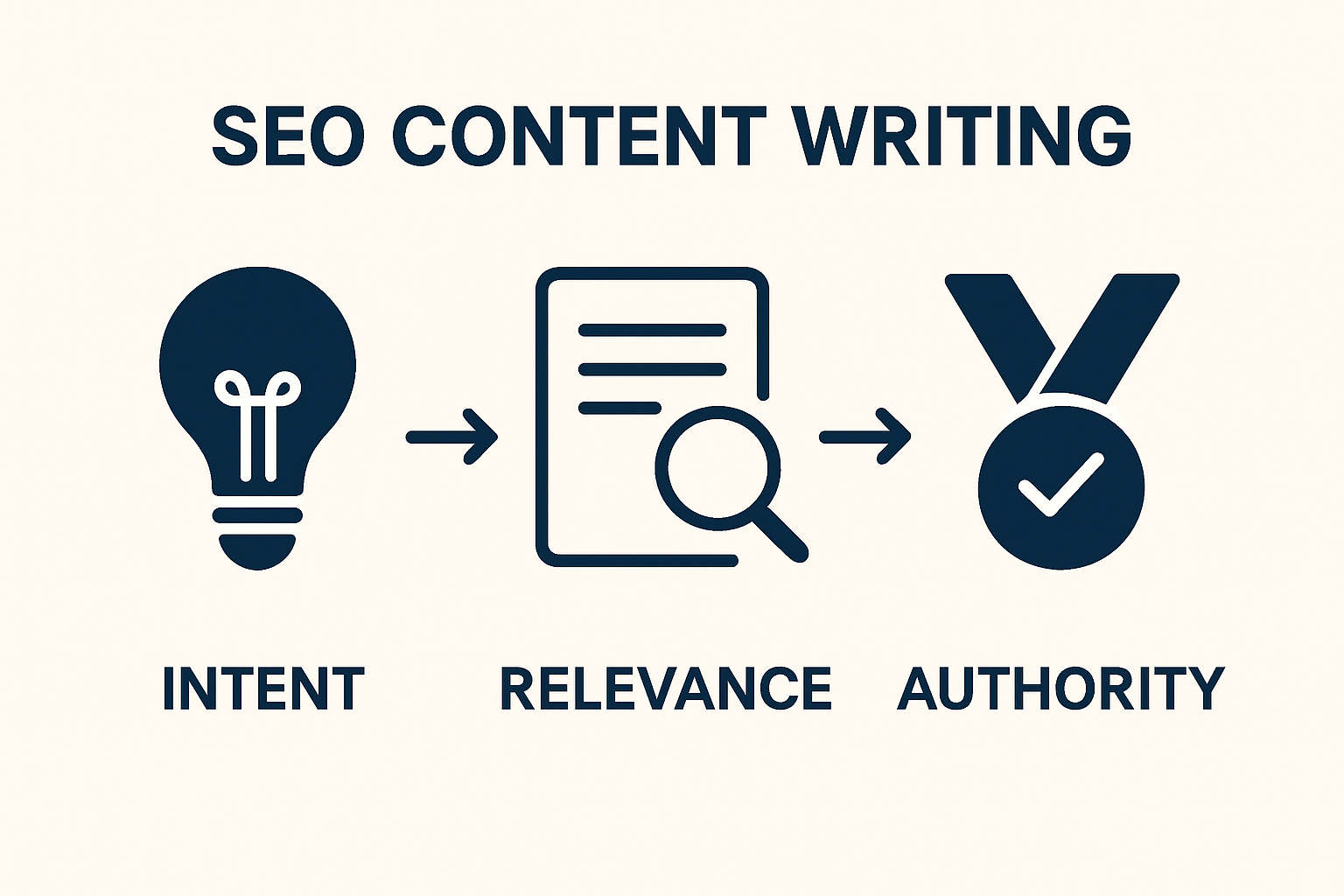
Core components: intent, relevance, authority
- Intent: Understand what the searcher wants to do. Format content to match it.
- Relevance: Cover all subtopics and entities. Use semantic terms naturally to show topical depth (Backlinko).
- Authority: Demonstrate E-E-A-T with expert insights, sourcing, references, and internal linking to related topics. Explore entity-first planning in Semantic SEO: The Fast Track to Unshakable Authority.
Understand Search Intent Before You Write
The fastest way to win is matching what searchers expect. Search engines reward pages that directly satisfy the task behind the query (GreenMo).
Types of intent with examples
- Informational: “what is seo content” → Expect definitions, examples, graphics, FAQs.
- Commercial: “best seo tools 2026” → Expect listicles, comparisons, pros/cons.
- Transactional: “buy project management software” → Expect pricing, demos, trust badges.
- Navigational: “seosolved login” → Expect brand home or login page.
Check the SERP layout: Are there featured snippets, People Also Ask, videos, or product listings? The layout hints at the winning format (Backlinko).
Mapping intent to content types
- Informational → In-depth guides, checklists, FAQs, and glossaries that build trust and drive soft conversions.
- Commercial → Comparisons, case studies, and “best tools” pages with feature tables and CTAs.
- Transactional → Service pages, demos, and pricing. Keep copy concise; emphasize credibility and next steps.
- Navigational → Clear hub or brand pages with strong internal navigation.
Use informational posts to warm up visitors and then guide them to relevant offers with conversion-aware CTAs (i.e., seo conversion content).
Keyword Research for Beginners That Actually Works
Keywords are your roadmap, but they’re not just words—they reflect intent buckets and topics. Learn head terms, long-tails, and intent basics (ClickRank).
Build a seed list from your audience and SERPs
- Start with customer language from calls, support tickets, forums, and review sites.
- Use autosuggest and People Also Ask to discover phrasing and secondary questions (Vazoola).
- Collect 20–50 seeds across themes. Tag each with probable intent.
- Note synonyms and entities (brands, features, problems).
Expand with competitor and SERP analysis
Identify pages that currently win. What topics, subheadings, and media do they use? What SERP features appear?
- Reverse-engineer their outline and missing angles you can cover better.
- Inventory internal links and anchor patterns they use.
- Mine “related searches” for cluster ideas.
Deep dive into your rivals’ strengths with Competitor SEO Analysis: The 2026 Ultimate Playbook.
Select primary, secondary, and supporting entities
- One primary keyword that matches intent and business fit.
- 3–8 secondary phrases covering subtopics and variations.
- Supporting entities (people, brands, features) to strengthen semantic relevance. Learn how in Semantic SEO.
- Map each topic to a unique URL to avoid cannibalization.
Plan Your Outline and Content Brief
A great brief prevents rewrites. Document intent, winning format, outline, entities, sources, and conversion goals. See a concise checklist of brief elements from Backlinko.
Structure titles, headings, and questions
- Draft a compelling H1 and a clear H2/H3 hierarchy that mirrors the SERP’s subtopics.
- List 5–10 FAQs. Each should answer a long-tail query in 40–60 words.
- Plan skimmable sections with bullets, short paragraphs, and pull-quotes.
For speed and consistency, use AI Content Brief Mastery: Your 2026 Guide to Ranking.
Add E-E-A-T and sourcing expectations
- Quote subject-matter experts or include firsthand examples.
- Cite credible sources; avoid fluff. Google rewards pages that solve real problems (Big Red SEO).
- Write for readers first to earn links and shares (Campaign Monitor).
On-Page SEO Essentials for Content
On-page SEO is the translation layer that helps search engines crawl, index, and rank your work (ClickRank).
Titles, meta descriptions, and URL slugs
- Title tag: Front-load the primary keyword, keep 50–60 characters, promise a benefit.
- Meta description: 130–150 characters; include keyword once, a value prop, and a soft CTA.
- URL: short, hyphenated, readable; include the primary term (seo optimised article practice).
Internal links and anchor strategy
Use descriptive anchors to pass context and authority. Link up to pillars and across clusters to improve crawling and UX.
- Link from clusters to your hub page and back.
- Use natural anchors (not over-optimized). Mix exact, partial, and branded.
- Automate scale with tools and rules. See Automated Internal Linking.
Schema basics for articles and blogs
- Add Article schema to identify author, date, and headline.
- Use FAQ schema for short Q&A to win SERP real estate.
- Keep markup accurate and consistent with the page content.
Try this now: Want your next post to ship fully optimized? Stat Ranking Today.
Write SEO-Friendly Body Copy
Great copy is clear, useful, and aligned with the reader’s task—then lightly optimized. Avoid stuffing; include related terms naturally (Backlinko).
Open strong: intros that match intent fast
- In the first 2–3 sentences, acknowledge the problem and state the outcome.
- Preview how the article solves it (sections, tools, timeline).
- Use a promise or stat to hook attention.
Scannability: paragraphs, lists, and visuals
- Keep paragraphs under 3–4 lines.
- Use bullets, tables, and subheads every ~200 words.
- Add screenshots, diagrams, or short videos; compress images and add descriptive alt text (ClickRank).
Natural keyword and entity placement
- Include the primary term in title, intro, one H2/H3, and once in conclusion.
- Distribute secondary terms where they fit contextually.
- Cover related entities to signal topical completeness. No forced repetition.
Optimize Blog Posts for Rankings and CTR
Target SERP features, improve accessibility, and guide readers to the next best action.
Featured snippets and People Also Ask
- Answer the core question under 40–60 words near the top.
- Use list or table formatting for steps and comparisons.
- Turn common PAA queries into H3s with short, direct answers.
- Add a concise definition box and a how-to list for snippet eligibility.
Images, alt text, and media optimization
- Compress images (WebP/AVIF), serve responsive sizes, lazy-load below the fold.
- Write specific, functional alt text (what’s shown and why it matters).
- Transcribe videos; summarize key takeaways for skimmers.
Conversion-aware CTAs in content
- Match CTA to intent: guides → checklists, comparisons → demos.
- Use action verbs and low-friction next steps.
- Place CTAs where users finish a task or learn something new.
Cluster Strategy and Internal Linking Architecture
Topic clusters build authority: a pillar page covers the overview; clusters go deep on subtopics and all interlink to signal coverage.
Pillars vs. clusters: when to use each
- Pillars: High-level, comprehensive overviews (2,000+ words) that target head terms.
- Clusters: Focused posts that target long-tails and related entities.
Use your pillar as the hub that links out to clusters and back. Learn scalable patterns in Automated Internal Linking.
Anchor text and hub navigation patterns
- Use descriptive, natural anchors; avoid repeating the exact same phrase everywhere.
- Include hub modules or “further reading” at the end of sections.
- Audit orphan pages and add links from relevant hubs.
Local and Niche SEO Content Considerations
Local intent is high-intent. Tailor pages to geography and niche attributes to capture qualified traffic.
Local modifiers and service pages
- Create geo-specific service pages (e.g., “roof repair in Austin”).
- Include coverage areas, testimonials, and FAQs relevant to the location.
- Publish localized guides addressing regional rules or trends.
Google Business Profile and citations in content
- Keep NAP consistent. Embed a map and link to your GBP where relevant.
- Mention unique local proof: licenses, associations, awards.
- Reference location-specific case studies when possible.
AI and SEO Content in 2026: What Works
AI accelerates research and drafting, but humans guide strategy, edit for accuracy, and add experience. Use AI where it helps, and add expertise where it matters.
Where AI assists vs. where humans must edit
- AI assists: topic ideation, outline generation, entity discovery, first drafts.
- Human editing: fact-checking, brand voice, unique examples, data validation, compliance.
- Explore AI strategy in AI SEO Strategy: The 2026 Ultimate Guide.
Citations, credibility, and originality
- Validate claims against primary sources; add dates and links.
- Integrate expert commentary or proprietary data to stand out.
- Run plagiarism and duplication checks; expand with new angles.
Measure, Improve, and Republish
Content compounds when you iterate. Track performance, diagnose gaps, and refresh to win more SERP real estate. Prioritize bets that can show impact within one to two quarters (Directive Consulting).
Content KPIs and diagnostics
- Visibility: impressions, top-10 keywords, featured snippets.
- Engagement: CTR, scroll depth, time on page, return visits.
- Quality: PAA presence, internal link clicks, backlink growth.
- Outcomes: assisted conversions, demo requests, revenue influence.
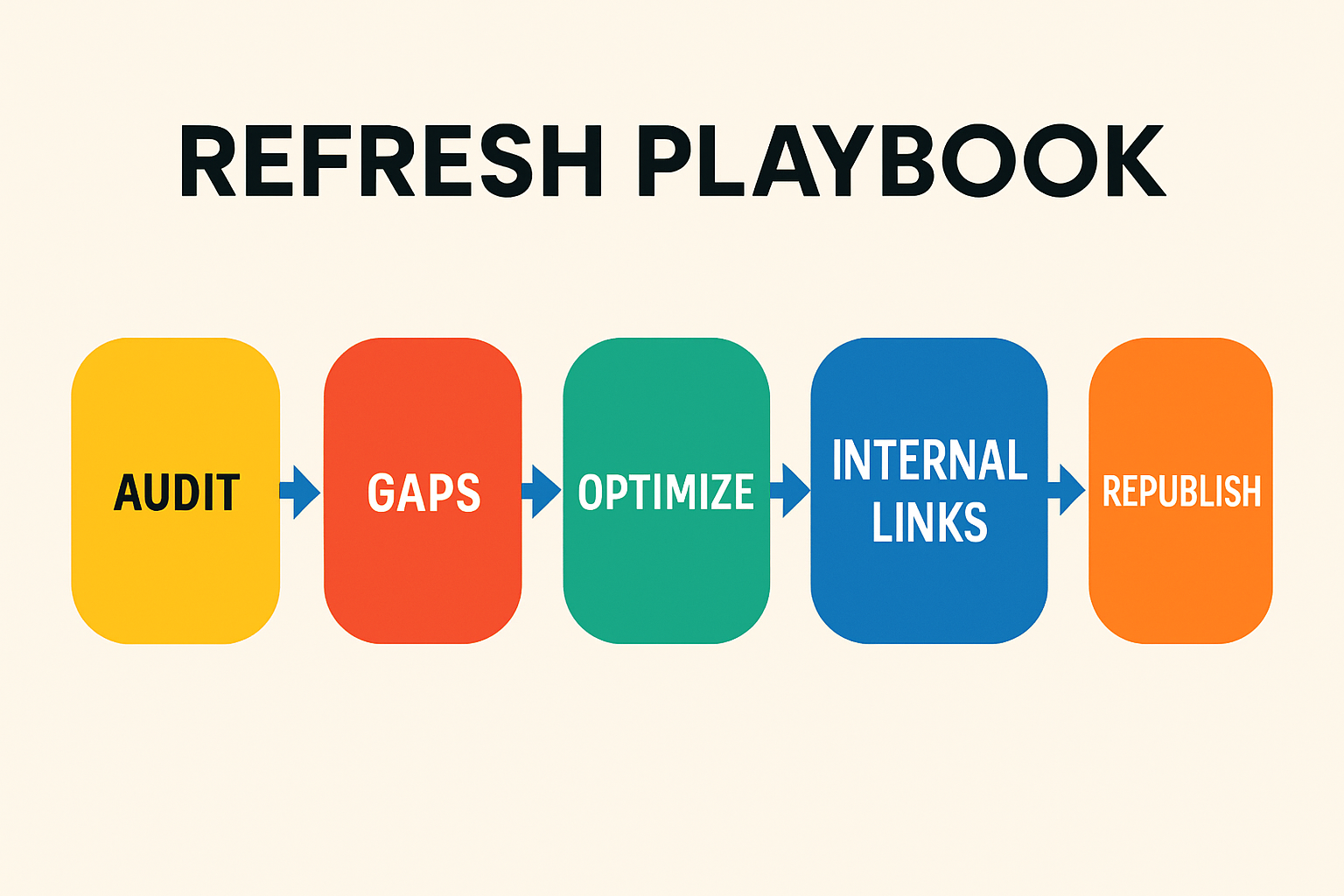
Refresh playbook: fill gaps and boost CTR
- Audit: Identify decaying posts, cannibalization, and thin coverage.
- Expand: Add missing subtopics, FAQs, tables, and examples.
- Optimize: Update title/meta for higher CTR; improve internal links.
- Enhance: Add schema, compress images, clarify CTAs.
- Republish: Change the date if substantive, resubmit, and re-promote.
Templates, Checklists, and Writing Prompts
Use these to ship consistent, high-quality SEO blog posts.
SEO blog post checklist
- Confirm search intent and winning format from SERP.
- Choose primary keyword + 3–8 secondary terms and entities.
- Draft a brief: outline, FAQs, sources, CTA, internal links.
- Write clear intro with a promise; add tables, bullets, visuals.
- Optimize title/meta/URL; add Article and FAQ schema.
- Place internal links to pillars and clusters.
- Publish, monitor KPIs, refresh at 30–90 days.
Reusable brief and outline template
- Target & Intent: Keyword, persona, SERP format.
- Outline: H2/H3s, snippet blocks, FAQ list.
- Entities: Required terms, brands, concepts.
- Evidence: Data sources, quotes, examples.
- Optimization: Title/meta/URL, schema, internal links.
- Conversion: Primary and secondary CTAs.
Common Mistakes to Avoid
Small errors can suppress rankings and credibility. Fix these first.
Keyword stuffing and over-optimization
- Use natural phrasing; avoid repeating exact keywords in every subhead.
- Replace redundancy with related entities and synonyms.
- Prioritize clarity over density (Pepper).
Thin, duplicate, or off-intent content
- Expand with examples, data, and FAQs; target a depth that truly answers the query. Thorough pages often outperform thin ones (GreenMo).
- Consolidate overlapping URLs to resolve cannibalization.
- Realign the format to match the SERP.
Ignoring E-E-A-T and sourcing
- Add expert commentary, cite sources, and show author credentials.
- Include dates, version history, and transparent update notes.
- Ensure claims help readers solve problems, not hit word counts (Big Red SEO).
How SEOsolved Accelerates SEO Content Writing
Manual SEO content production is slow and inconsistent. SEOsolved removes friction so teams can publish more—without sacrificing quality.
What SEOsolved automates
- Competitor analysis: Surfaces what leaders cover—and what they miss.
- Keyword discovery: Finds hundreds of opportunities across intents.
- Content roadmap: Prioritized pillars and clusters tailored to your niche.
- Draft generation: High-quality, SEO-optimized articles with credible sources in as little as 30 minutes.
Where SEOsolved fits in your workflow
- Use it for research and brief creation to ensure intent fit from day one.
- Generate first drafts, then edit with your brand voice and firsthand examples.
- Leverage internal linking suggestions to strengthen your cluster architecture.
Quick start steps
- Connect your site and enter target topics.
- Review the auto-built roadmap and pick a high-intent post.
- Generate a brief, then a draft; add your unique POV and data.
- Publish, interlink to pillars, and monitor KPIs for 30–90 days.
Call to action
Ready to scale SEO content without guesswork? Stat Ranking Today.
FAQs: SEO Content Writing for Beginners
What is SEO content and why is it important?
It’s content designed to match search intent and earn rankings. It grows qualified traffic, builds authority, and supports conversions long after publishing.
How do I write an SEO-friendly article step by step?
Validate intent, pick a primary keyword, build a brief, draft with clear headings and FAQs, optimize tags and schema, add internal links, publish, and refresh.
What makes content truly optimized, not just keyword-stuffed?
Intent alignment, comprehensive coverage, semantic entities, strong UX, credible sources, and measured improvements—not density alone.
Do blogs still help SEO in 2026?
Yes—high-quality, intent-matched blogs win long-tail queries, snippets, and links, feeding your topic clusters and conversions over time.
How should I use AI for SEO writing?
Use AI for research, briefs, and first drafts. Keep humans for editing, facts, E-E-A-T, and adding unique insights and examples.
For deeper dives, explore AI SEO Strategy and AI Content Brief Mastery.